The Complete & Best Guide to School ERP for Indian Schools in 2025
 November 10, 2025

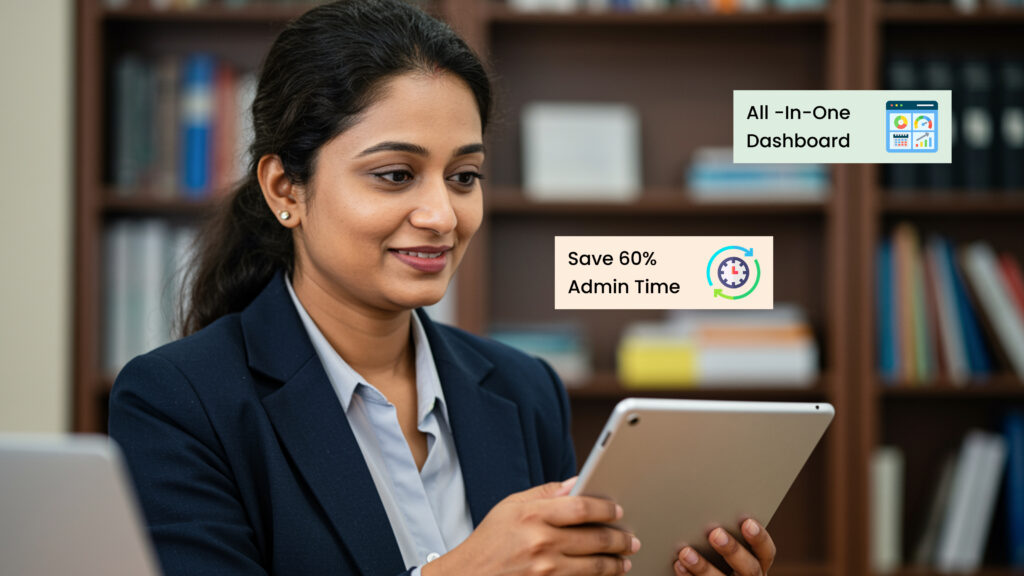
Table of Contents
iSchoolCloud‘s School ERP can reduce your administrative work by 60% and improve parent satisfaction dramatically—but what is it exactly? This comprehensive guide explains school management software for Gujarat principals in plain language. Learn what features matter, how implementation works, typical costs for small and medium schools, and real success stories from Rajkot and Ahmedabad institutions.
Last Tuesday morning, I watched Mrs. Sharma, a principal in Rajkot, frantically searching through three different filing cabinets for a student’s admission form while his mother waited at the counter. The peon was out sick, the office clerk was handling fee payments, and nobody could find the file quickly.
“This happens almost every day,” Mrs. Sharma told me later, exhausted. “We have students’ information scattered across registers, files, folders, and computer spreadsheets. Finding anything takes forever.”
That same afternoon, I visited another school just 15 minutes away. When a parent asked about her daughter’s attendance record, the receptionist pulled it up on her computer in literally five seconds. Fee payment history? Three clicks. Report card from last year? Right there on the screen.
The difference between these two schools? The second one uses something called a School ERP system.
If you’re a school principal or owner in Gujarat wondering that What is school ERP this “ERP” term means and whether you should care about it, this guide will explain everything in simple, practical terms.
What is School ERP? (The Simple Answer)

School ERP is digital software that brings all your school’s information and processes into one connected system– like having a super-organized digital assistant who never forgets anything, never loses a file, and can find any information instantly.
Think of it this way: If your school was a house, ERP would be like having all your important documents stored in one smart filing cabinet instead of scattered across different rooms. Need student records? Check the cabinet. Want attendance reports? Same cabinet. Fee payment details? Right there in the same place.
The letters “ERP” stand for Enterprise Resource Planning, but don’t let the corporate jargon confuse you. For schools, it simply means software that helps you manage students, staff, fees, attendance, exams, and parent communication– all from one place instead of juggling multiple registers, files, and spreadsheets.
Why Indian Schools Are Talking About ERP Now
You might be thinking, “We’ve managed with registers and files for decades. Why change now?”
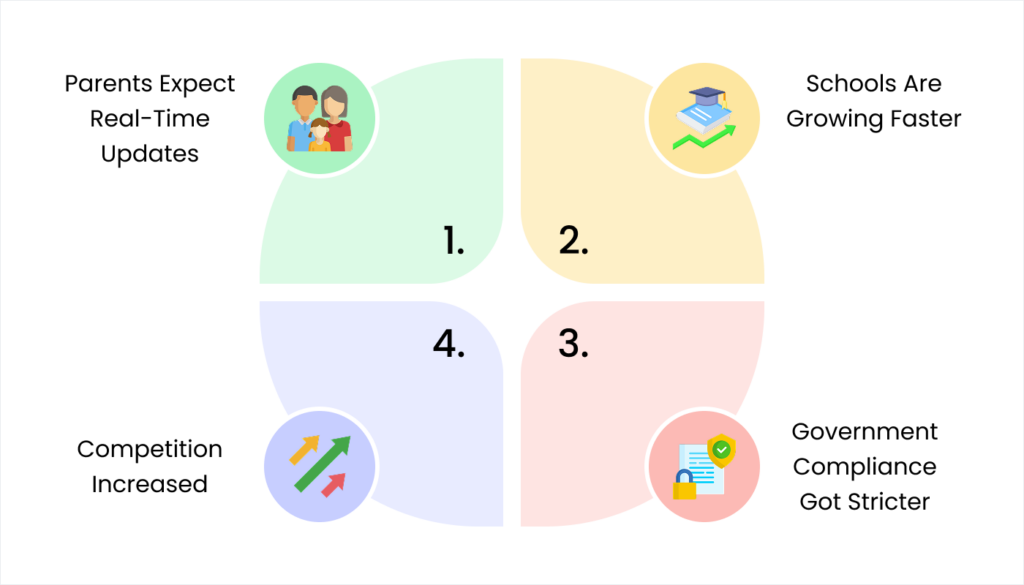
Fair question. Here’s what’s changed in the last few years:
- Parents Expect Real-Time Updates
Today’s parents don’t want to wait for quarterly meetings to know how their child is doing. They want instant attendance notifications, homework updates on their phones, and the ability to check fee status anytime. Your paper registers can’t give them that.
- Schools Are Growing Faster
That 200-student school you started might now have 400 students. Managing double the data with the same paper-based methods means double the chaos and mistakes. ERP systems handle growth without breaking down.
- Government Compliance Got Stricter
Whether it’s CBSE documentation, state board requirements, or annual inspections, the paperwork keeps increasing. ERP systems generate these reports automatically instead of requiring your staff to spend weeks preparing them manually.
- Competition Increased
When the school down the street sends automated attendance messages to parents while you’re still struggling with phone calls and WhatsApp groups, parents notice. Modern school management isn’t optional anymore – it’s expected.
Breaking Down School ERP: What’s Actually Inside?
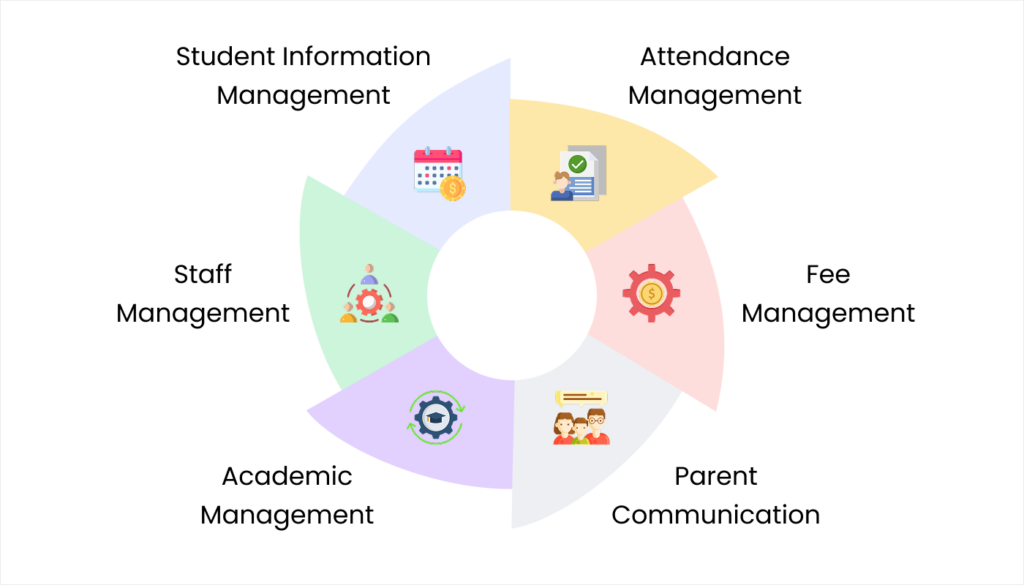
Let’s open the hood and see what a school ERP system actually does. I’ll explain each component using simple terms.
1. Student Information Management (The Digital Student File)
Remember those thick student files with admission forms, medical records, and report cards? ERP converts all that into organized digital profiles.
What it includes:
- Complete student details (name, date of birth, parents’ contact information)
- Academic history from admission through current class
- Medical information and emergency contacts
- Photos and documents stored digitally
- Sibling information and family details
Real benefit: When a parent calls asking about their child’s blood group or emergency contact, your staff finds it in three seconds instead of hunting through files for ten minutes.
2. Attendance Management (The Automatic Register)
Teachers mark attendance once – either on a computer, tablet, or even their phone. The system automatically:
- Sends SMS or app notifications to parents if their child is absent
- Generates monthly attendance reports
- Calculates attendance percentages for report cards
- Tracks patterns (which students are frequently late or absent)
- Creates compliance reports for government requirements
Time saved: What used to take teachers 15 minutes of manual register-filling now takes 2 minutes. For a school with 20 classes, that’s over 4 hours saved daily across all teachers.
3. Fee Management (The Digital Cashier)
This might be the module that gives school administrators the most relief.
What it handles:
- Different fee structures for different student categories
- Installment payment tracking
- Automatic late fee calculations
- Receipt generation with proper formatting
- Fee reminder messages to parents
- Complete payment history for every student
- Month-end and year-end financial reports
Real impact: A school in Ahmedabad reported that their fee collection improved by 15% simply because parents received automatic reminders before due dates instead of after.
4. Parent Communication (The Information Bridge)
This is where ERP really shines for improving parent relationships.
Communication features:
- Automated attendance notifications (absent/late)
- Homework and assignment updates
- Exam schedules and result announcements
- School event and holiday notifications
- Individual messages from teachers to specific parents
- Emergency announcements to all parents instantly
- Birthday wishes and celebration reminders
Parent feedback: Schools using good communication systems report that parents feel “finally connected” to their child’s daily school experience.
5. Academic Management (The Smart Gradebook)
Teachers enter grades once, and the system does everything else:
- Calculates averages and percentages automatically
- Generates report cards in your school’s format
- Tracks student progress over time
- Identifies students who need extra help
- Creates subject-wise performance analysis
- Prepares exam schedules and seat arrangements
Teacher benefit: Report card preparation that used to take weeks of evening work now happens automatically in hours.
6. Staff Management (The HR Helper)
Managing your teaching and non-teaching staff becomes simpler:
- Complete staff profiles and employment records
- Attendance tracking for staff members
- Salary calculations and payment records
- Leave management and approval workflows
- Performance tracking and feedback documentation
Administrative relief: No more confusion about who’s on leave, who hasn’t been paid, or whose contract needs renewal.
Common Misconceptions About : What is school ERP

Let me address the concerns and misunderstandings I hear from Gujarat school owners:
- Misconception #1: “It’s Too Expensive for Small Schools”
Reality: ERP systems come in all sizes and prices. Small schools (under 300 students) can find affordable options starting around ₹5,000-8,000 monthly. When you calculate how much time and money you waste on inefficient manual processes, most schools find ERP actually saves money within the first year.
- Misconception #2: “Our Staff Won’t Be Able to Learn It”
Reality: Modern school ERP systems are designed to be simple. If your staff can use WhatsApp and Google, they can learn ERP. Good vendors provide training, and most schools report their staff becomes comfortable within 2-3 weeks.
A 55-year-old office administrator in Surat told me: “I was terrified of computers. Now I train new staff on the system. It’s actually easier than maintaining all those registers.”
- Misconception #3: “We’ll Lose Our Personal Touch”
Reality: ERP doesn’t make schools impersonal – it frees up time for more personal interactions. When your office staff isn’t buried in paperwork, they can actually talk to parents and help students. When teachers aren’t filling registers, they can focus on teaching.
- Misconception #4: “What if the Internet Goes Down?”
Reality: Good ERP systems have offline capabilities. You can mark attendance or collect fees even without internet, and data syncs automatically when connectivity returns. Plus, internet reliability in Gujarat cities is much better than it was even five years ago.
- Misconception #5: “It’s Only for Big Schools or CBSE Schools”
Reality: ERP systems work for schools of all sizes following any board – CBSE, GSEB, ICSE, or even preschools. The software adapts to your needs, not the other way around.
Types of School ERP Systems
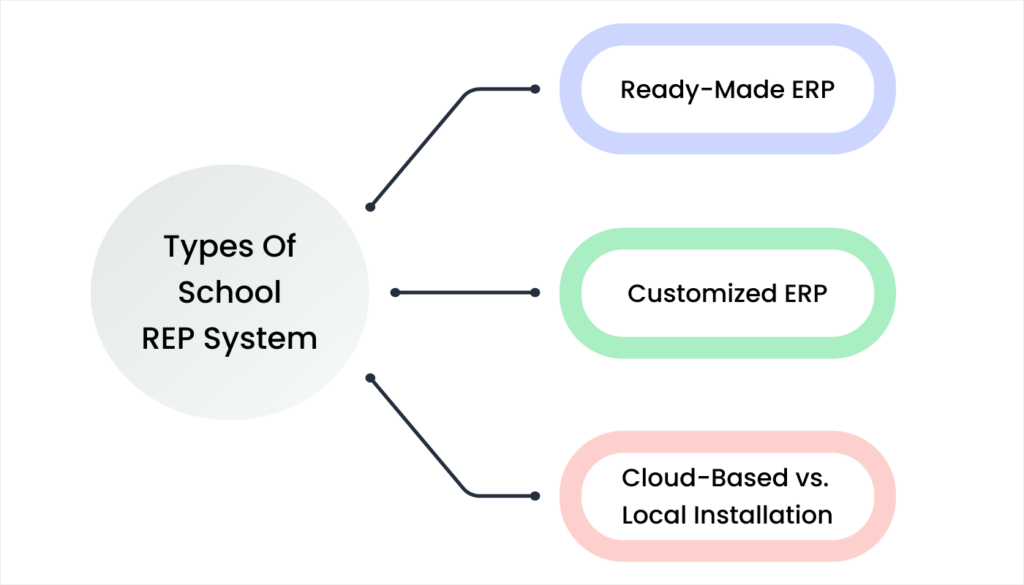
Not all ERP systems are the same. Here are the main types you’ll encounter:
Ready-Made ERP (Off-the-Shelf Software)
What it is: Pre-built software designed to work for most schools with standard features.
Pros:
- Lower initial cost
- Quick to implement (2-4 weeks)
- Regular updates and improvements
- Proven features used by many schools
Cons:
- Limited customization options
- Might not fit unique school processes
- You adapt to the software instead of it adapting to you
Best for: Schools with standard operations willing to adjust workflows to match software capabilities.
Customized ERP (Built for Your School)
What it is: Software developed specifically for your school’s unique requirements.
Pros:
- Perfect fit for your processes
- Can add specialized features you need
- Complete control over functionality
- Can grow and change with your school
Cons:
- Higher initial investment
- Longer development time (6-12 weeks)
- Requires ongoing technical relationship with developer
Best for: Schools with unique programs, complex fee structures, or specific requirements that ready-made software can’t handle.
Cloud-Based vs. Local Installation
Cloud-Based: Software runs on internet servers; you access it through your browser or app.
- No local servers needed
- Access from anywhere
- Automatic backups
- Lower upfront costs
Local Installation: Software installed on your school’s computers.
- Complete data control
- Works without internet
- Higher initial cost for servers
- You manage backups
Most Gujarat schools choose cloud-based for convenience and lower costs.
How to Know If Your School Needs ERP
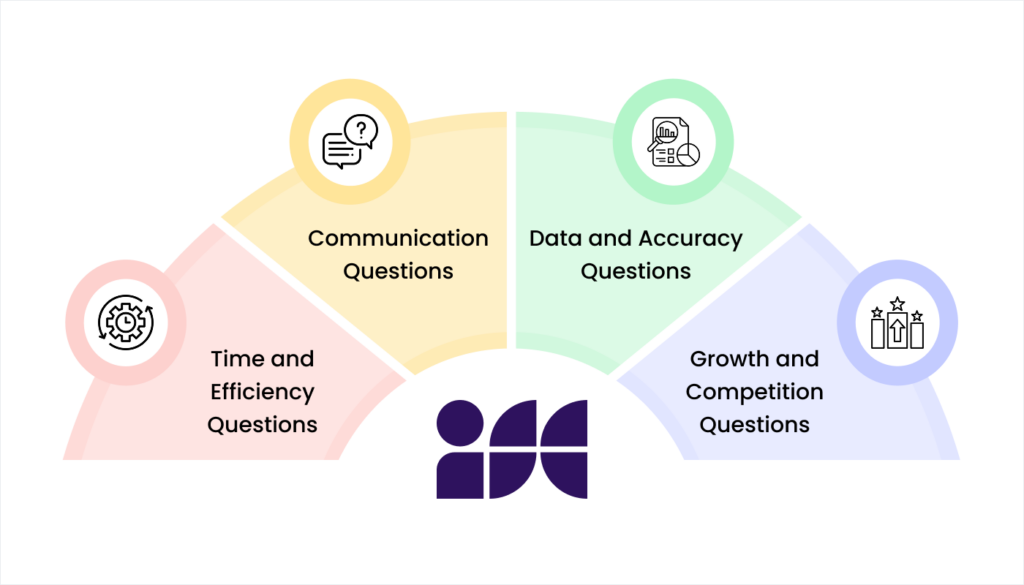
Answer these questions honestly:
- Time and Efficiency Questions: □ Does your office staff spend more than 2 hours daily just finding and organizing information? □ Do teachers complain about excessive paperwork cutting into teaching time? □ Does report card preparation require overtime or weekend work? □ Are you hiring more administrative staff as enrollment grows?
- Communication Questions: □ Do parents frequently call asking for information you should be able to provide instantly? □ Do important announcements sometimes not reach all parents? □ Are you overwhelmed with WhatsApp messages from parent groups? □ Do you wish parents felt more connected to their child’s daily school experience?
- Data and Accuracy Questions: □ Have you made embarrassing mistakes in report cards or fee calculations? □ Do you dread government inspections because organizing records is so painful? □ Is your student information scattered across multiple files, registers, and spreadsheets? □ Are you worried about what would happen if your experienced office manager left?
- Growth and Competition Questions: □ Are other schools in your area offering better parent communication? □ Is managing more students becoming increasingly difficult with current systems? □ Do you want to appear more professional and modern to prospective parents?
If you checked 5 or more boxes, your school would definitely benefit from ERP.
Success Stories from Gujarat Schools

Case 1: Small School in Rajkot (250 students)
Before ERP:
- Office staff worked overtime during exam season
- Parents called constantly about attendance and fees
- Report cards took 2 weeks to prepare
After ERP (6 months later):
- No more overtime needed
- Parent calls reduced by 70%
- Report cards ready in 2 days
- Parent satisfaction improved dramatically
What the principal said: “I wish we’d done this five years ago. The time savings alone justify the investment.”
Case 2: Medium School in Ahmedabad (550 students)
- Challenge: Complex fee structure with different amounts for different student categories made manual management nearly impossible.
- Solution: Customized ERP with specialized fee management
Results:
- Fee collection improved by 18% due to automatic reminders
- Accounting errors reduced to nearly zero
- Staff stress levels decreased noticeably
Choosing the Right ERP for Your School
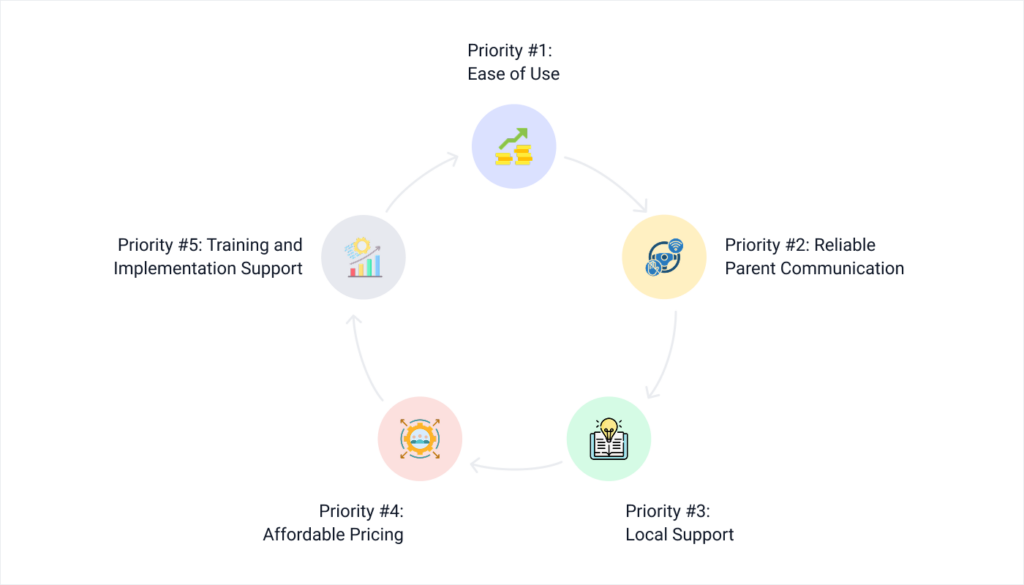
Based on conversations with dozens of Gujarat school principals, here’s what actually matters:
Priority #1: Ease of Use
- Can your office staff operate it without constant help?
- Does it feel intuitive or confusing?
- Are menus and buttons clearly labeled?
Priority #2: Reliable Parent Communication
- Does it send SMS reliably even during monsoon season?
- Can parents access information easily?
- Are messages delivered in both English and Gujarati if needed?
Priority #3: Local Support
- Does the vendor have support staff in Gujarat?
- Can they provide help in Hindi or Gujarati?
- Do they understand Indian school operations?
Priority #4: Affordable Pricing
- Is the cost sustainable for your school’s budget?
- Are there hidden fees for basic features?
- Can you scale up gradually as you grow?
Priority #5: Training and Implementation Support
- Will they train your entire staff thoroughly?
- What happens after the initial setup period?
- Can they help with data migration?
Your Next Steps
If you’ve read this far, you’re probably thinking seriously about ERP for your school. Here’s what to do next:
This Week:
- Assess your current administrative costs (time and money)
- Talk to your office staff about their biggest daily frustrations
- Survey parents about what communication improvements they’d value
Next Week:
- Research 3-4 ERP vendors serving Gujarat schools
- Request demos from your shortlisted options
- Ask for references from schools similar to yours
Following Week:
- Visit a school using ERP to see it in real operation
- Calculate your expected ROI based on time savings
- Make your decision and begin implementation planning
The Bottom Line

School ERP isn’t about fancy technology or following trends. It’s about running your school more efficiently so you can focus on what actually matters – providing excellent education to students.
When Mrs. Sharma’s school (the one from my opening story) finally implemented iSchoolCloud‘s ERP four months after I first visited, she called to thank me.”My staff is happier, parents are satisfied, and I actually leave office at 5 PM now instead of 7,” she said. “I didn’t realize how much energy we were wasting on administrative chaos.”
Your school doesn’t need to be large or wealthy to benefit from ERP. You just need to recognize that better tools create better outcomes for everyone – students, teachers, parents, and administrators.
The question isn’t whether ERP can help your school. The question is: how much longer will you continue managing the hard way when simpler solutions exist?
Ready to explore School ERP options for your Gujarat school?
iSchoolCloud help schools in Rajkot and across Gujarat find the right ERP solutions for their specific needs and budget. From assessment and selection to implementation and training, we understand exactly what Indian schools require.
Contact us for a free consultation about bringing efficient school management to your institution. Let’s discuss how ERP can solve your specific administrative challenges.


 4.9 5000 Total Reviews
Join Our Inner Circle for Special Perks

 Trusted by 50000 educational pioneers