In the past five years, schools across Rajkot and Gujarat have been quietly transforming how they operate. What started as an attempt to “go digital” during emergencies has now turned into something bigger—a race to run smarter, not harder.
Yet, one question keeps coming up from school principals and trustees: “If we invest in a School ERP, will we really get our money back?”
That’s a fair question. Because for many, technology has often felt like a cost—not a return. But the story we’re about to explore shows that with the right School ERP Investment, schools are not just saving time and money—they’re gaining peace of mind and stronger parent trust.
Let’s dive into a real Rajkot case study and uncover how schools calculate School ERP ROI — and why every rupee spent on a Cloud-Based School ERP Gujarat system is paying off faster than expected.
1. The Hidden Costs of Running a School Without ERP
School ERP Investment: Will You Get Your Money Back? (Rajkot School Case Study) 13
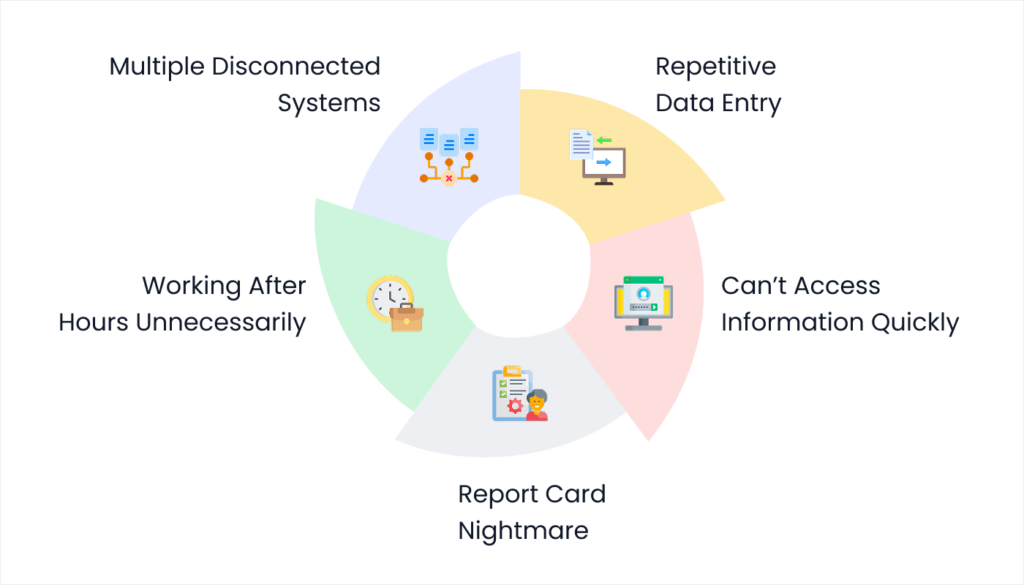
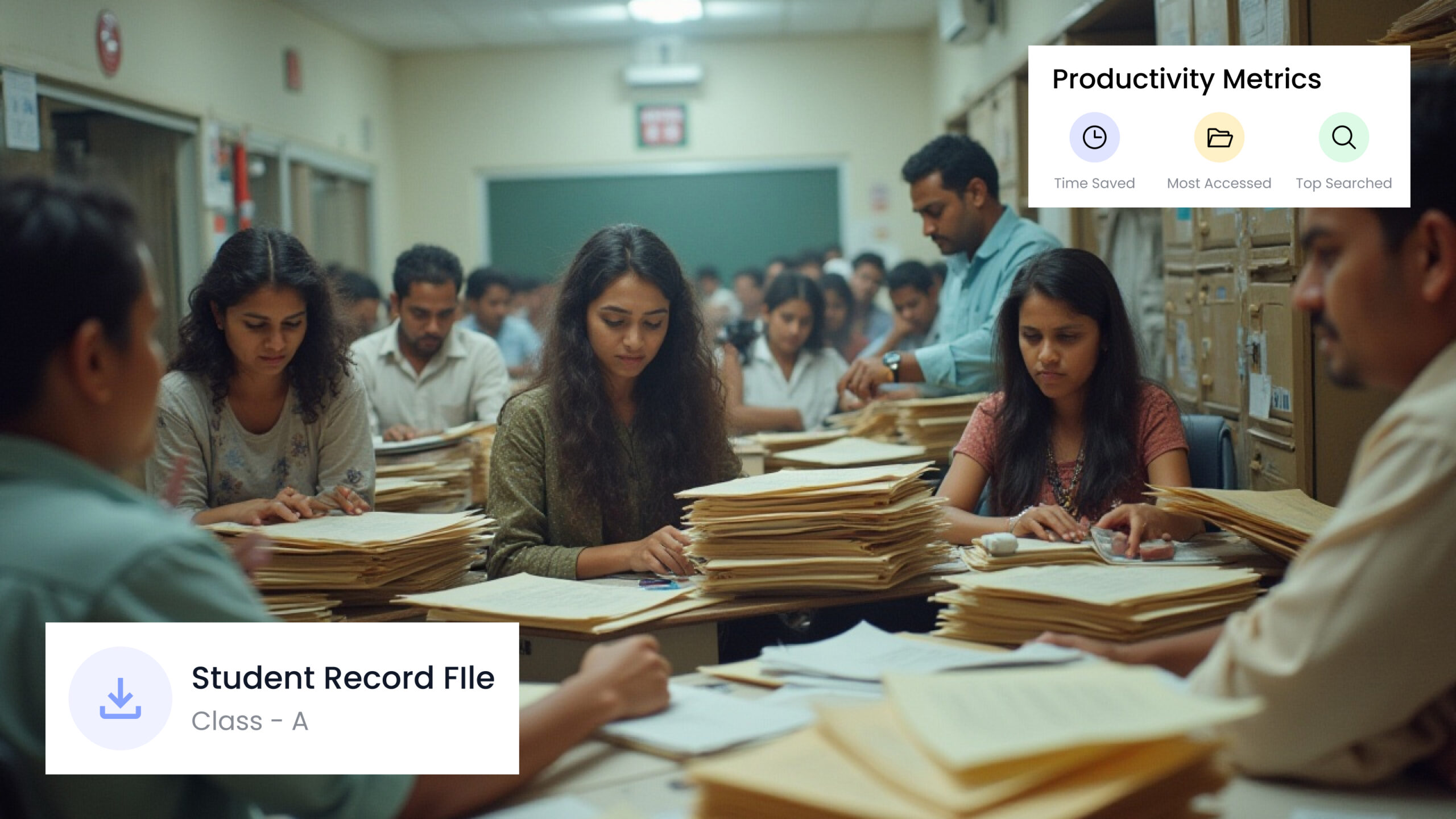
Before measuring ROI, we must understand what it really costs to run a school without integration.
In most Gujarat schools today, you’ll find:
Separate software for fees, attendance, and transport
Manual data coordination between teachers, office staff, and accountants
Hundreds of daily parent calls asking, “Has my child reached school?” or “Did my payment go through?”
Hours of report preparation that could be automated in seconds
When we calculated this for one Rajkot school, the findings were surprising:
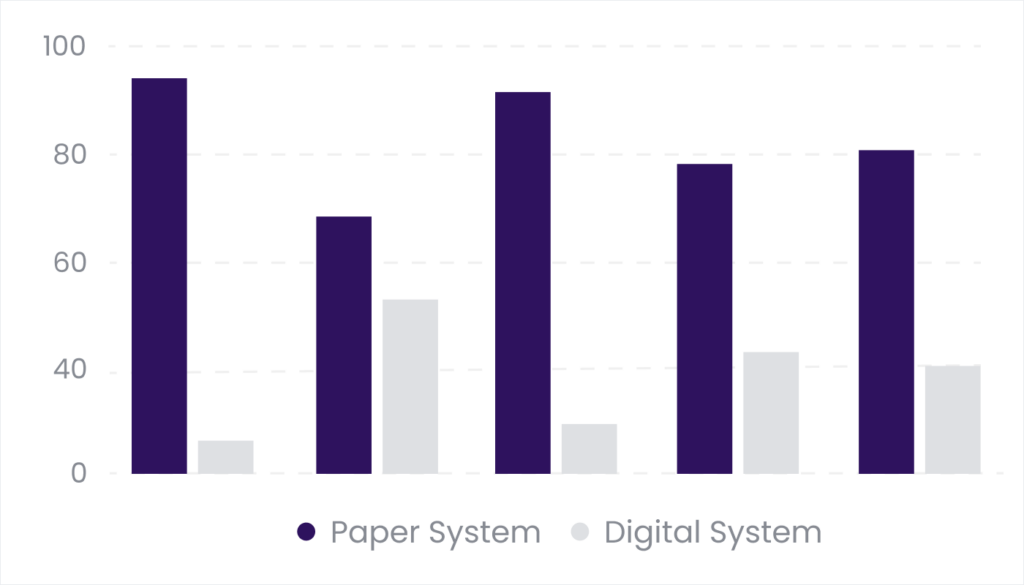
26 hours per week wasted on coordination
₹2–3 lakh annual cost in extra staff time
₹1 lakh spent fixing manual errors
₹3–5 lakh lost in missed or delayed fee collections
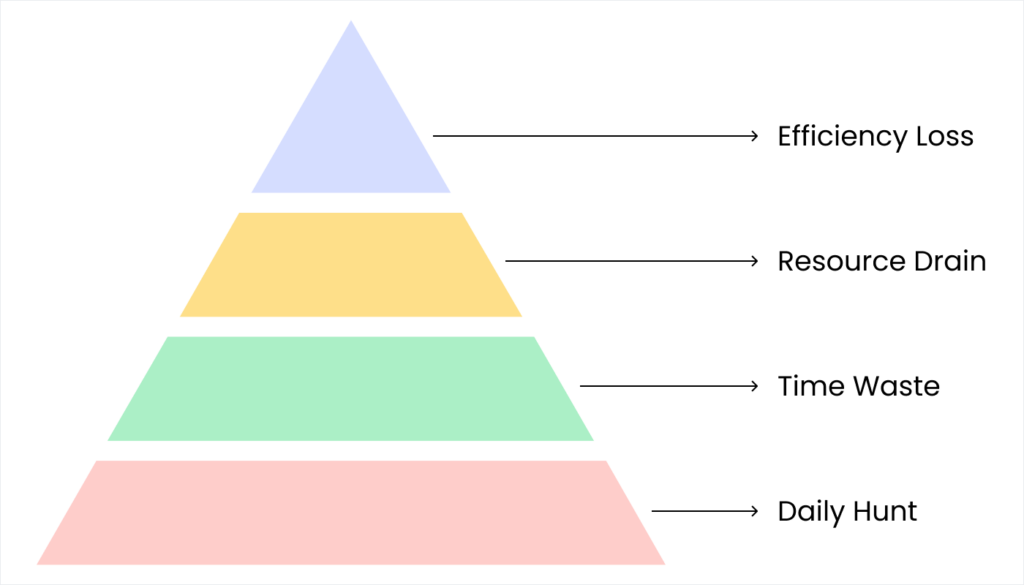
That’s ₹6–9 lakh of invisible annual loss—simply because systems don’t talk to each other.
So when you hear about School ERP Investment Rajkot, don’t compare it to “software cost.” Compare it to the cost of inefficiency you’re already paying every month.
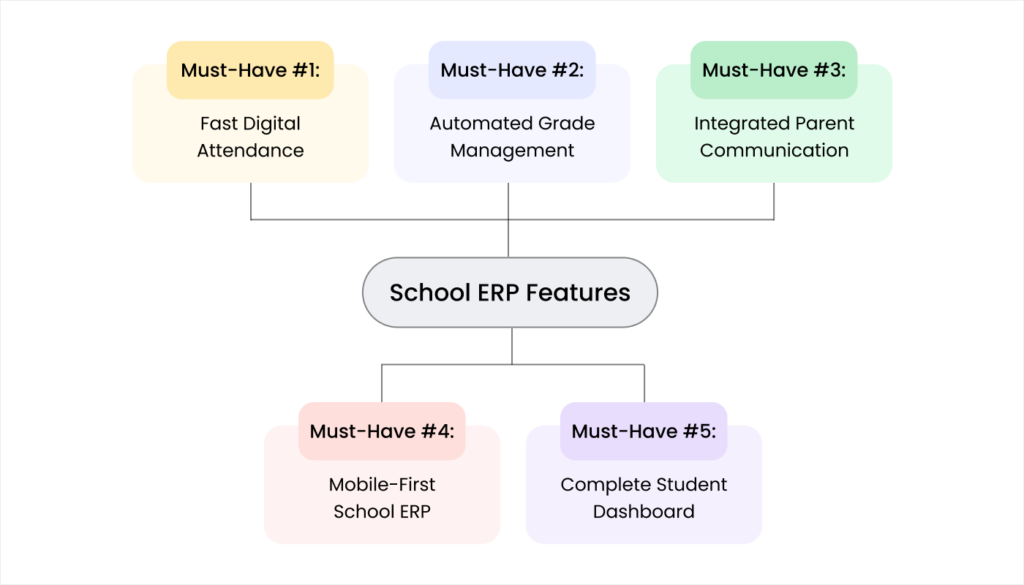
2. What a Smart School ERP Actually Does
School ERP Investment: Will You Get Your Money Back? (Rajkot School Case Study) 14
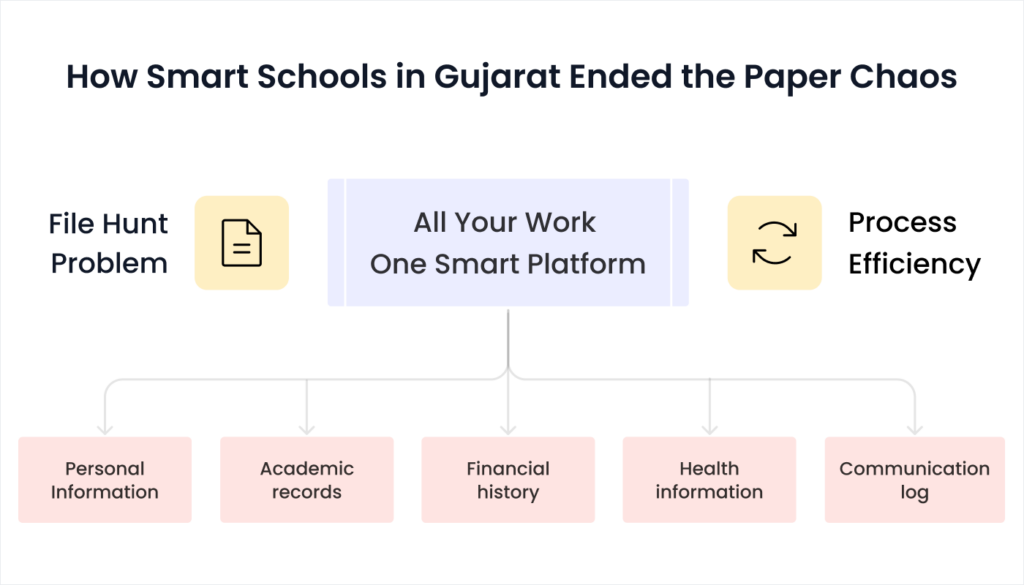
A modern Cloud-Based School ERP Gujarat solution isn’t just software—it’s the digital nervous system of your school.
It connects every department:
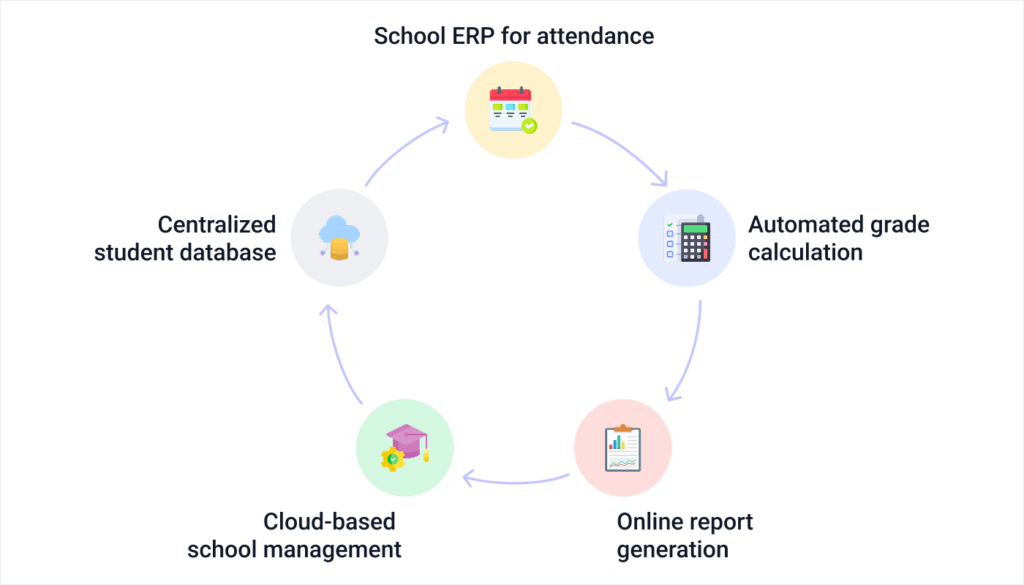
Fees → Attendance → Bus Tracking → Parent Communication → Reports → Payroll
Imagine a system where:
When a student marks attendance, it automatically updates fee eligibility.
Bus routes sync in real-time with attendance.
Parents get instant notifications: “Your child reached school at 8:05 AM.”
The accountant doesn’t have to call teachers to verify absences.
Reports for trustees generate in one click.
That’s what real ERP Implementation for Schools looks like—effortless integration and smarter management without adding staff.
3. The Rajkot Case Study: How One School Saw ROI in Just 8 Months
School ERP Investment: Will You Get Your Money Back? (Rajkot School Case Study) 15
Let’s take the example of Bright Horizon School, Rajkot (name changed for confidentiality).
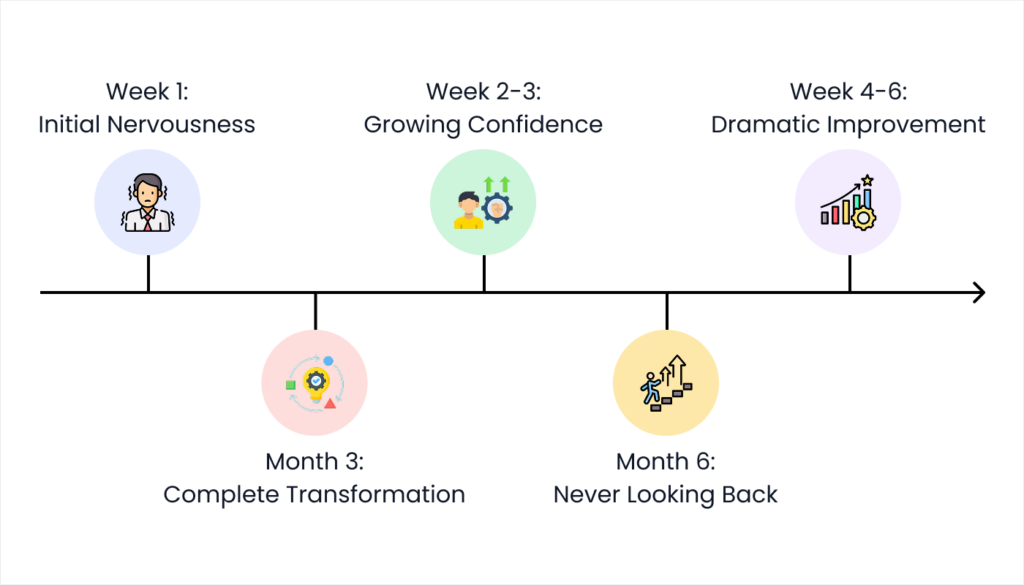
When the principal decided to implement a School ERP, the initial reaction from staff was predictable:
“We’ve managed fine with registers and Excel. Why change?”
But after 6 months, the transformation was visible.
Before ERP Implementation
Fee collection delayed every month
Parents called 50+ times daily for attendance and bus status
Teachers spent 2 hours daily on data entry
Reports for management took 2–3 days to compile
After ERP Implementation
85% fees collected online before the due date
70% fewer phone calls to the office
Attendance marked digitally in under 3 minutes
Reports generated automatically every evening
By the end of the academic year, the school had:
Saved ₹3.6 lakh in staff time
Reduced manual errors by 90%
Improved parent satisfaction scores by 40%
Attracted 14 new admissions purely due to “modern management” reputation
The ROI? They recovered their entire School ERP Investment in 8 months.
That’s the power of School Management Software ROI when used strategically.
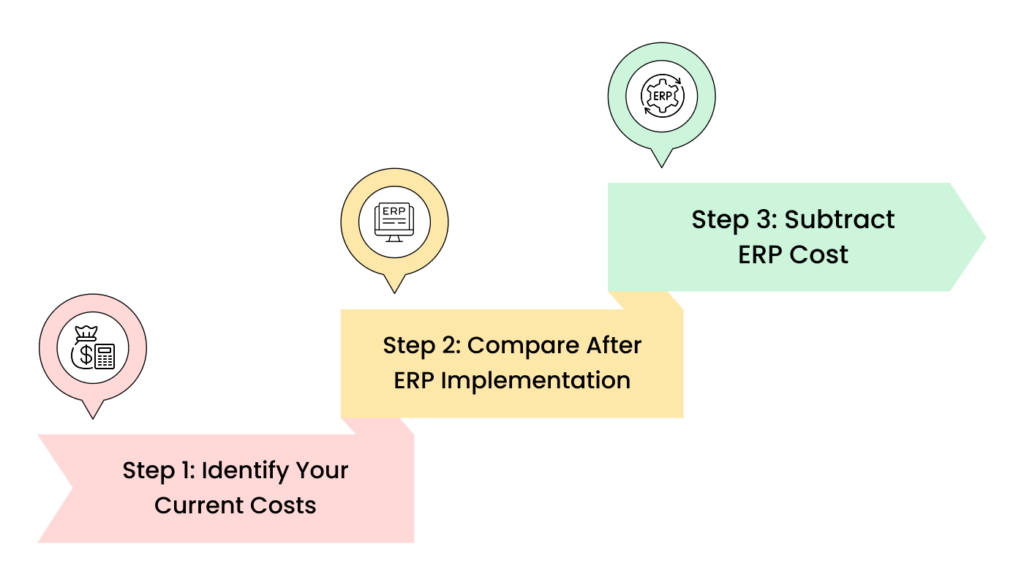
4. Calculating Your School ERP ROI
School ERP Investment: Will You Get Your Money Back? (Rajkot School Case Study) 16
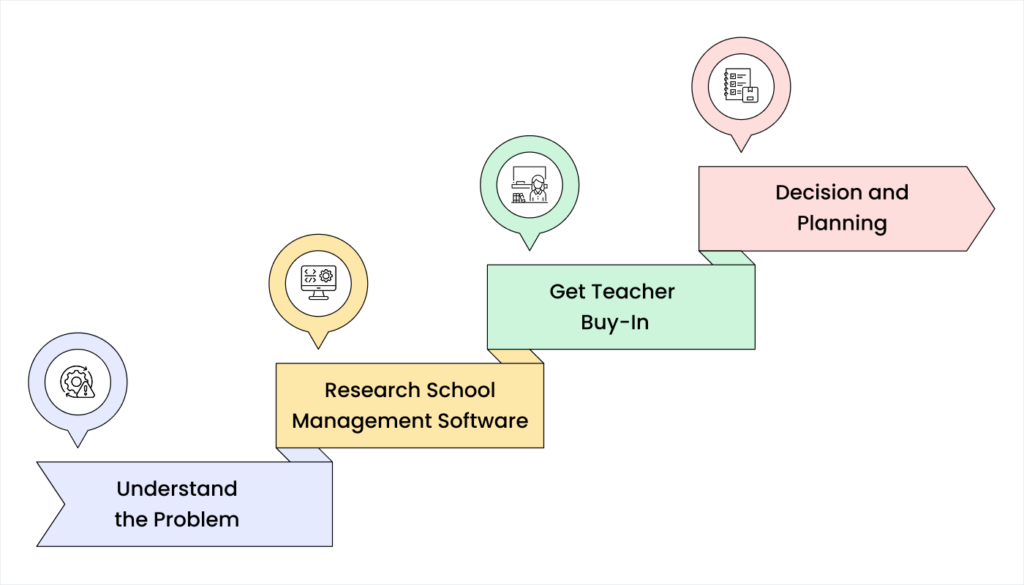
Many principals ask, “How do I actually calculate ROI for my school?” Here’s a simple method that any school can use.
Step 1: Identify Your Current Costs
Add up:
Manual hours spent on reports, attendance, and calls
Staff overtime costs
Errors in fee tracking or collection delays
Paper, printing, and communication expenses
Step 2: Compare After ERP Implementation
Measure:
Time saved per week
Fee collection improvement
Reduced stationery/communication expenses
Staff workload reduction
Step 3: Subtract ERP Cost
Most Affordable School ERP Solutions Gujarat range between ₹80,000 and ₹1.5 lakh per year (depending on school size).
If your savings cross ₹2–3 lakh annually—and they usually do—your School ERP ROI is 200% or more within the first year.
5. Why Cloud-Based School ERP Gujarat Systems Deliver Higher ROI
School ERP Investment: Will You Get Your Money Back? (Rajkot School Case Study) 17
Let’s be clear — not all ERPs are equal. Traditional desktop-based systems might look cheaper at first but often come with hidden costs: maintenance, limited access, and frequent downtime.
A Cloud-Based School ERP Gujarat system eliminates all that by:
Allowing access anytime, anywhere
Updating data in real-time across all devices
Reducing server maintenance costs
Enabling parents and staff to stay connected even from home
Because updates happen automatically, your system grows smarter without additional investment—improving ROI year after year.
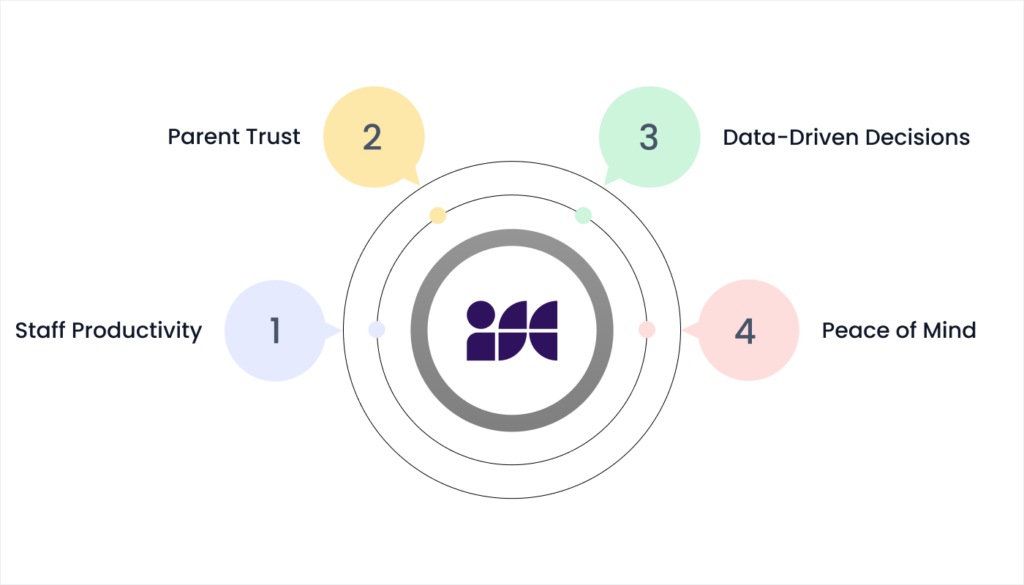
6. Benefits of ERP for Schools: Beyond Numbers
School ERP Investment: Will You Get Your Money Back? (Rajkot School Case Study) 18
The financial ROI is only half the story. The other half is human.
Here’s what schools actually experience:
A. Staff Productivity
Teachers and office staff spend less time on repetitive tasks and more on student engagement.
B. Parent Trust
Transparent fee management, instant notifications, and online access build long-term trust with parents—a key factor for admissions and retention.
C. Data-Driven Decisions
Principals get live dashboards showing attendance, fee trends, and transport performance—helping them make smarter decisions instantly.
D. Peace of Mind
When everything runs in one system, your school feels lighter. No chaos, no confusion, no “who has the latest data?” moments.
That’s the School ERP ROI—time, clarity, and confidence.
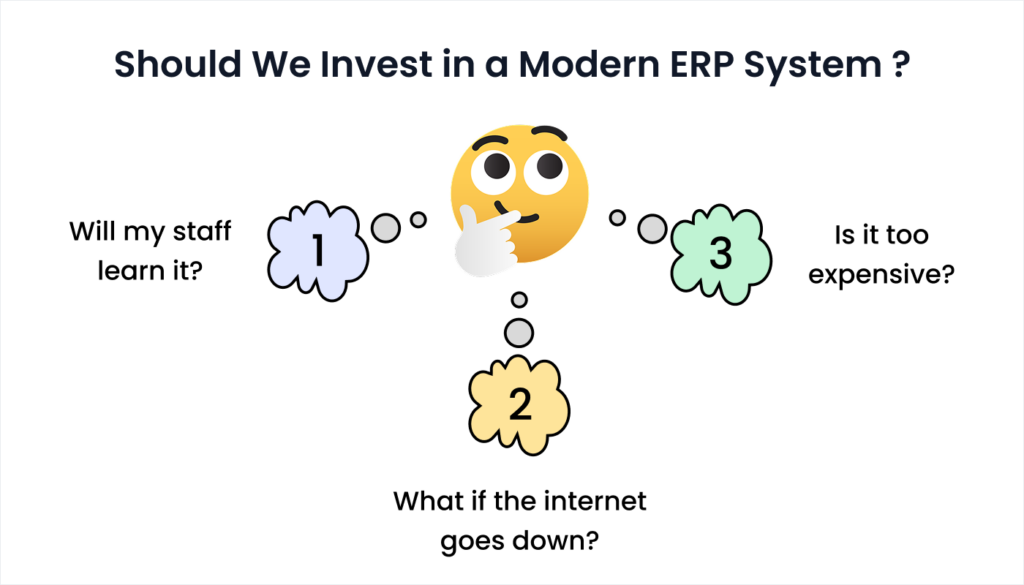
7. Common Concerns (and Real Answers)
School ERP Investment: Will You Get Your Money Back? (Rajkot School Case Study) 19
“Will my staff learn it?”
If your staff can use WhatsApp, they can use a modern ERP. Systems today are designed with simplicity in mind.
“What if the internet goes down?”
Most systems have offline modes. Data syncs automatically once the connection is restored.
“Is it too expensive?”
The real question is—how much are your current inefficiencies costing you every year?
Most Rajkot schools recover their School ERP Investment within the first two terms.
8. How to Choose the Right ERP Partner
School ERP Investment: Will You Get Your Money Back? (Rajkot School Case Study) 20
A few pointers before investing:
✅ Look for local support—teams that understand Rajkot and Gujarat school structures ✅ Ensure it’s cloud-based, not desktop-only ✅ Check for customizable fee structures and GPS bus tracking ✅ Ask for references from similar-sized schools ✅ Choose a partner who trains your staff, not just installs software
The right partner doesn’t just sell you software—they guide you through change.
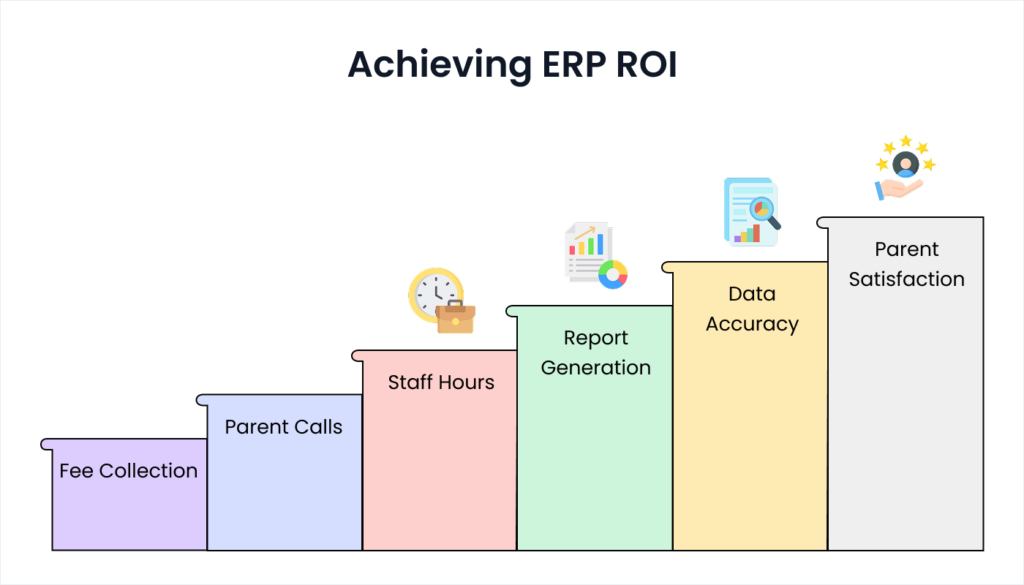
9. Real ROI Indicators to Watch
School ERP Investment: Will You Get Your Money Back? (Rajkot School Case Study) 21
Once your ERP is live, measure progress every month with these metrics:
Fee collection timeline improvement
Parent call volume reduction
Staff hour savings
Report generation time
Data accuracy
Parent satisfaction
When these improve, your ROI is already happening—even before you finish your first year.
10. The Competitive Edge for Rajkot Schools
School ERP Investment: Will You Get Your Money Back? (Rajkot School Case Study) 22
Parents today compare schools the same way they compare smartphones—convenience, speed, and modern features matter.
When your school offers:
Online fee payments
Real-time attendance notifications
Live bus tracking
Instant access to progress reports
…it doesn’t just make your staff’s life easier—it makes your school look smarter and feel trustworthy.
That’s why School ERP Case Study Rajkot examples are spreading fast—modern technology now defines reputation.
Conclusion: Your ERP Is Not a Cost—It’s a Smart Business Decision
School ERP Investment: Will You Get Your Money Back? (Rajkot School Case Study) 23
At the end of the day, a School ERP Investment isn’t about technology. It’s about time, reputation, and long-term growth.
When schools in Gujarat and Rajkot switch to Affordable, Cloud-Based School ERP Solutions, they discover something unexpected:
The return isn’t just in rupees—it’s in smiles, satisfied parents, stress-free mornings, and confident staff.
So, will you get your money back? Absolutely—and more than that, you’ll get your time, trust, and peace of mind back too.
Last month, I met Principal Mehta from a small school near Kalavad Road. She looked defeated.
“Every parent who visits asks about our ‘technology infrastructure,'” she said, shaking her head. “They tour the school, love everything about our teaching quality, then ask if we have an app or online system. When I say no, I see disappointment in their eyes.”
“How much would it cost to become ‘modern’?” she asked. “We’re a small school. We don’t have ₹10 lakhs sitting around for fancy technology.”
Here’s what I told her – and what happened next surprised both of us.
Three months later, her school looks completely modern to visiting parents. She has a parent communication app, digital attendance, online fee checking, and even video updates for families.
Total investment? Under ₹15,000 for the first year.
The secret? She stopped thinking “modern school technology” meant expensive custom software and massive infrastructure investments. Instead, she discovered what progressive schools already know: affordable school technology Rajkot doesn’t mean compromising on quality or professionalism.
The Big Technology Misconception Gujarat Schools Believe
Simple 5 Technologies That Make Rajkot Schools Look Modern (Without Big Investment) 35
Most school owners in Rajkot think going digital requires investments measured in lakhs. This misconception keeps perfectly good schools looking outdated while competitors appear modern with a fraction of the investment.
Here’s the truth: The technology gap between “traditional” and “modern” schools is getting smaller and cheaper every month. When it comes to low-cost school modernization, Gujarat is leading the way with practical, proven solutions.
Why Technology Prices Have Dropped Dramatically – The Rise of Affordable School Technology Rajkot
Five years ago, school management software really did cost lakhs to implement. Custom development, expensive servers, dedicated IT teams – the barriers were real.
Today? Everything has changed:
Cloud computing eliminated the need for expensive servers. Your data lives safely on the internet, accessible from any device with a browser.
Smartphone adoption in Gujarat means you don’t need to provide devices to parents. They already have the only technology they need in their pockets.
Competition among software providers has driven prices down dramatically. What cost ₹5 lakhs three years ago now costs ₹50,000 – often with better features.
Ready-made solutions mean you’re not paying developers to build everything from scratch. You’re using proven systems that thousands of schools already trust.
The Real Cost of Looking Outdated
While you’re worrying about technology costs, here’s what staying completely traditional actually costs Gujarat school software:
Lost enrollments: Parents choosing more “modern-looking” schools even when teaching quality is equal
Staff inefficiency: Administrative work taking 5-10 hours weekly that could be eliminated
Parent frustration: Families calling repeatedly for information they should be able to access themselves
Competitive disadvantage: Newer schools appearing more professional with minimal investment
The question isn’t whether you can afford budget school solutions Gujarat – it’s whether you can afford not to implement them.
Technology Solution #1: WhatsApp Business for Professional Communication (₹0/month)
Simple 5 Technologies That Make Rajkot Schools Look Modern (Without Big Investment) 36
Yes, you read that correctly. Zero rupees per month.
Before you dismiss this as “too simple,” understand that some of Rajkot’s most respected schools use WhatsApp Business as their primary parent communication tool. The key is using it professionally, not like a personal account.
This is the foundation of simple school management – using free tools that parents already understand and trust.
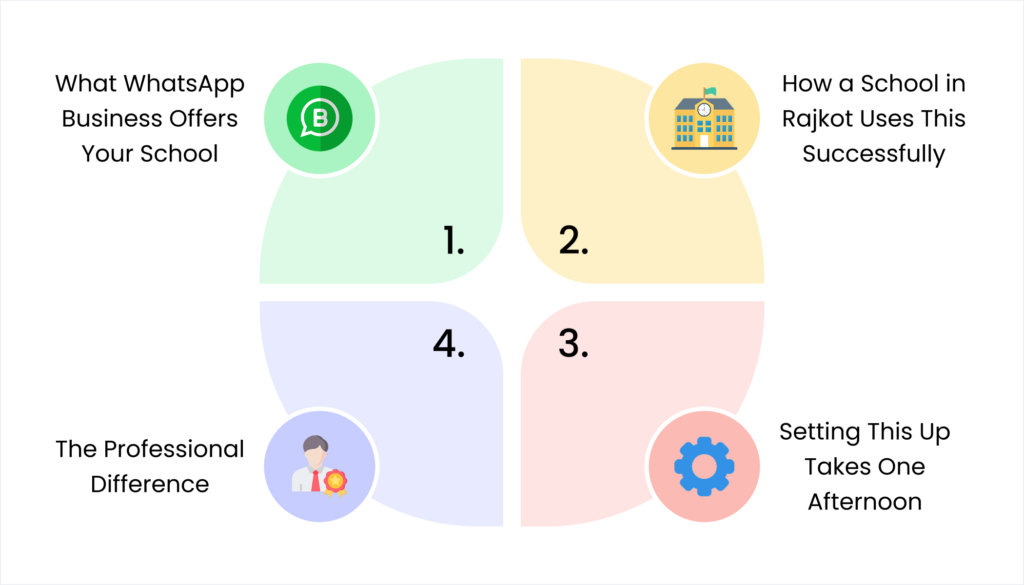
What WhatsApp Business Offers Your School
Automated greeting messages: Parents who contact you get instant responses even when you’re busy
Quick replies: Save templates for frequently asked questions (admission process, fee structure, school timings)
Catalog feature: Share your school’s programs, facilities, and achievements in organized format
Business profile: Professional information including school address, contact details, and website link
Message labels: Organize parent conversations by class, inquiry type, or urgency
Away messages: Automatic responses during holidays or after school hours
How a School in Rajkot Uses This Successfully
Shanti Vidyalaya near Jamnagar Road implemented WhatsApp Business last year as part of their low-cost school modernization strategy. Here’s their simple system:
Main school number on WhatsApp Business for general inquiries and announcements
Class-wise groups managed by class teachers for homework and updates
Quick reply templates for 15 most common parent questions
Catalog showcasing their extracurricular programs and achievements
Result? Parents love the instant communication, and the office staff spends 60% less time answering phone calls about routine matters.
Setting This Up Takes One Afternoon
Download WhatsApp Business (free from Play Store)
Set up your school’s business profile with complete information
Create quick reply templates for common questions
Add your school’s contact details and location
Start using it professionally
Investment: ₹0 Time to implement: 2-3 hours Monthly cost: ₹0 Parent satisfaction impact: Immediate and significant
The Professional Difference
The key is treating WhatsApp Business differently from personal WhatsApp:
Set boundaries: Clear communication hours (8 AM – 6 PM on school days)
Professional language: Formal, helpful responses even in casual messaging platform
Organized approach: Use labels and categories to stay organized
Consistent branding: Use your school logo as the profile picture
This isn’t just “using WhatsApp.” It’s implementing professional communication technology that costs nothing but delivers real value. For schools exploring affordable school technology Rajkot options, this is the perfect starting point.
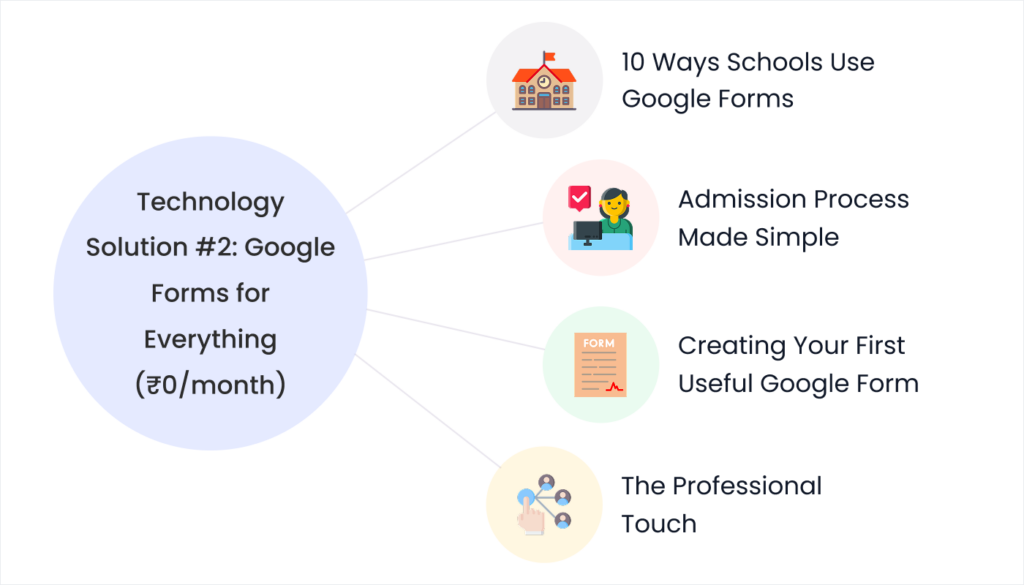
Technology Solution #2: Google Forms for Everything (₹0/month)
Simple 5 Technologies That Make Rajkot Schools Look Modern (Without Big Investment) 37
Google Forms is criminally underused by Gujarat schools. This free tool can replace expensive software for multiple school functions, making it an essential part of any simple school management system.
10 Ways Schools Use Google Forms
Admission applications: Complete forms with document upload capabilities
Parent feedback surveys: Understand what families think about your school
Scholarship applications: Organized documentation of financial need
Real Example: Admission Process Made Simple
A school in Rajkot’s University Road area digitized their entire admission process using only Google Forms as part of their budget school solutions Gujarat implementation. Here’s what they created:
Form 1: Initial inquiry form on their website
Form 2: Complete admission application with document upload
Form 3: Parent interview scheduling
Form 4: Fee structure acknowledgment and payment confirmation
Their admission office went from “drowning in paper” to “completely organized” in one week. Parents love the convenience of applying from home, and the school saves hours of data entry work.
Creating Your First Useful Google Form
Let’s create a parent feedback form as your first project:
Go to forms.google.com (free with any Gmail account)
Click “Blank form”
Add questions about school satisfaction, communication, teaching quality
Include a section for suggestions and concerns
Make it anonymous to encourage honest feedback
Share the link via WhatsApp or print QR codes for physical distribution
Results automatically compile into a spreadsheet. You can see parent sentiment immediately and spot patterns in feedback.
Investment: ₹0 Time to implement: 1-2 hours per form Monthly cost: ₹0 Usefulness: Replaces multiple expensive software solutions
The Professional Touch
Make your Google Forms look professional:
Add your school logo as the header image
Use school colors in the form design
Write clear instructions in simple language
Test thoroughly before sending to parents
Send confirmation emails automatically to form submitters
Technology Solution #3: Attendance Management via Simple Apps (₹500-1,500/month)
Simple 5 Technologies That Make Rajkot Schools Look Modern (Without Big Investment) 38
This is where you make your first small financial investment – and see immediate returns. When exploring affordable school technology Rajkot solutions, attendance management offers the best ROI for small schools.
Several apps designed specifically for Indian schools offer basic attendance management at prices that won’t hurt your budget.
What You Get for ₹500-1,500 Monthly
Teacher attendance marking: Quick check-in/check-out for each class
Automatic parent SMS: Instant notification when child is absent
Monthly reports: Attendance summaries for records and compliance
Multiple users: All teachers can mark attendance from their phones
Cloud storage: No risk of losing data if a phone breaks
Support: Help when you need it via phone or WhatsApp
How This Works in Practice
Morning routine in schools using simple school management apps:
8:30 AM: Teacher opens app, sees class list
8:35 AM: Marks present/absent for each student (takes 2 minutes)
8:36 AM: Parents of absent students receive SMS automatically
8:40 AM: Teacher starts teaching, not paperwork
Compare this to traditional attendance:
8:30 AM: Teacher finds attendance register
8:35 AM: Marks attendance in register
8:40 AM: Must copy attendance to office copy later
10:00 AM: Office staff calls parents of absent students
By afternoon: Information might reach parents, might not
Selecting the Right Attendance App
Look for these features in budget school solutions Gujarat:
Works offline: Internet issues shouldn’t stop attendance marking
Simple interface: Teachers shouldn’t need training
Bilingual SMS: Messages in both Gujarati and English
Reliable: Actually sends notifications every time
Affordable: Under ₹2,000/month for schools under 500 students
Apps Currently Popular in Gujarat Schools
Several apps serve Rajkot and Gujarat schools well:
BasicSchoolApp: ₹499/month for schools under 200 students
AttendanceSimple: ₹899/month with SMS included
GujaratSchoolTrack: ₹1,299/month with bilingual support
Most offer free trials so you can test before committing.
Investment: ₹500-1,500/month
Time to implement: 1 week including teacher training
ROI timeline: Immediate – saves hours of staff time daily
Parent perception impact: “This school is organized and modern”
Technology Solution #4: Digital Fee Tracking with Basic Software (₹1,000-2,500/month)
Simple 5 Technologies That Make Rajkot Schools Look Modern (Without Big Investment) 39
Fee management causes headaches in almost every school. Parents can’t remember payment dates, office staff spends hours answering “What’s my balance?” questions, and tracking partial payments feels impossible.
Simple fee management software solves these problems without costing lakhs. This is a crucial component of low-cost school modernization that delivers immediate benefits.
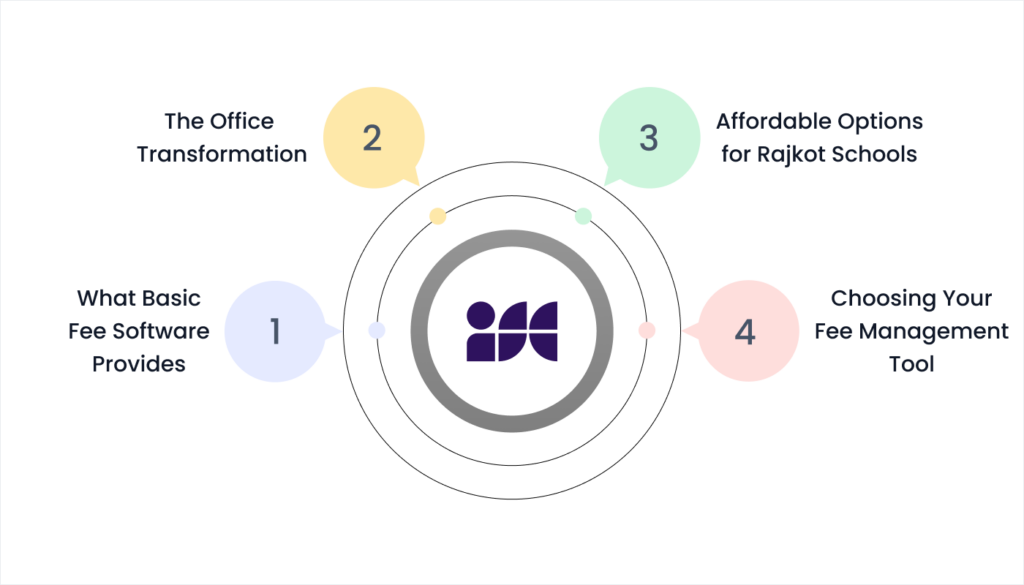
What Basic Fee Software Provides
Student-wise fee tracking: Complete payment history for each family
SMS reminders: Automatic notifications before due dates
Online balance checking: Parents can check their status anytime
Payment plans: Track families paying in installments
Reports: Monthly collection summaries for accounting
The Office Transformation
A school principal in Rajkot shared her experience with implementing simple school management for fee tracking:
“Before fee software, our office phone rang 40-50 times daily with fee questions. Parents wanted to know their balance, payment dates, receipt copies… My staff spent half the day answering these calls.
Now? Parents check their balance online or via SMS. They receive automatic reminders before due dates. Our phone rings maybe 5-6 times daily with fee questions, and those are usually special situations.”
Time savings: 3-4 hours daily for office staff
Parent satisfaction: Dramatically improved
Payment collection: Actually improved because reminders go out automatically
Online portal where parents check balance and payment history
SMS integration for automated reminders and receipts
Simple receipt printing from any computer
Basic reporting for accounting purposes
Phone support when you need help
Prices typically range from ₹1,000-2,500 monthly depending on student count and features needed.
Choosing Your Fee Management Tool
Key questions to ask providers:
Can parents check balance themselves (reduces phone calls)?
Does it send automatic payment reminders?
Can it handle partial payments and installments?
Is receipt generation simple and quick?
What happens if internet is down temporarily?
Investment: ₹1,000-2,500/month
Time to implement: 2-3 weeks including data entry
Break-even point: Usually 2-3 months through efficiency gains
Professional image impact: Significant
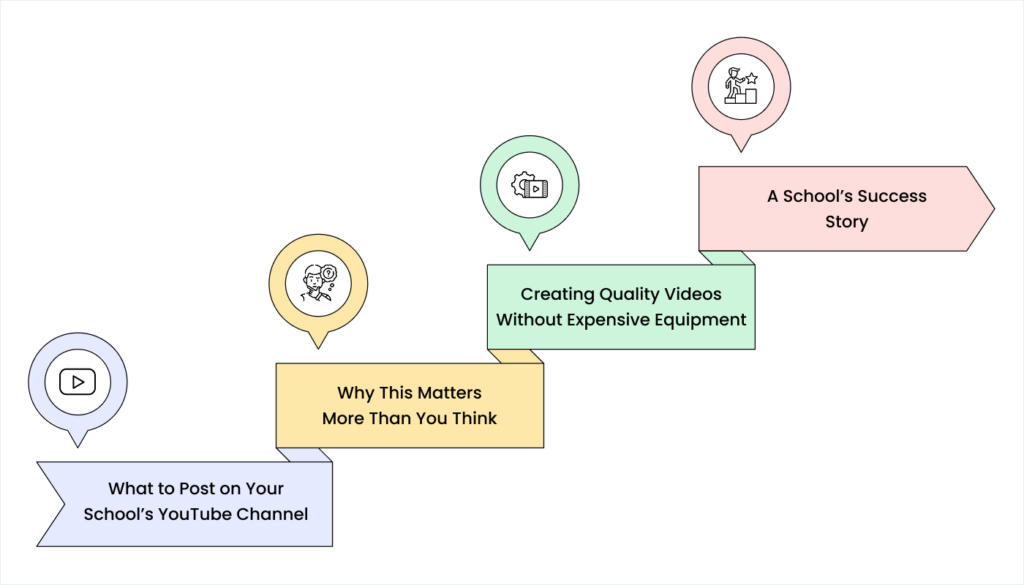
Technology Solution #5: YouTube Channel for School Visibility (₹0/month)
Simple 5 Technologies That Make Rajkot Schools Look Modern (Without Big Investment) 40
This last solution costs nothing financially but requires a small time investment. The return? Massive improvements in how parents perceive your school.
Every school in Rajkot should have a YouTube channel. Not for fancy productions, but for simple, authentic videos showing what makes your school special. This is often the most overlooked aspect of affordable school technology Rajkot strategies.
What to Post on Your School’s YouTube Channel
Welcome video: Principal introducing the school (3-4 minutes)
Classroom walkthroughs: Show your learning environment
Teacher introductions: Help parents know who teaches their children
Parents researching schools Google your name. What do they find?
If you have no YouTube presence, they see nothing or old, poor-quality videos that make your school look outdated.
If you have a simple YouTube channel with 10-15 videos, they see:
Clean, well-maintained facilities
Happy students learning
Caring teachers who know their students
Parents who trust your school
Modern approach to education
Creating Quality Videos Without Expensive Equipment
You don’t need professional videographers or expensive cameras. A smartphone and these simple tips create perfectly acceptable videos for your low-cost school modernization plan:
Good lighting: Film during daytime near windows
Steady shots: Hold phone still or prop it against something
Clear audio: Film in quieter areas, speak clearly
Short duration: 2-5 minutes is perfect for most content
Simple editing: Basic cuts using free phone apps
Consistent posting: New video every 2-3 weeks maintains interest
A School’s Success Story
A small school near Rajkot railway station started a YouTube channel last year as part of their budget school solutions Gujarat initiative. They posted:
Welcome video from principal
6 classroom videos showing different grades
3 teacher introduction videos
2 parent testimonial videos
4 event highlight videos
Total investment: ₹0 (used school office manager’s phone)
Time investment: 1-2 hours monthly
Result: Inquiries from prospective parents increased by 40% within 6 months
Parents specifically mentioned “we watched your YouTube videos” during admission inquiries. The channel made the school feel modern, transparent, and confident.
Investment: ₹0
Time investment: 2-3 hours monthly
Impact on inquiry generation: Very significant
Professional image boost: Substantial
Implementing All Five Solutions: Your Roadmap
Simple 5 Technologies That Make Rajkot Schools Look Modern (Without Big Investment) 41
Don’t try to implement everything simultaneously. Here’s a realistic 90-day roadmap for affordable school technology Rajkot implementation:
Month 1: Free Solutions
Week 1: Set up WhatsApp Business for professional communication
Week 2: Create 3-4 essential Google Forms (admission, feedback, leave application)
Week 3: Launch school YouTube channel with welcome video
Week 4: Add 2-3 more YouTube videos, promote WhatsApp number to parents
Investment so far: ₹0
Parent perception change: Already noticeable
Month 2: Add Attendance Management
Week 1: Research and select attendance app
Week 2: Set up system, enter student data
Week 3: Train teachers on using the app
Week 4: Go live with automatic parent SMS notifications
Simple 5 Technologies That Make Rajkot Schools Look Modern (Without Big Investment) 42
If you’re ready to make your Rajkot school look modern without spending lakhs, here’s exactly what to do this week:
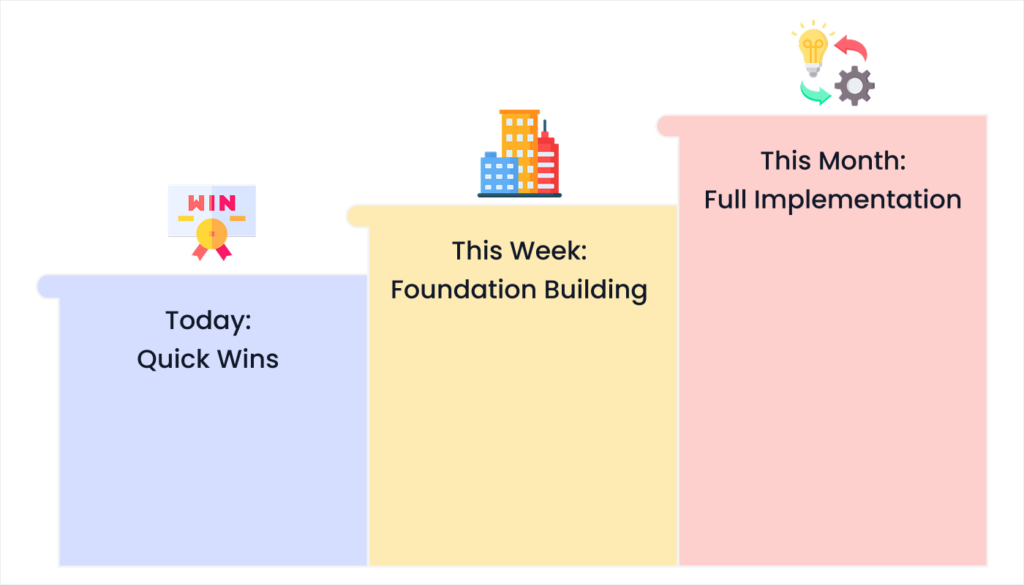
Today: Quick Wins
Download WhatsApp Business app
Set up your school’s business profile
Create one Google Form (try an admission inquiry form)
Record a 3-minute welcome video on your phone
Time investment: 2-3 hours
Financial investment: ₹0
Visibility impact: Immediate
This Week: Foundation Building
Promote your WhatsApp Business number to current parents
Create 2-3 more Google Forms for common school processes
Upload your first video to new YouTube channel
Research attendance management apps and request demos
Time investment: 5-8 hours total
Financial investment: ₹0
Parent perception shift: Noticeable
This Month: Full Implementation
Select and launch attendance management app
Train teachers on new system
Add 3-4 more videos to YouTube channel
Research fee management software options
Plan next month’s technology additions
Time investment: 15-20 hours total
Financial investment: ₹500-1,500
Professional image improvement: Substantial
The Real Question Isn’t “Can We Afford This?”
Simple 5 Technologies That Make Rajkot Schools Look Modern (Without Big Investment) 43
The real question is: Can you afford to let competitors gain advantages while your school continues looking outdated to prospective parents?
For less than you probably spend on school stationery monthly, you can implement affordable school technology that makes your institution look modern, organized, and professional.
Principal Mehta from our opening story? Three months after our conversation, she told me:
“Parents who visit now are impressed before they even see our classrooms. They’ve watched our YouTube videos, filled out our online form, and received professional responses via WhatsApp. By the time they arrive, they’re already convinced we’re a modern, well-run school.”
“And it cost us less than what we used to spend on paper and file folders.”
That’s the power of smart, budget school solutions Gujarat choices.
Ready to Make Your School Look Modern?
Simple 5 Technologies That Make Rajkot Schools Look Modern (Without Big Investment) 44
You don’t need lakhs in your budget. You don’t need technical expertise. You don’t need months of planning.
You just need to start with one simple solution this week and build from there.
The technology exists. The solutions are proven. Gujarat schools are already using them successfully. The only question is: When will your school join them?
Want Personalized Guidance?
We help Rajkot schools modernize on realistic budgets. From selecting the right tools to implementing them successfully, we understand Gujarat schools’ unique needs and constraints.
Contact us for a free consultation about bringing modern technology to your school without breaking your budget. Let’s discuss which affordable school technology Rajkot solutions make sense for your situation and create a practical implementation plan.
Your school’s modern future doesn’t require a massive investment – just smart choices and a willingness to start today. With the right low-cost school modernization strategy, you can compete with any school in your area.
Transform your Rajkot school with affordable technology that delivers real results. Start today with budget-friendly solutions that parents notice and competitors respect.
The Daily Battle Every Rajkot Parent Knows Too Well
How to Know What Your Child Did in School Today (Without Asking 'Kya Kiya?') 55
It’s 4 PM in your Rajkot home. Your child’s school bag lands with that familiar thud near the door. You’ve been waiting all day for this moment, hoping today will be different. Maybe today you’ll finally crack the code of parent-school communication families desperately need.
“Beta, aaje school ma shu karyu?” you ask hopefully.
“Kuch khaas nahi,” comes the predictable response.
Your heart sinks. Again. Seven hours at school, and all you get is “nothing special”? You know there’s more to the story. The paint stains on the uniform tell one tale. The untouched water bottle tells another. The suspiciously empty homework diary? That’s a mystery you’ll solve at 9 PM when the class WhatsApp group explodes with “What’s tomorrow’s homework?”
Last Tuesday, Mrs. Mehta from your building discovered her daughter had been selected as class monitor three weeks ago. She found out from another parent at D-Mart! The child never mentioned it. When asked why, she simply shrugged, “Bhool gayi.”
This isn’t just frustrating – it’s painful. While companies offer real-time school updates Gujarat businesses use to track packages, we parents can’t track what happens to our most precious packages – our children – during school hours.
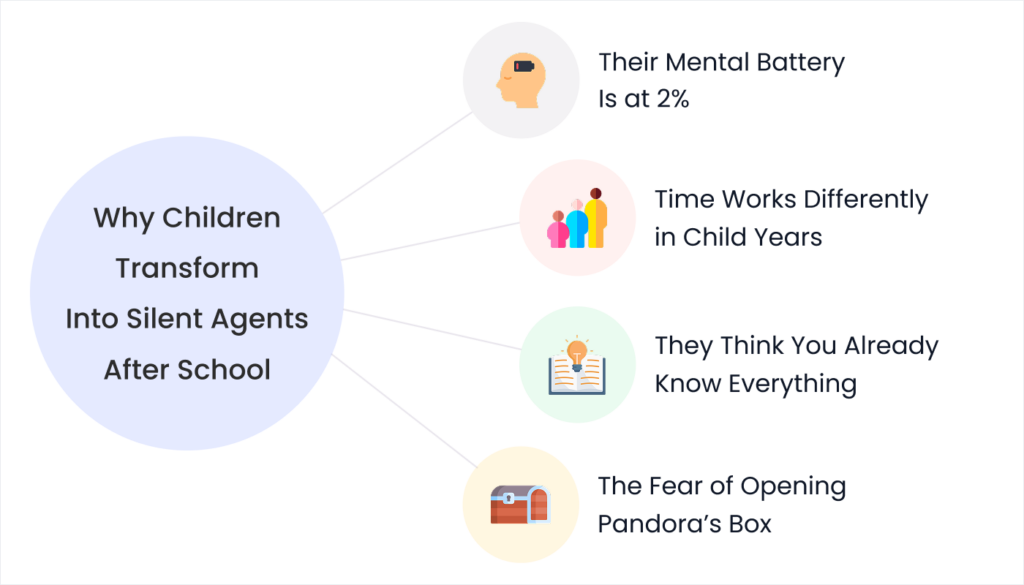
Why Children Transform Into Silent Agents After School
How to Know What Your Child Did in School Today (Without Asking 'Kya Kiya?') 56
Before you blame your child for being secretive, let’s understand what’s really happening in their exhausted little minds when they walk through that door. The lack of parent school communication Rajkot schools should facilitate isn’t entirely your child’s fault.
Their Mental Battery Is at 2%
Imagine attending back-to-back meetings in different languages with different bosses for seven hours straight. That’s your child’s school day. By afternoon, their brain is like your phone at the end of the day – desperately needing a recharge.
Between morning assembly and final bell, your child has:
Switched between six different subjects (each with different rules and expectations)
Navigated playground politics (who’s best friends with whom today?)
Managed bathroom permissions and water breaks
Decoded teacher moods and adjusted behavior accordingly
Survived the cafeteria food negotiations
Remembered which notebook belongs to which period
Dealt with that one classmate who always borrows pencils and never returns them
When you ask “How was school?” their overloaded brain simply crashes. No wonder daily school activities trackingfeels impossible without proper systems.
Time Works Differently in Child Years
For adults, this morning feels recent. For children? This morning might as well be last Diwali. Their perception of time is completely different from ours.
The special appreciation they received in morning assembly? Ancient history by lunch. The science experiment that excited them at 10 AM? Completely overwritten by the drama of who sat where during lunch break.
This time distortion makes parent school communication Rajkot particularly challenging because what feels important to us doesn’t even register in their evening memory.
They Think You Already Know Everything
Children, especially younger ones, assume parents have magical knowledge. After all, you knew they didn’t really brush their teeth properly. You knew they sneaked extra screen time. You somehow knew they didn’t finish their lunch even before opening the tiffin box.
So why wouldn’t you know about the spelling test or the new seating arrangement? This assumption blocks real-time school updates Gujarat parents desperately need.
The Fear of Opening Pandora’s Box
Smart kids learn quickly: one piece of information leads to twenty questions. Mentioning homework leads to “Did you understand it?” Talking about friends leads to “Are you being nice to everyone?” Discussing lunch leads to “Why didn’t you finish your vegetables?”
They’ve discovered that “nothing special” is the safest answer – it ends conversations instead of starting them.
What Gujarat Parents Actually Want to Know (The Truth)
How to Know What Your Child Did in School Today (Without Asking 'Kya Kiya?') 57
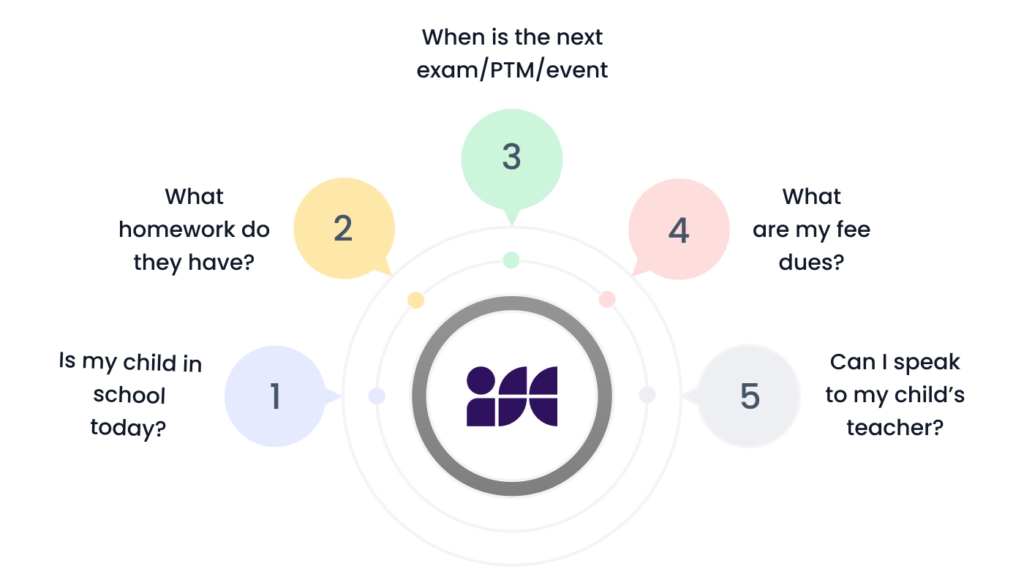
Let’s be honest about what keeps us scrolling through school WhatsApp groups at midnight, desperately seeking a parent teacher communication app that could answer our real questions:
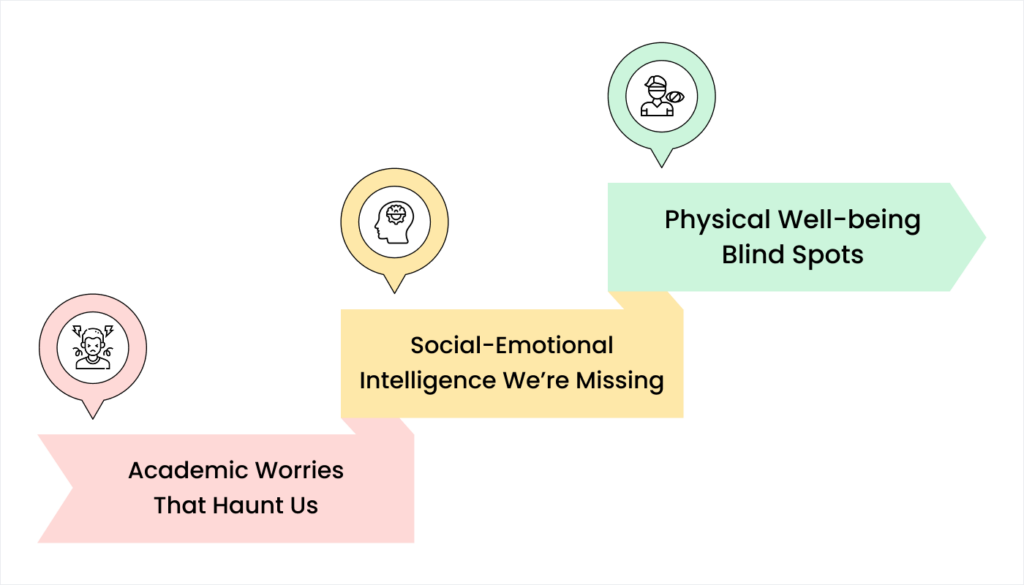
Academic Worries That Haunt Us
“Is my child understanding or just surviving?” You don’t want to discover during March PTM that your child has been struggling with multiplication since October. Early intervention could prevent the academic confidence crisis that follows falling behind. Daily school activities tracking would reveal these struggles immediately.
“What exactly IS the homework?” The number of “Tomorrow’s homework please???” messages flooding every Rajkot school’s parent group at 8 PM proves we’re all fighting this battle. Children develop selective memory about assignments, and without proper parent school communication Rajkot systems, we’re left guessing.
“Is my child participating or hiding?” Some children are classroom stars who never mention their achievements. Others sit silently confused, too shy to ask for help. Both scenarios need different parental support, but without real-time school updates Gujarat schools should provide, we’re blind.
Social-Emotional Intelligence We’re Missing
“Who influences my child six hours a day?” Your sweet, obedient child might be best friends with the class troublemaker. Or maybe they’re being influenced by the topper who makes studying cool. Without knowing their social circle, how can you guide their choices?
“Is my child included or isolated?” Birthday invitations, group project partnerships, lunch companions – these social dynamics shape self-esteem for life. A good parent teacher communication app would flag social concerns before they become crises.
“Is anyone troubling them?” Bullying often goes unreported for weeks. Children don’t tell because they’re embarrassed, scared, or don’t recognize emotional bullying as “real” bullying. Daily school activities tracking could reveal behavioral patterns indicating problems.
Physical Well-being Blind Spots
“Did they actually eat?” “I ate everything” could mean they traded nutritious home food for canteen junk. In Gujarat’s heat, proper nutrition isn’t optional. Real-time school updates Gujarat parents receive should include basic wellness information.
“Are they drinking water?” That full water bottle returning home isn’t cute – it’s concerning. Dehydration affects concentration, mood, and health. Yet without proper parent school communication Rajkot style updates, we don’t know until they’re home with a headache.
“Are they physically safe?” Playground accidents, rough play, or worse – we often discover injuries or incidents hours or days later. Immediate communication could prevent small issues from becoming big problems.
Detective Techniques That Actually Work (Parent-Tested)
How to Know What Your Child Did in School Today (Without Asking 'Kya Kiya?') 58
After interviewing dozens of Rajkot parents who’ve cracked the code without waiting for a parent teacher communication app, here are proven conversation starters:
Questions That Open Floodgates
“What made you laugh today?” Children love sharing funny moments. This reveals classroom dynamics, teacher personalities, and friend interactions without feeling like interrogation.
“Who got in trouble today?” Every class has drama. Children remember rule-breaking even when they forget everything else. This shows you classroom management styles and where your child stands behaviorally.
“What was the most boring part?” Children excel at complaining! This question reveals subjects they find challenging, teachers they don’t connect with, or activities they’d rather avoid.
“What did everyone bring for lunch?” Food is social currency in schools. This innocent question uncovers friend groups, sharing habits, and social hierarchies. Until schools provide daily school activities tracking, this is valuable intelligence.
Strategic Timing for Maximum Information
The After-School Mistake Never interrogate immediately. They’re exhausted, hungry, and overwhelmed. Let them decompress with water, snacks, and 20 minutes of whatever they choose. Then approach casually.
The Bedtime Gold Mine Something magical happens under cozy blankets. Defenses drop. Tomorrow feels distant. Suddenly stories flow: “Mummy, I forgot to tell you…” These moments are worth more than any parent teacher communication app.
The Car Confession Zone The drive home from tuition or relatives creates perfect conditions. No eye contact pressure, nowhere to escape, casual atmosphere. Many parents report breakthrough conversations during evening drives around Rajkot’s Race Course or Aji Dam.
The Sibling Intelligence Network Multiple children? You have built-in informants. Younger ones report everything (“Didi got scolded today!”). Older ones reveal information while complaining about younger ones. Better than any real-time school updates Gujarat technology could provide.
How Progressive Schools Bridge the Communication Gap
How to Know What Your Child Did in School Today (Without Asking 'Kya Kiya?') 59
Forward-thinking schools across Gujarat are realizing that parent school communication Rajkot isn’t luxury – it’s necessity. They’re implementing systems that transform parent anxiety into partnership.
What Modern Communication Looks Like
Imagine replacing your evening interrogation with these automatic updates:
10:45 AM: “Aarav asked an excellent question about planets in Science class!” Pride swells during your tea break
1:00 PM: “Lunch update – Ate well, shared extra rotis with friend” Nutrition worry addressed
2:30 PM: “Homework: Math worksheet page 32, Hindi essay on ‘My Family'” No evening guessing games
This isn’t fantasy. Schools using proper daily school activities tracking report 70% reduction in parent phone calls and significantly higher satisfaction.
The Transformation When Parents Know
When parent school communication Rajkot works properly:
Homework becomes collaboration: “Let’s explore that planet question you asked!”
Problems get solved quickly: That friendship issue gets addressed before becoming a crisis
Achievements get celebrated: “Your teacher said your handwriting improved so much!”
Learning extends home: “Since you studied plants, let’s grow methi on our balcony”
Family stress reduces: Less worry means happier dinners and bedtime
Children feel supported: They know home and school are connected, working together
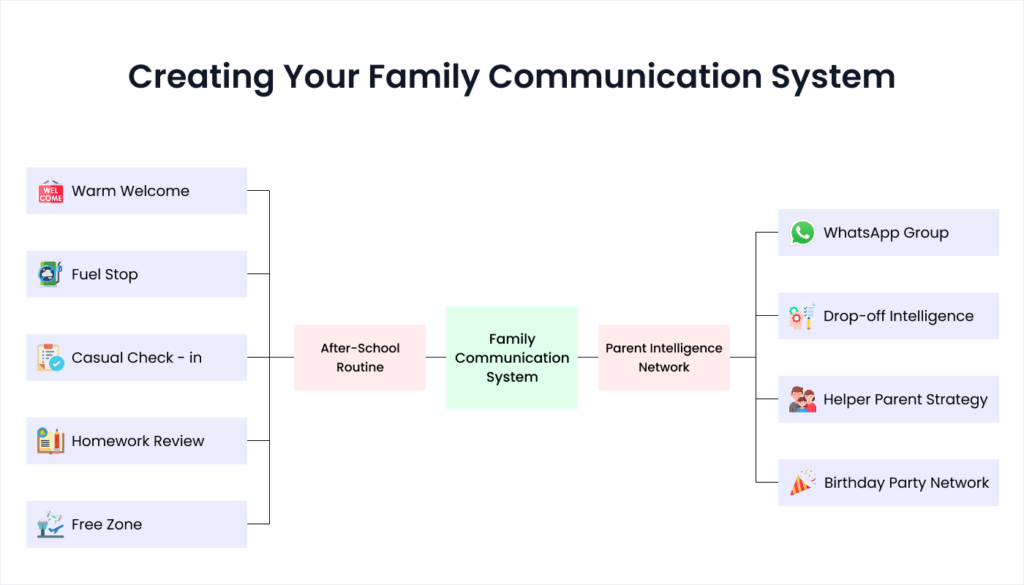
Creating Your Family Communication System
How to Know What Your Child Did in School Today (Without Asking 'Kya Kiya?') 60
While waiting for schools to implement a parent teacher communication app, build your own information network:
The After-School Routine That Works
3:00 PM – The Warm Welcome No questions! Just “Missed you!” or “Happy you’re home!” Physical affection optional but recommended.
3:15 PM – The Fuel Stop Favorite snacks ready. YOU share first: “You won’t believe what happened at office today…” This models open communication.
3:30 PM – The Casual Check-in Now try specific questions while they’re relaxed and blood sugar is stable.
4:00 PM – The Homework Review Natural conversation about today’s learning emerges during homework time.
5:00 PM – The Free Zone They’ve shared, you’ve listened, everyone’s recharged. No more questions.
Building Your Parent Intelligence Network
The WhatsApp Group Gold Mine Yes, those groups with excessive good morning messages. They’re also information treasure troves. Other parents share photos, mention stories, ask questions. You piece together your child’s day from fragments. It’s manual real-time school updates Gujarat style.
The Drop-off Intelligence Gathering Those five minutes during morning drop-off? Golden. Quick teacher interactions, observing your child’s friend groups, noticing classroom displays. Better than waiting for a formal parent teacher communication app.
The Helper Parent Strategy Volunteer for school events. Not for the school’s benefit – for yours. You’ll see your child’s world firsthand, understand teacher dynamics, and build relationships that provide ongoing information.
The Birthday Party Network Accept those birthday invitations, even when inconvenient. Other parents share invaluable observations about your child that you’d never discover otherwise. Natural daily school activities trackingthrough community.
Technology That’s Changing Everything
How to Know What Your Child Did in School Today (Without Asking 'Kya Kiya?') 61
The fear that technology makes schools impersonal? Completely backwards. Good parent teacher communication app solutions enhance human connection by handling routine communication efficiently.
What Parents Can Expect Soon
Automated Attendance = Morning Peace No more calling school asking “Did my child reach?” Real-time school updates Gujarat parents need start with basic safety confirmation.
Digital Homework Clarity = Evening Calm Clear, written assignments both parent and child can reference. No more WhatsApp group panic at 8 PM.
Achievement Instant Sharing = Timely Pride When your child does something wonderful, knowing immediately allows real-time positive reinforcement.
Two-Way Communication = Complete Picture “Grandmother is unwell, Kavya might be distracted” – teachers appreciate context. Proper parent school communication Rajkot systems work both ways.
Behavioral Pattern Tracking = Early InterventionDaily school activities tracking reveals patterns humans might miss. Declining participation? Increasing absences? Systems flag concerns early.
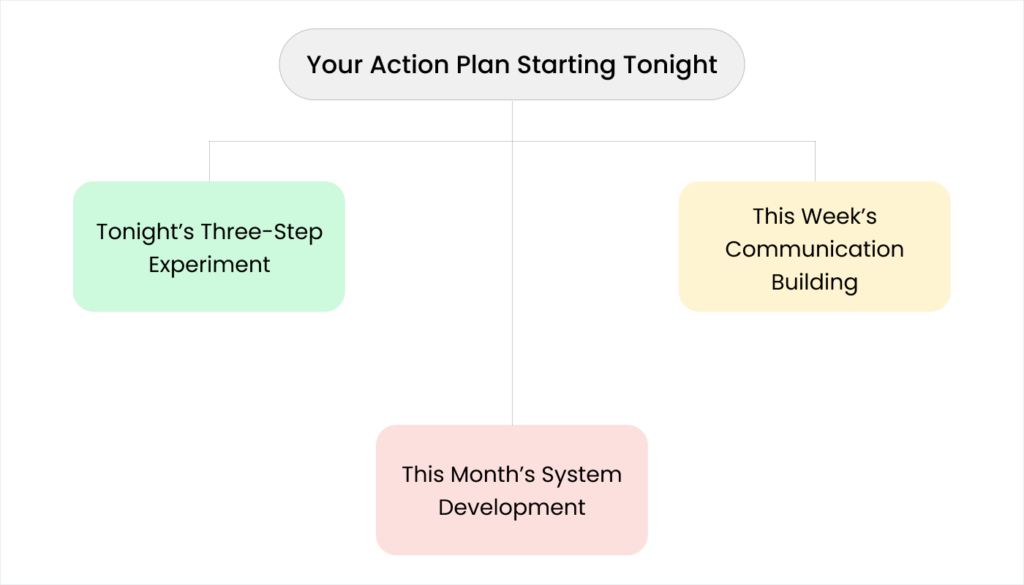
Your Action Plan Starting Tonight
How to Know What Your Child Did in School Today (Without Asking 'Kya Kiya?') 62
Tonight’s Three-Step Experiment
Step 1: Change Your Greeting Instead of “Kya kiya?” try “So happy you’re home!” Feel their surprise.
Step 2: Share Your Day First “Something funny happened at work today…” Watch them lean in.
Step 3: Ask Differently “What made you smile today?” instead of “How was school?”
This Week’s Communication Building
Monday: Try one new question technique Tuesday: Sit during snack time, no phone Wednesday: Share your childhood school story Thursday: Ask about friends, not studies Friday: Celebrate whatever they share, however small
This Month’s System Development
Week 1: Build teacher relationship through appreciation notes
Week 2: Connect with two other parents for information sharing
Week 3: Establish bedtime conversation routine
Week 4: Review what’s working, adjust approach
The Future of School Communication in Gujarat
How to Know What Your Child Did in School Today (Without Asking 'Kya Kiya?') 63
Schools implementing comprehensive parent teacher communication app systems report:
70% fewer routine inquiry phone calls
85% homework completion improvement
60% reduction in parent anxiety
40% increase in parent satisfaction scores
Significant improvement in student performance
Better teacher-parent relationships
Reduced administrative burden on staff
The question isn’t whether your school will adopt real-time school updates Gujarat technology – it’s when. And whether you’ll advocate for it or wait.
Ready to transform your school’s communication?
If you’re tired of the daily “Kya kiya?” battle, if you want parent school communication Rajkot that actually works, if you believe real-time school updates Gujarat parents deserve should be standard, not luxury – we can help.
iSchoolCloud specializes in parent teacher communication app solutions that bring transparency without compromising privacy, connection without creating burden. Our daily school activities tracking helps Rajkot schools build the parent partnerships that help children thrive.
Because every “nothing special” hides something worth knowing. And every parent deserves to know their child’s something special.
Last Monday morning at 8:15 AM, Principal Mrs. Shah’s phone rang for the 47th time that day.
“Has my daughter reached school safely?” asked an anxious parent.
Before she could answer, another call came in. “Why am I being charged late fees when I paid on time?”
Her office manager was frantically flipping through attendance registers while the transport coordinator was updating bus locations on a wall chart. Meanwhile, the accountant was drowning in fee receipts trying to reconcile payments.
Sound familiar?
If you’re running a school fees bus tracking & attendance in one system in Rajkot or anywhere in Gujarat, you’ve lived this exact morning. Multiple phone calls about the same questions. Different staff members managing different parts of school operations. Parents calling because they can’t get simple information about their child.
Here’s what most school principals don’t realize School Fees :You don’t need three separate systems, five different registers, and constant phone interruptions to manage your school efficiently.
Progressive schools across Rajkot have discovered something powerful – when fees, bus tracking, and attendance work together in one system, life gets dramatically easier for everyone.
The Problem With Running Everything Separately
School Fees, Bus Tracking, Attendance - All in One Place? Here's How 74
Let’s be honest about what separate systems actually cost your school every single day.
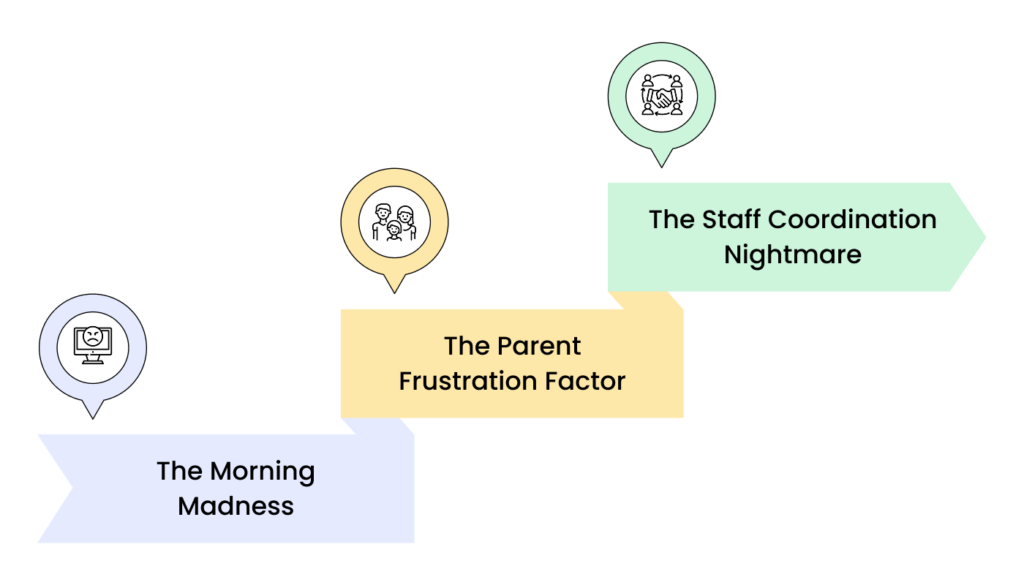
The Morning Madness
Picture your typical morning: Parents dropping off children want to quickly pay pending fees. But your fee records are in the accounts office while your attendance register is with the class teacher. The bus tracking information? That’s with the transport coordinator in a different building.
One simple parent request – “Is my child’s fee paid, did she reach school, and what’s her attendance this month?” – requires three different people to check three different systems.
A school administrator in Ahmedabad told me she spends the first two hours of every day just coordinating information between different departments. “I’m basically a human search engine,” she said, exhausted.
The Parent Frustration Factor
Today’s Gujarat parents don’t have time to make three different phone calls to get three pieces of information about their child. They’re busy at work, managing businesses, handling household responsibilities.
When parents call asking “Did the bus pick up my son?”, they don’t want to hear “Let me check with the transport office and call you back.” They want to know immediately. And honestly? They should be able to check themselves without bothering your office at all.
The Staff Coordination Nightmare
Your accounts person doesn’t know which students are regularly absent, so they keep sending fee reminders to families whose children haven’t attended school in weeks.
Your transport coordinator doesn’t know which students have unpaid fees, so buses keep picking up children whose parents haven’t paid for months.
Your attendance staff doesn’t know who’s supposed to arrive by bus versus private vehicle, creating confusion during morning routines.
When everything runs separately, nobody has the complete picture. And incomplete information leads to mistakes, wasted time, and parent complaints.
What “All In One Place” Actually Means
School Fees, Bus Tracking, Attendance - All in One Place? Here's How 75
Before we talk about solutions, let’s be clear about what “all in one” really means for Gujarat schools.
Not Just Different Software on One Computer – School Fees Management System
Some schools think “all in one” means installing separate attendance software, fee software, and bus tracking software on the same computer. That’s not integration – that’s just organizing your mess better.
Real integration means these systems talk to each other and share information automatically.
Real Integration Example
When a student marks attendance in the morning, that same information:
Updates the parent notification system (automated SMS: “Arjun reached school at 8:05 AM”)
Connects to the bus tracking system (confirms which bus he arrived on)
Links to the fee system (notes his attendance for fee calculation purposes)
One action triggers updates across your entire school operation. No manual entry. No phone calls. No coordination meetings.
The Single Parent Portal Benefit
Parents open one app or website and instantly see:
Their child’s attendance record
Current fee status and payment history
Bus location and route information
School announcements and updates
Direct communication with teachers
Everything they need about their child’s school experience – in one place, updated in real-time.
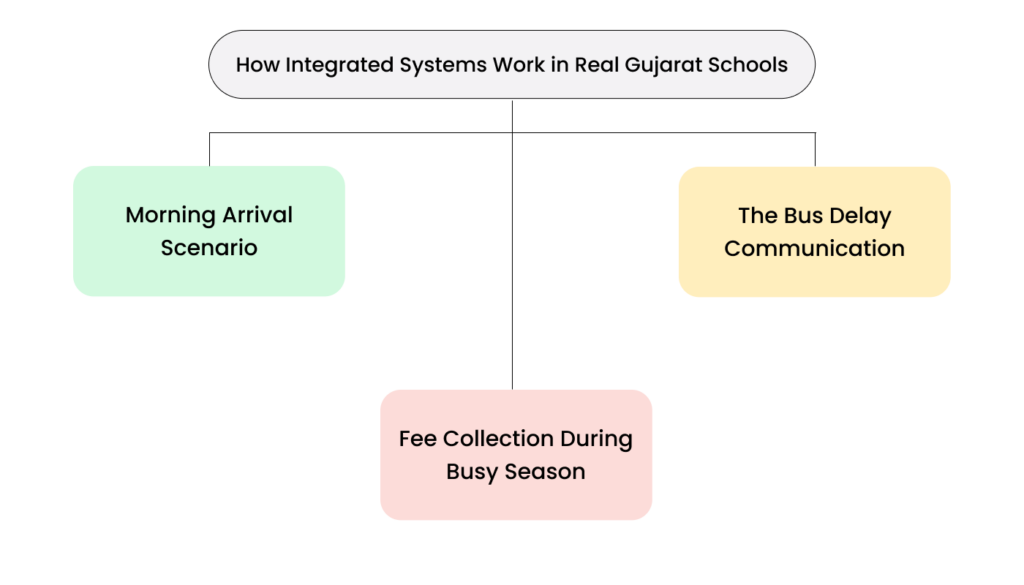
How Integrated Systems Work in Real Gujarat Schools
School Fees, Bus Tracking, Attendance - All in One Place? Here's How 76
Let me show you what this looks like in actual practice at schools across our state.
Morning Arrival Scenario
Old Way:
Bus driver manually updates arrival time on phone
Transport coordinator marks bus attendance on paper
Class teacher marks classroom attendance in register
Student scans ID card when boarding bus (bus attendance marked automatically)
Parents receive instant notification: “Riya boarded Bus #5 at 7:35 AM”
GPS shows bus location to concerned parents
Student arrives at school, enters through gate (school attendance marked automatically)
Parent receives: “Riya reached school at 8:10 AM”
Teacher sees complete attendance in real-time on tablet
Takes 5 minutes, zero phone calls
Fee Collection During Busy Season
Old Way:
Parents visit school to check fee balance
Wait in line at accounts office
Pay in cash, get handwritten receipt
Receipt gets filed in multiple registers
Parent calls next week asking for receipt copy because they lost it
Process repeats for partial payments, late fees, etc.
Integrated Way:
Parent checks fee status anytime on phone (exact amount due, due date, previous payment history)
Pays online from home or office
Instant digital receipt emailed and saved in system
Payment automatically updates in school accounts
Parent can download receipt anytime forever
Late fee calculations happen automatically based on your school’s rules
The Bus Delay Communication
Old Way:
Bus gets stuck in Rajkot traffic
Driver calls transport coordinator
Coordinator tries calling all parents on that route
Some parents don’t answer, miss the information
Parents waiting at stop get anxious, call school office
20+ phone calls, lots of stress
Integrated Way:
Bus gets delayed
System automatically sends notification to all parents on that route: “Bus #3 running 15 minutes late due to traffic on University Road. Current location: near Kalawad Road.”
Parents check app and see exact bus location on map
One notification reaches everyone instantly
Zero phone calls to school
The Parent Experience That Matters
School Fees, Bus Tracking, Attendance - All in One Place? Here's How 77
Let’s talk about what really matters – how this affects the families choosing your school.
The Working Parent Reality using Parent Communication App
Most Gujarat parents today are working professionals. They can’t keep calling schools during office hours for routine information. They need to check things quickly during chai break or lunch.
A parent at a Rajkot school told me: “Before, I had to step out of meetings to call the school and ask basic questions. Now I check my phone – two seconds, I have my answer. I can focus on work knowing I’ll get notifications if anything important happens.”
The Anxious Grandparent Comfort
Many Gujarat families have grandparents involved in children’s school routines. These elder family members often worry but don’t always feel comfortable calling schools repeatedly.
With integrated systems, grandparents can check the parent app anytime. They see that their grandchild reached school safely, view the bus location during return time, and feel reassured – all without needing to make phone calls they might feel shy about.
The Peace of Mind Factor
Parents don’t choose schools just based on academic reputation anymore. They choose schools that make them feel informed and connected to their child’s daily experience.
When you can honestly tell prospective parents during admission: “You’ll receive automatic updates when your child reaches school, you can check fees anytime without calling us, and you’ll see the bus location during pickup and drop” – that’s a powerful reason for families to choose your school over competitors.
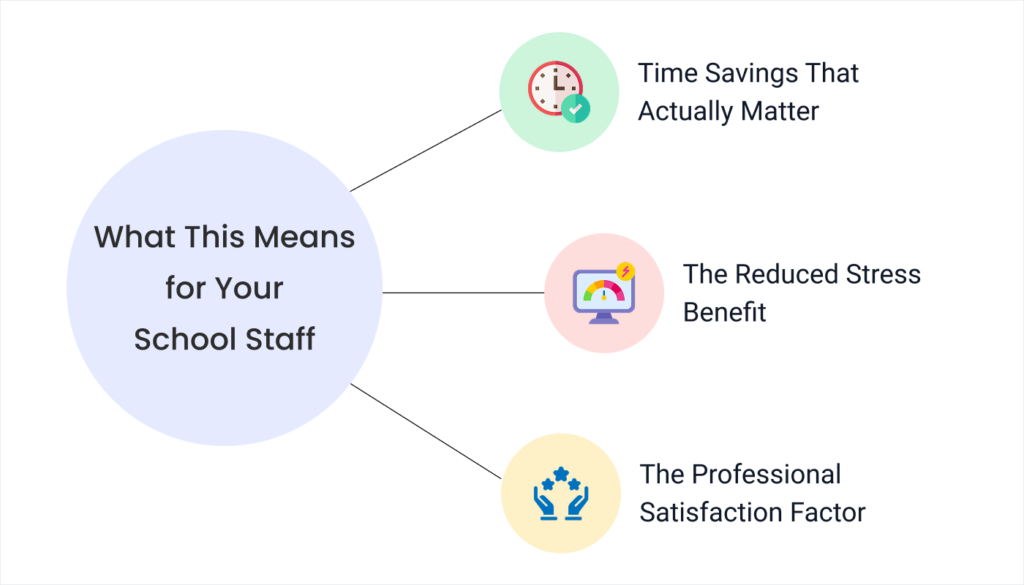
What This Means for Your School Staff – School Fees
School Fees, Bus Tracking, Attendance - All in One Place? Here's How 78
Let’s be real about the people who actually have to use these systems every day – your hardworking staff.
Time Savings That Actually Matter
Your office staff isn’t wasting time because they’re lazy – they’re wasting time because your current systems require manual coordination and repetitive work.
A school in Surat calculated that their three office staff members were spending:
12 hours weekly just answering routine parent queries about fees and attendance
8 hours weekly manually coordinating bus and attendance information
6 hours weekly preparing reports that should be automatically generated
That’s 26 hours of wasted productivity every single week – more than half of one full-time employee’s entire work week!
After implementing an integrated system, those same tasks took:
2 hours weekly (most parent queries answered by automated system)
The staff didn’t work less – they just worked on things that actually help students and parents instead of routine coordination.
The Reduced Stress Benefit
Talk to any school office staff in Gujarat about their most stressful times:
First week of every month (fee collection chaos)
Morning hours daily (parent calls about attendance and buses)
Exam periods (results, report cards, multiple queries)
Integrated systems don’t eliminate busy periods, but they make them manageable. Staff can actually go home on time during fee collection week. Morning phone calls drop by 70-80%. Report card preparation that used to take two full days now takes two hours.
Less stress means happier staff, which means better service to parents, which means better school reputation.
The Professional Satisfaction Factor
Your staff didn’t join school administration to spend all day answering the same questions repeatedly or manually copying information from one register to another.
They wanted to help students succeed and support families. Integrated systems give them time to do the work they actually care about.
Common Concerns Gujarat School Owners Have
School Fees, Bus Tracking, Attendance - All in One Place? Here's How 79
Whenever I discuss integrated systems with Rajkot principals, certain worries come up repeatedly. Let’s address them honestly.
“This Sounds Expensive”
Fair concern. Let’s look at real numbers.
Current Costs You’re Already Paying:
Extra staff time: ₹2-3 lakhs annually (overtime, inefficiency)
Parent dissatisfaction: Lost admissions worth ₹3-5 lakhs annually
Error corrections: ₹50,000-1 lakh annually
Missed fee collections: 5-10% of annual fees (poor tracking)
Integrated System Investment:
Software cost: ₹80,000-1.5 lakhs annually (depending on school size)
Training and setup: ₹30,000-50,000 (one-time)
Ongoing support: Usually included
Most Gujarat schools find that integrated systems pay for themselves within 8-12 months just through reduced staff overtime and improved fee collection.
“My Staff Won’t Learn New Technology”
I’ve heard this worry dozens of times. Here’s the reality: If your staff can use WhatsApp, they can use modern school systems.
Today’s school software is designed to be simpler than the multiple manual processes you’re currently using. Taking attendance on a tablet is actually easier than filling registers and then manually entering data into multiple places.
The key is proper training and patient implementation. Schools that succeed start with one area (usually attendance), let staff get comfortable, then gradually add other features.
“What If the Internet Goes Down?”
Valid concern for any digital system. Here’s how well-designed systems handle this:
Modern school systems have offline modes. If your internet connection drops:
Staff can still mark attendance on tablets (syncs when connection returns)
Critical operations continue without interruption
Data is stored locally and uploaded automatically when connectivity resumes
Most Gujarat cities now have reliable internet, and mobile data provides excellent backup. In three years of implementation across dozens of schools, internet issues caused serious problems less than 0.1% of operational time.
“Will This Work for Our Specific School?”
Every Gujarat school is unique. Different fee structures, different bus routes, different attendance policies.
That’s exactly why integrated systems work better than separate solutions. They’re designed to adapt to your school’s specific requirements, not force you to change successful processes.
Your fee structure with discounts, sibling offers, and payment plans? The system handles it.
Your specific bus routes through Rajkot neighborhoods? GPS tracking maps your exact routes.
Your attendance policies for late arrivals and early dismissals? Configured to match your rules.
Making the Move: Your Practical Next Steps
School Fees, Bus Tracking, Attendance - All in One Place? Here's How 80
If you’re convinced that integrated systems make sense for your school, here’s how to move forward intelligently.
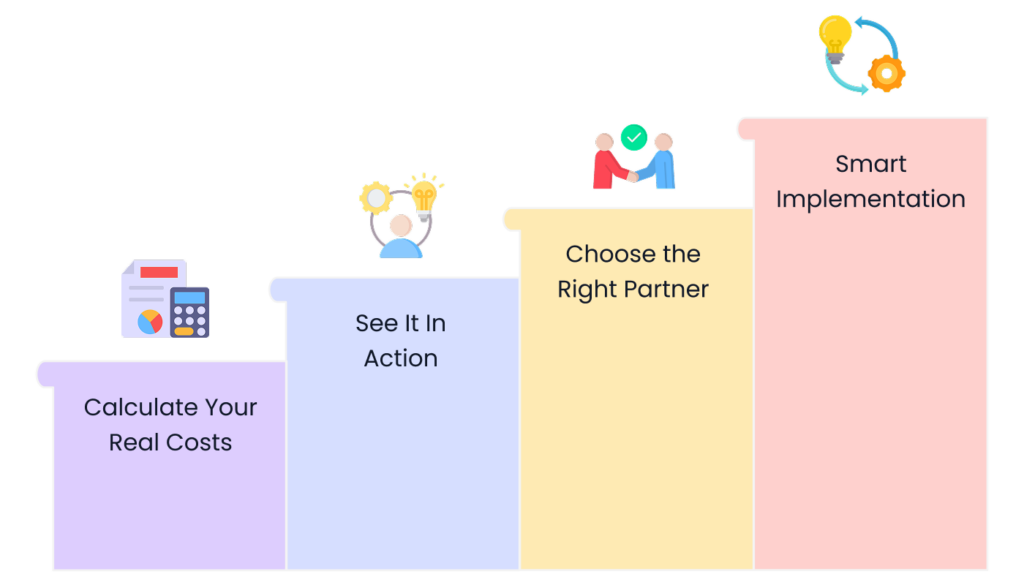
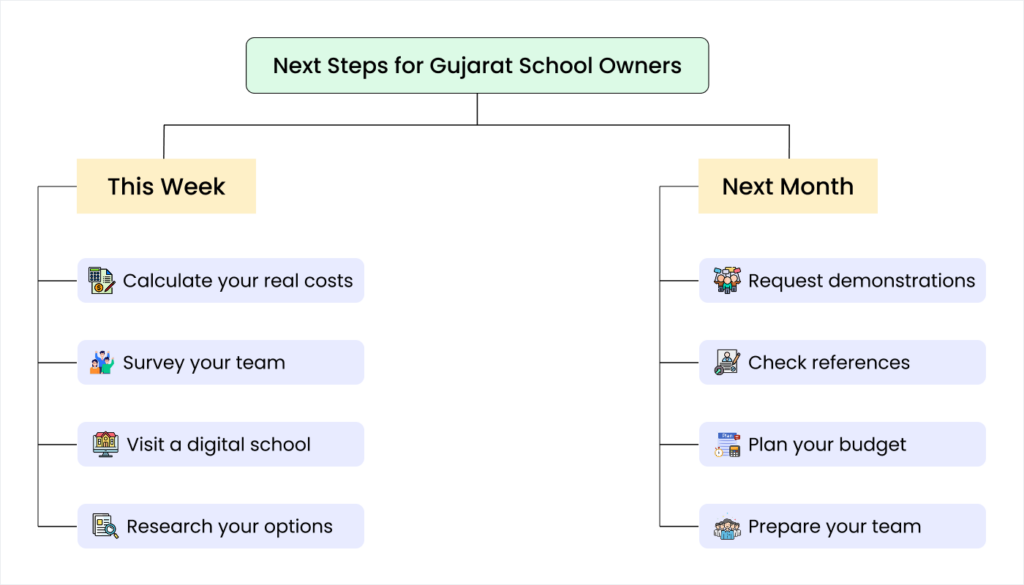
Step 1: Calculate Your Real Costs (This Week)
Spend one week tracking:
How many hours staff spends on routine fee, attendance, and bus queries
How many parent calls could be eliminated by instant information access
What your staff wishes took less time
You’ll be shocked by how much time your current separate systems actually waste.
Step 2: See It In Action (Next 2 Weeks)
Visit or call 2-3 Rajkot or Gujarat schools using integrated systems. Ask them:
What surprised you most after implementation?
How long did staff take to feel comfortable?
What would you do differently?
How do parents really respond?
Real school experiences matter more than any sales presentation.
Step 3: Choose the Right Partner (Week 3-4)
Not all school management systems are equal. Look for:
Must-Have Features for Gujarat Schools:
Works well on basic Android phones (for parent access)
Supports Gujarati and English
Local support team available
Understands Gujarat school fee structures
Can map Rajkot bus routes
Warning Signs to Avoid:
Vendors who can’t provide references from similar-sized Gujarat schools
Systems that require expensive hardware upgrades
Complicated interfaces that need extensive training
No local support presence
Step 4: Smart Implementation (Month 2-3)
Don’t try to implement everything simultaneously. Start with one area:
Attendance – Daily use builds staff confidence quickly
Fee management – Major time savings, improves cash flow
Master one area completely before adding others. Success breeds confidence and makes subsequent implementations easier.
The Competitive Reality You Can’t Ignore
School Fees, Bus Tracking, Attendance - All in One Place? Here's How 81
While you’re considering options, some Gujarat schools are already implementing integrated systems. Others are researching solutions. A few are still deciding.
What Parents Are Starting to Expect
Parents in Rajkot today are comparing schools during admission time. When they visit three schools:
School A: “You can call us anytime to check on your child.”
School B: “We send weekly SMS updates about attendance and fees.”
School C: “You’ll receive instant notifications when your child reaches school, you can see the bus location anytime, and check fee status 24/7 from your phone.”
Which school sounds most modern and parent-friendly?
The Word-of-Mouth Advantage
Parents talk to each other. When families at your school struggle to get basic information while their neighbor’s child’s school sends automatic updates, that comparison creates reputation challenges.
Progressive Gujarat schools using integrated systems report that “modern communication” becomes one of their biggest word-of-mouth advantages during admission season.
Your School’s Connected Future
School Fees, Bus Tracking, Attendance - All in One Place? Here's How 82
The question isn’t whether schools will eventually move to integrated systems – it’s whether your institution will lead this change or scramble to catch up when families start choosing competitors with better parent communication.
Every week you delay means another week of:
Unnecessary staff time wasted on coordination
Parent frustration with separate systems
Missed opportunities to impress prospective families
Your competition gaining ground
The Simple Truth
Managing school fees, bus tracking, and attendance doesn’t need to be complicated. It doesn’t require three different systems, five different people, and constant phone calls.
One integrated system. One parent app. One complete view of your school operations.
That’s not future technology – it’s what progressive Rajkot schools are already using today.
The only question remaining is: When will your school join them?
Ready to see how integrated school management could work specifically for your institution?
We’d love to show you exactly how fees, bus tracking, and attendance work together in one system designed specifically for Gujarat schools. See real demonstrations, get honest answers to your questions, and learn from schools that have already made this transition successfully.
Contact us today for a personalized consultation about bringing all-in-one school management to your institution.
Your school’s easier, more efficient future starts with one simple conversation.
Last month, I walked into a principal’s office in Rajkot. On her desk sat a brand new iPad that still had the plastic wrap on it. Behind her, a ₹4 lakh interactive whiteboard gathered dust. And on her computer screen? An expensive school management software dashboard showing zero logins for the past week.
“We spent ₹8 lakhs on all this last year,” she said quietly. “The sales guy made it look so impressive. But honestly? Nobody uses any of it. My teachers still prefer their paper registers.”
Her voice dropped to almost a whisper. “I can’t tell the school board I wasted their money.”
She’s not alone. After talking to dozens of Gujarat school principals, I’ve discovered a dirty secret about going paperless: Most schools are buying technology that looks great in presentations but fails miserably in daily use.
Here’s what nobody tells you about paperless schools – and what you actually need to know before spending another rupee on technology.
The Expensive Lie About Paperless Schools
The Smart Principal's Guide to Running a Paperless School in 2025: What Actually Helps vs. What's Just for Show 93
Walk into any education technology conference, and smart principal guide you will show you mind-blowing demos. Schools with fancy dashboards, teachers using tablets, students learning on interactive boards, parents getting notifications in seventeen different ways.
It all looks incredible. Until you try using it on Tuesday morning when half your staff calls in sick, the internet is slow because of rain, and you have 200 parents waiting for admission forms.
The Research Nobody Shares
A recent study found that schools waste 67% of the software licenses they purchase. That’s not a typo. Two-thirds of paid technology sits unused.
Some schools? They’re wasting 90% of what they buy.
Think about that. If your school spends ₹3 lakhs on software, you’re potentially throwing ₹2 lakhs directly into the trash.
The global waste on unused classroom technology? Over ₹26,000 crores annually.
Why does this happen? Because schools buy what impresses during demos, not what actually helps during real work.
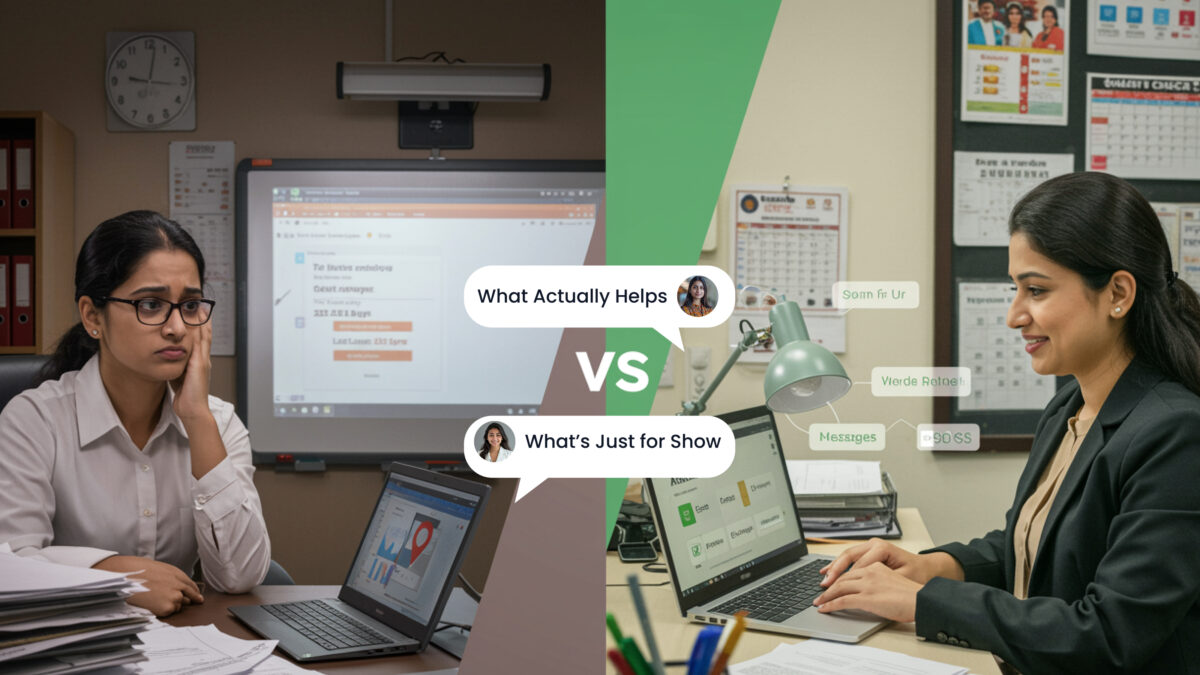
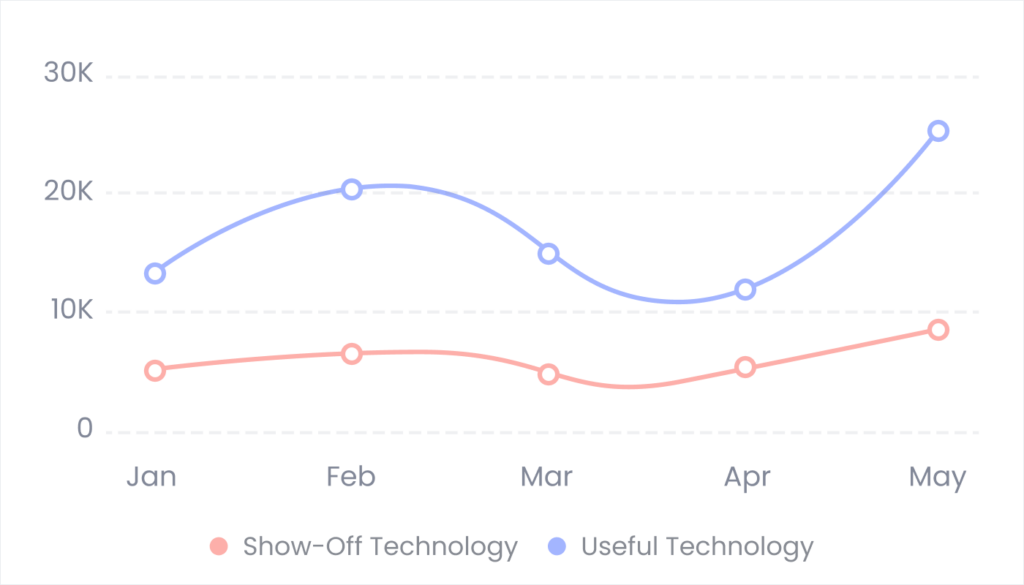
What Makes Technology “Show-Off” vs. “Useful”
The Smart Principal's Guide to Running a Paperless School in 2025: What Actually Helps vs. What's Just for Show 94
Here’s how to tell the difference between technology that actually helps and technology that just makes you look modern:
Show-Off Technology: Looks Great, Works Poorly
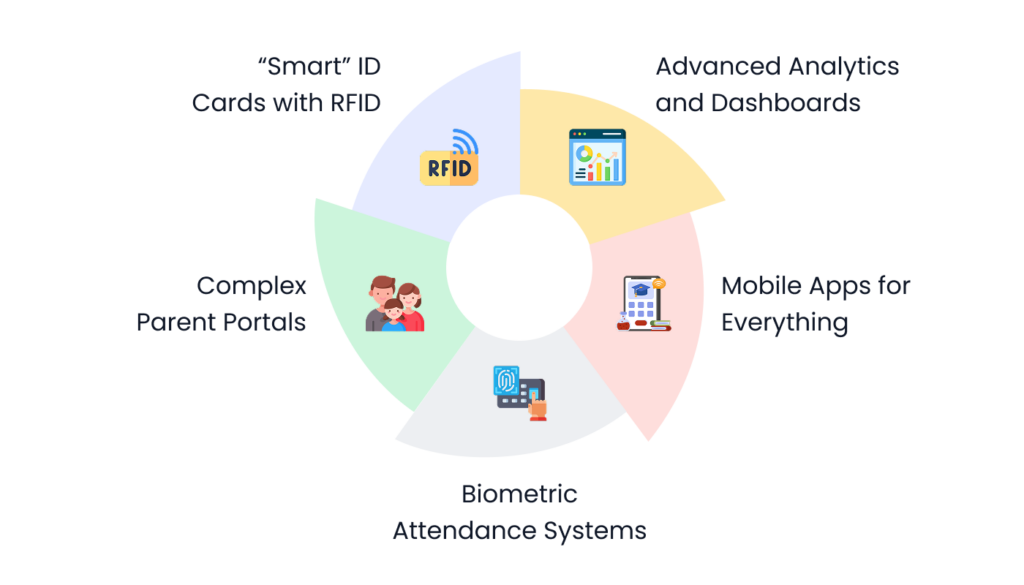
Feature overload: Software with 47 different modules and dashboards for everything imaginable. Sounds impressive until your 55-year-old office manager needs to find simple attendance records and has to navigate through seven screens.
Real example from Ahmedabad: A school bought software with modules for everything from cafeteria management to bus tracking to library systems to sports scheduling. After one year, they used exactly three modules – attendance, fees, and basic communication. The rest? Never opened.
Fancy hardware nobody requested: Interactive whiteboards that require special training, tablets for every student that teachers don’t know how to use, biometric systems that break during monsoon season.
A Surat school spent ₹6 lakhs on interactive whiteboards. After the initial excitement wore off, teachers went back to regular whiteboards because the “smart” ones took 10 minutes to start up every morning and crashed whenever internet slowed down.
“Revolutionary” new approaches: Software that forces you to completely change how your school operates. The vendor calls it “innovation.” Your staff calls it “unnecessary complication.”
Reality check: If the technology requires a complete overhaul of processes that were working fine, it’s probably not solving your actual problems.
Useful Technology: Simple, Practical, Actually Used
Solves one problem really well: Instead of doing 47 things poorly, it does 5 things excellently – the exact 5 things you need most.
Example: A Rajkot school chose simple software that only handled attendance and parent notifications. Within two weeks, it cut their morning administrative time by 45 minutes daily. Parents loved getting instant updates. Teachers found it easier than paper registers.
Requires minimal training: Your staff should be able to use it within a day or two, not after weeks of training courses.
The test: If your newest office staff member can’t figure out basic operations within 30 minutes, the software is too complicated.
Works with your current setup: Instead of requiring new computers, special internet connections, or complete process overhauls, it fits into how your school already operates.
Fails gracefully: When internet cuts out (because this is India), you can still access basic functions offline. When the system has problems, you can quickly switch to backup methods without chaos.
The Five Questions That Expose Show-Off Technology
The Smart Principal's Guide to Running a Paperless School in 2025: What Actually Helps vs. What's Just for Show 95
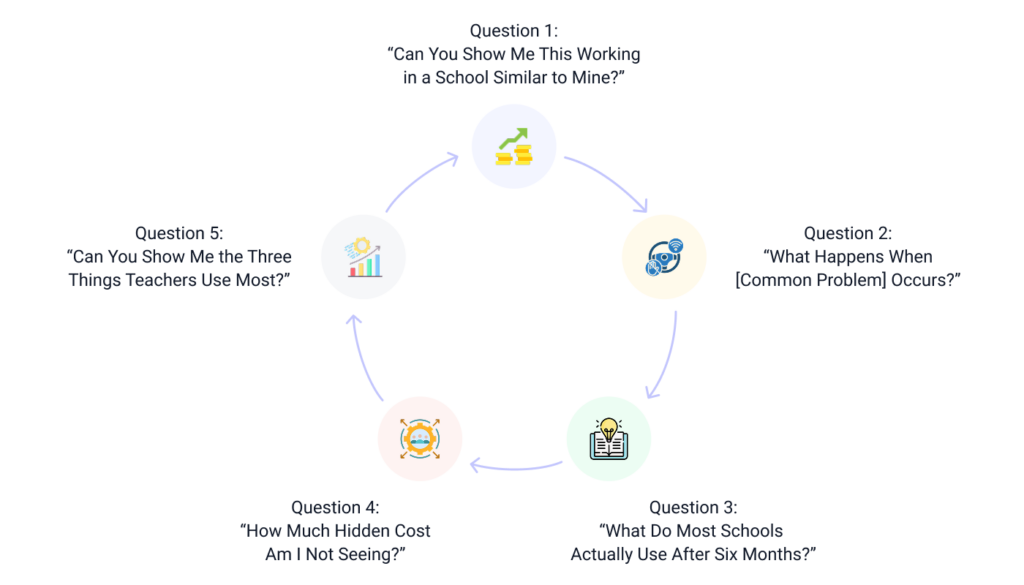
Before buying any paperless solution, ask these brutally honest questions. Digital school transformation’s vendors hate them, but they’ll save you lakhs.
Question 1: “Can You Show Me This Working in a School Similar to Mine?”
Not a demo. Not a presentation. An actual school in Gujarat that’s been using this daily for at least six months.
Red flags:
Vendor only shows demos, never real school visits
“Our best implementations are in international schools” (translation: this won’t work in typical Indian schools)
Reference schools are 3x larger or smaller than yours
Schools using it are in metro cities with perfect internet
Good signs:
They immediately offer contact details for 3-4 similar schools
Happy to arrange unannounced visits
Reference schools sound like your school’s situation
Question 2: “What Happens When [Common Problem] Occurs?”
Test with real problems Gujarat schools face:
“What happens when power goes out during fee collection?”
“What if internet cuts during attendance time?”
“What if my oldest staff member who barely uses email needs to use this?”
“What happens during monsoon when connectivity is terrible?”
Watch how vendors respond. Confident vendors have specific answers. Worried vendors change the subject or claim problems won’t happen (they will).
Question 3: “What Do Most Schools Actually Use After Six Months?”
This reveals the truth. The vendor might have sold 50 features, but real schools probably only use 5-7 regularly.
If their answer is “everything!” – they’re lying. Nobody uses every feature of any software.
Good vendors honestly tell you, “Most schools use these core features daily and occasionally use these advanced features.” That’s realistic.
Question 4: “How Much Hidden Cost Am I Not Seeing?”
The software might cost ₹1.5 lakhs annually, but what about:
Training costs
Hardware upgrades needed
Internet speed improvements required
Technical support costs
Data migration expenses
Customization charges
A school in Baroda learned this the hard way. ₹2 lakh software quote turned into ₹5 lakhs actual first-year cost after all hidden expenses appeared.
Question 5: “Can You Show Me the Three Things Teachers Use Most?”
If the vendor starts with complex dashboards and reports, warning bells should ring. Teachers need simple daily tools – attendance, homework tracking, basic communication.
Good software puts the most-used features front and center, not buried under menus.
The Practical Paperless Setup That Actually Works
After studying schools across Gujarat that successfully went paperless without wasting money, here’s what actually works:
Start With the Most Painful Problems Only
Don’t try to digitize everything. Pick your single biggest daily headache and solve only that first.
Common starting points that work:
Daily attendance + parent notifications – Usually saves 30-60 minutes daily, parents love it
Fee tracking and inquiries – Cuts phone calls by 70%, reduces errors significantly
Basic parent communication – Replaces WhatsApp madness with organized system
Master one area completely. Only then add the next feature.
A 400-student school in Rajkot went paperless over 18 months:
Month 1-3: Just attendance and parent SMS
Month 4-7: Added fee management after attendance became smooth
Month 8-12: Added homework tracking once staff was comfortable
Month 13-18: Added exam results and report cards
Result? Everything actually works because they didn’t rush.
Choose Software Your Least Tech-Savvy Staff Member Can Use
Seriously. Give the login to your oldest, least computer-comfortable staff member. If they can do basic tasks within 30 minutes, the software passes this test.
If they’re confused or frustrated, the software is too complicated. Period.
Demand Proper Training, Not Just Installation
Installation without training is like buying a car but never learning to drive it. You have an expensive thing you can’t use.
Minimum training requirements:
Full day hands-on training for all staff who’ll use it daily
Follow-up session after two weeks to address problems
Quick reference guides in Hindi/Gujarati
On-call support in local languages for first month
Schools that skip training end up abandoning expensive software within months.
Insist on Offline Capability
Internet in India isn’t reliable enough to depend on completely cloud-based systems. Your software must work offline for basic functions.
Essential offline capabilities:
Mark attendance even without internet (syncs later)
Access yesterday’s records and basic student information
Print receipts for fee payments
View today’s schedule and homework
Plan for Monsoon Season Reality
If the technology only works in perfect conditions, it won’t work in Gujarat schools.
Monsoon-proof checklist:
Paper backups for critical daily tasks
Works on basic phones, not just smartphones
Doesn’t require perfect internet speeds
Data backs up automatically even with slow connections
Real Cost of Going Paperless (The Honest Numbers)
The Smart Principal's Guide to Running a Paperless School in 2025: What Actually Helps vs. What's Just for Show 96
Vendors love showing low monthly costs. Let’s look at real annual expenses Gujarat schools actually face:
Year One (Highest Cost)
Small school example:
Software: ₹80,000
Training: ₹15,000
Minor hardware upgrades: ₹20,000
Data migration help: ₹10,000
Total: ₹1.25 lakhs
Medium school example:
Software: ₹1.8 lakhs
Training: ₹30,000
Hardware/internet upgrades: ₹40,000
Implementation support: ₹25,000
Total: ₹2.75 lakhs
Year Two Onwards (Recurring)
Costs drop significantly after first year:
Software renewal: 80% of first year cost
Minimal training (only new staff)
Minimal hardware costs
ROI Timeline: Most Gujarat schools see positive ROI within 12-15 months through:
Reduced overtime during busy periods
Fewer administrative errors
Better fee collection
Less paper/printing costs
Higher parent satisfaction (better retention)
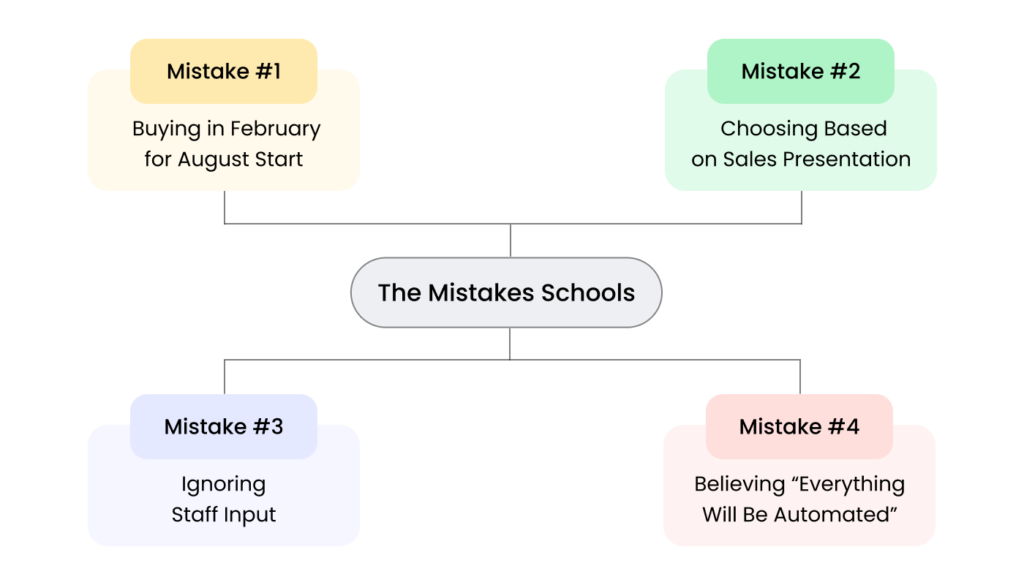
The Mistakes Schools Make (And How to Avoid Them)
The Smart Principal's Guide to Running a Paperless School in 2025: What Actually Helps vs. What's Just for Show 97
Mistake #1: Buying in February for August Start
Schools decide they want to go paperless, buy software in February, then forget about it until new academic year starts.
Result? Panic implementation, no proper training, staff resistance, failure.
Better approach: Buy in March-April, train thoroughly in May-June, test run in July with last year’s students, confident launch in August.
Mistake #2: Choosing Based on Sales Presentation
Vendors are professional presenters. Everything looks amazing in their slides.
Reality check: Software that needs 45-minute presentation to explain basics is probably too complicated.
Better approach: Insist on trial period with your actual school data. If vendor resists, that’s a red flag.
Mistake #3: Ignoring Staff Input
Principal decides, buys, announces. Teachers hate it, sabotage through passive resistance.
Example: Rajkot school bought tablet-based attendance system. Teachers claimed tablets “didn’t work reliably” and continued paper registers. After six months, expensive tablets sat unused.
Real issue? Teachers were never asked, never trained properly, never understood benefits.
Better approach: Include teachers in decision. Get their buy-in before buying. Train thoroughly. Listen to their concerns.
Mistake #4: Believing “Everything Will Be Automated”
Vendors promise complete automation. Reality is much messier.
You’ll still need:
Staff to manage system
Someone monitoring for errors
Backup procedures for failures
Training for new staff
Updates and troubleshooting
Better approach: Plan for 60-70% automation of routine tasks, not 100%. That’s realistic.
Technology You Probably Don’t Need (Despite What Vendors Say)
The Smart Principal's Guide to Running a Paperless School in 2025: What Actually Helps vs. What's Just for Show 98
Let’s be honest about features that sound impressive but rarely get used:
Advanced Analytics and Dashboards
Unless you’re a 1000+ student school with dedicated data analyst, you probably won’t use complex analytics.
Basic reports? Yes, those are useful. But predictive analytics, complex graphs, trend projections? Most schools never look at them after initial excitement.
Mobile Apps for Everything
Separate apps for teachers, students, parents, management – sounds modern. Reality? More apps mean more confusion and lower adoption.
Better: One simple parent app, one simple teacher portal (works in browser), no separate apps needed.
Biometric Attendance Systems
Sounds high-tech. Problems? Fingerprint readers fail during monsoon. Students with rough hands from playing don’t register. Systems break frequently.
Better: Simple card-based or app-based attendance. Easier, more reliable, cheaper.
Complex Parent Portals
Portals with 15 different sections showing everything from cafeteria balance to library books borrowed to detailed academic progress with color-coded graphs.
Reality? Parents want four things:
Is my child present today?
What’s the homework?
When are exams?
What are the fee dues?
Give them simple access to these four. Skip the rest.
“Smart” ID Cards with RFID
Every student gets ID card that automatically records attendance, library visits, cafeteria purchases, bus boarding.
Sounds amazing. Reality? Cards get lost, damaged, forgotten. Readers break. System becomes more trouble than it’s worth for smaller schools.
Makes sense for 1000+ student schools. Waste of money for smaller institutions.
The Questions Parents Actually Ask (Focus Here)
The Smart Principal's Guide to Running a Paperless School in 2025: What Actually Helps vs. What's Just for Show 99
After analyzing thousands of parent queries Gujarat schools receive, 80% fall into five categories. Your paperless system should handle these effortlessly:
1. “Is my child in school today?”
Parents want instant confirmation that child reached school safely.
Simple solution: Automatic SMS when attendance marked. Parents get message by 10 AM daily.
2. “What homework do they have?”
Parents helping with homework need to know assignments.
Simple solution: Homework posted daily, accessible via SMS query or simple app.
3. “When is the next exam/PTM/event?”
Parents planning their schedules need advance notice.
Simple solution: Calendar shared via SMS/app with automatic reminders 3 days and 1 day before.
4. “What are my fee dues?”
Most frequent office phone call.
Simple solution: Balance checking via SMS or app, automatic reminders for upcoming due dates.
5. “Can I speak to my child’s teacher?”
Parents wanting updates on specific concerns.
Simple solution: Teacher contact option with 24-hour response commitment.
Technology that handles these five things well is infinitely more useful than complex systems trying to do fifty things poorly.
The Real Benefit
The best thing about going paperless isn’t the technology itself. It’s freeing your teachers and staff from mindless administrative tasks so they can focus on actually educating students.
When your teachers spend 30 minutes less daily on attendance paperwork, they have 30 more minutes for lesson planning, student help, or simply being less stressed.
That’s the real win.
Your Action Plan (What to Do This Week)
The Smart Principal's Guide to Running a Paperless School in 2025: What Actually Helps vs. What's Just for Show 100
Ready to go paperless the right way? Start here:
Monday-Tuesday: Identify Your Pain Points
Ask your staff:
What daily task takes longest that shouldn’t?
What do parents ask about most that we should have instant answers for?
What manual processes cause most mistakes?
Write down top 3 pain points. Those are your priorities.
Wednesday-Thursday: Research Solutions
Look for software that solves your specific pain points, not software with most features.
Talk to 3-4 schools similar to yours that went paperless. Ask:
What do you actually use daily?
What features sounded great but you never use?
What would you choose differently if starting over?
Friday: Set Realistic Budget
Calculate:
How much time does current manual process waste? (hours × salary rate)
What’s realistic technology budget for your school size?
Can you afford to waste money on wrong choice?
Next Week: Start Small
Choose ONE area to digitize. Just one.
Get it working perfectly before adding more.
The Bottom Line
The Smart Principal's Guide to Running a Paperless School in 2025: What Actually Helps vs. What's Just for Show 101
Going paperless can genuinely help your school. But only if you choose technology that actually solves real problems instead of technology that just looks impressive.
The smart principal’s approach:
Start with your biggest daily pain point
Choose simple solutions your least tech-savvy staff can use
Train properly, don’t just install
Test thoroughly before full launch
Add features gradually, not all at once
Skip the show-off technology. Invest in useful tools. Your staff, students, and parents will thank you.
And your school board will thank you when the technology actually gets used instead of gathering dust like that iPad on the principal’s desk.
Ready to go paperless the smart way?
We help Gujarat schools choose practical technology that actually works in real Indian school conditions – not just impressive demos. From assessment to implementation to training, we focus on solutions your staff will actually use.
Contact us for honest consultation about paperless options that fit your school’s specific needs and budget. No sales pressure, just straight answers about what will and won’t work for schools like yours.
Last week, a school principal in Rajkot called me, sounding frustrated.
“Three parents asked me why we don’t have a school app like Sunshine Academy,” she said. “They showed me all these fancy features – live bus tracking, AI homework help, virtual tours of the school. Now I feel like we’re falling behind. School app worth it Rajkot — that’s what I keep thinking these days.”
I asked her a simple question: “Does Sunshine Academy actually use all those features, or do they just have them to look impressive?”
She paused. “I… I don’t know. I just saw the demo.”
Here’s the uncomfortable truth about school apps: About 70% of fancy features in most school apps sit unused after the first month. Schools pay for impressive-looking technology that parents download once, explore for ten minutes, and then never open again.
But here’s the other truth: Some features genuinely make life better for everyone – parents actually use them daily, teachers save real time, and the school runs noticeably smoother.
The difference between these two scenarios? Knowing which features solve real problems versus which ones just look good in sales presentations.
If you’re feeling pressure to get a school app because “everyone else has one,” this guide will help you make a smart decision instead of an expensive mistake.
Why School Apps Became the New Status Symbol
Other Schools Have Apps – But Are They Really Worth the Money? 112
Five years ago, having a website made your school look modern. Today, it’s all about the app.
The app arms race started innocently enough. A few forward-thinking schools created apps with genuinely useful features. Parents loved the convenience. Word spread.
Then everyone else panicked and rushed to get apps too – often without thinking through whether they actually needed one.
The Pressure Points Every Principal Feels
The competition has one, so we need one too : This is how most schools end up with apps. Not because they identified a problem the app would solve, but because they felt left behind.
Parents expect modern technology : True. But parents expect useful technology, not just any technology. They’d rather have a simple system that works than a complicated app that frustrates them.
It makes us look professional and advanced : Also true. But only if the app actually works well. A buggy, confusing app makes you look less professional, not more.
What Actually Happened at Those “Other Schools”
I talked to administrators at five Rajkot schools that launched apps in the last two years. Here’s what they shared privately:
School A (Fancy app with 20+ features):
“We paid ₹3.5 lakhs for the first year. Parents use exactly three features: attendance notifications, fee balance checking, and the school calendar. Everything else? Nobody even knows it exists.”
School B (Mid-range app):
“The app has a homework submission feature that teachers love showing off. Reality? Only 2 out of 12 teachers actually use it. The rest still collect homework on paper.”
School C (Budget app):
“We got the cheapest app we could find. It crashes so often that parents went back to calling the office. We’re actually getting more phone calls now because people can’t trust the app information.”
School D (Successful implementation):
“We only chose features we knew we’d use daily. Parents love it because it’s simple and reliable. Worth every rupee.”
School E (Abandoned after 8 months):
“The vendor promised everything would be easy. Nobody told us we’d need to update content daily, train parents extensively, and have someone answer technical questions constantly. We gave up.”
The pattern? Schools that chose features carefully did well. Schools that bought impressive-looking packages mostly wasted money.
The Real Question: What Problems Are You Actually Solving?
Other Schools Have Apps – But Are They Really Worth the Money? 113
Before looking at any app, spend one week documenting actual problems at your school. In that scenario, write down every instance of where you wondered if a school app worth it Rajkot could really solve the issue.
Communication breakdowns
Parents calling to ask things they should already know
Important announcements that some families miss
Confusion about exam dates, holidays, or schedule changes
Time wasted on routine questions
“Did my child reach school today?”
“What’s our fee balance?”
“When is the next parent meeting?”
“What was today’s homework?”
Administrative inefficiencies
Attendance taking too long
Fee collection record-keeping
Report card distribution logistics
Permission slip collection
Information that’s hard to find
Old circulars and announcements
School calendar and event schedules
Teacher contact information
Document requirements for various processes
Now here’s the critical part: If your list is short or the problems are minor, you probably don’t need an app.
Seriously. A reliable WhatsApp broadcast list and organized SMS system might solve 80% of your issues for one-tenth the cost of an app.
Features That Actually Get Used vs. Features That Sound Cool
Other Schools Have Apps – But Are They Really Worth the Money? 114
Let me break down school app features by how often parents really use them, based on data from actual Gujarat schools.
High Usage Features (Parents Use Multiple Times Weekly)
Daily attendance notifications
Reality check: Parents love knowing their child reached school safely. This single feature generates more daily usage than everything else combined.
Usage rate: 85-95% of parents check this
Worth the cost: Absolutely yes
SMS alternative: Works just as well for most schools
Fee balance checking
Reality check: Parents want to know what they owe without calling the office. Simple, clear, always useful.
Usage rate: 70-85% of parents use monthly
Worth the cost: Yes, saves massive office time
Manual alternative: Requires constant phone calls and record checking
School calendar/holiday list
Reality check: Parents refer to this constantly. “When is the next holiday?” is one of the most common questions.
Usage rate: 60-75% monthly usage
Worth the cost: Yes if updated properly
Paper alternative: Gets lost or outdated quickly
Medium Usage Features (Parents Use Occasionally)
Homework assignments
Reality check: Sounds great in theory. In practice, keeping this updated daily is exhausting for teachers.
Usage rate: 40-60% if teachers maintain it consistently
Worth the cost: Only if teachers will actually use it
WhatsApp alternative: Teachers already send homework in class groups
Exam results and report cards
Reality check: Parents definitely want this, but it’s only useful a few times per year.
Usage rate: 90%+ during report card season, then zero
Worth the cost: Maybe – depends on total app cost
Paper alternative: Still works fine for most schools
Photo and video galleries
Reality check: Parents love seeing pictures of school events. But maintaining a photo gallery requires constant work.
Usage rate: 30-50% depending on how often content is added
Worth the cost: No – social media does this better and reaches more people
Alternative: School Instagram or Facebook page
Low Usage Features (Parents Rarely Touch)
Live GPS bus tracking
Reality check: Sounds amazing in demos. Requires expensive hardware, constant maintenance, and reliable internet on moving buses.
Usage rate: 15-30% after initial excitement wears off
Worth the cost: Usually no – parents adapt to regular bus schedules
Alternative: SMS when bus is running late
Virtual classroom/video lessons library
Reality check: Building quality educational content is a full-time job. Most schools can’t maintain this.
Usage rate: Under 20% in most schools
Worth the cost: No unless you have dedicated staff creating content
Alternative: Recommend good external educational apps/websites
In-app communication/chat features
Reality check: Parents already have WhatsApp. They don’t want another messaging app.
Usage rate: Under 15% – parents ignore app messages
Worth the cost: No – causes more confusion than help
Alternative: Organized WhatsApp groups work better
School shop/uniform ordering
Reality check: Most parents prefer buying uniforms in person to check size and quality.
Usage rate: Under 10% in most Gujarat schools
Worth the cost: No – adds complexity without solving real problems
Alternative: In-person shopping during admission
The Money Talk: What School Apps Actually Cost — school app worth it Rajkot question every principal is asking
Other Schools Have Apps – But Are They Really Worth the Money? 115
Sales presentations show monthly subscription costs. Reality includes many hidden expenses that catch schools by surprise.
Visible Costs (What They Tell You About)
Small schools (under 300 students): App subscription: ₹30,000 – ₹80,000 annually Features included: Basic attendance, announcements, calendar
Medium schools (300-700 students): App subscription: ₹80,000 – ₹2 lakhs annually Features included: Attendance, fees, homework, galleries
Large schools (700+ students): App subscription: ₹2 – ₹5 lakhs annually Features included: Everything + custom features + priority support
Hidden Costs (What They Don’t Mention Upfront)
Initial setup and data migration ₹15,000 – ₹50,000 one-time Somebody has to enter all your existing student data, which takes significant time.
Staff training ₹10,000 – ₹30,000 Teachers and office staff need to learn how to update the app and troubleshoot basic issues.
Parent education and support Time cost, not money Expect to spend weeks helping parents download, install, and learn to use the app. Many will need individual help.
Content maintenance Ongoing staff time Someone needs to update announcements, upload photos, post homework, and respond to app-based queries. This becomes a part-time job.
Technical support ₹20,000 – ₹60,000 annually Good vendors include this. Cheap vendors charge extra every time something breaks.
Hardware upgrades ₹30,000 – ₹1 lakh Your existing computers might struggle with the app’s admin panel. Internet connection might need upgrading.
The Real Total Cost
For most Gujarat schools, the true first-year cost of a school app is:
Small school: ₹75,000 – ₹1.5 lakhs
Medium school: ₹1.5 – ₹3 lakhs
Large school: ₹3 – ₹7 lakhs
Now ask yourself: Is solving your school’s communication problems worth this investment, or could simpler solutions work just as well?
Decision Framework: Do You Actually Need an App?
Other Schools Have Apps – But Are They Really Worth the Money? 116
Use this honest evaluation to decide whether an app makes sense for your school.
Score Your School (Be Brutally Honest)
Question 1: How many parents regularly complain about missing important information?
Constantly (daily) = 5 points
Often (weekly) = 3 points
Occasionally (monthly) = 1 point
Rarely = 0 points
Question 2: How many hours weekly does your office staff spend answering routine questions (attendance, fees, schedule)?
Over 20 hours = 5 points
10-20 hours = 3 points
5-10 hours = 1 point
Under 5 hours = 0 points
Question 3: How tech-comfortable is your parent community?
Most parents use multiple apps daily = 5 points
About half are comfortable with apps = 3 points
Few parents use apps beyond WhatsApp = 1 point
Many parents struggle with smartphones = 0 points
Question 4: Do you have staff who can maintain digital content daily?
Yes, we have dedicated staff = 5 points
We can assign this responsibility = 3 points
This would be extra burden on existing staff = 1 point
No staff capacity for this = 0 points
Your Total Score: What It Means
20-25 points: An app could genuinely help your school You have real communication problems, capable staff, suitable parents, and appropriate budget. Research options carefully and choose features that match actual needs.
12-19 points: Consider simpler alternatives first You have some problems worth solving, but a full app might be overkill. Try SMS systems and website improvements before committing to app investment.
6-11 points: Probably not worth it yet Your communication issues might not justify app costs. Focus on optimizing existing methods (phone, SMS, WhatsApp) before adding complexity.
0-5 points: Definitely don’t need an app Save your money. Your current systems probably work fine, or simpler upgrades would serve you better.
Real Scenarios: When Apps Help and When They Don’t
Other Schools Have Apps – But Are They Really Worth the Money? 117
Let me share actual situations from Gujarat schools to show you when apps make sense versus when they’re wasteful.
Success Story: Mid-Size School in Rajkot
The situation: 550 students, 40+ teachers, parents constantly calling office asking about attendance and fees.
What they did: Chose app with only three features: automated attendance alerts, fee balance checking, and school calendar. Nothing fancy.
Implementation cost: ₹1.2 lakhs first year
Results after one year:
Phone calls to office dropped 65%
Office staff could focus on helping students instead of answering routine questions
Parents rated school communication 8.5/10 (up from 6/10)
Teacher satisfaction improved because families were better informed
Why it worked:
They identified specific problems and chose features that directly solved those problems. No extras, no showing off.
Expensive Mistake: Small School in Surat
The situation: 180 students, principal felt pressure because nearby school launched fancy app with 15+ features.
What they did: Bought comprehensive app package with live bus tracking, virtual classrooms, AI homework help, photo galleries, online shop.
Implementation cost: ₹2.8 lakhs first year
What actually happened:
Only 30% of parents ever downloaded the app
Teachers refused to use virtual classroom feature (too complicated)
GPS tracking equipment never got installed properly
Photo galleries stayed empty because no staff had time to maintain them
Parents continued calling with questions because app was too confusing
By month 8: School stopped renewing subscription. Lost ₹2.8 lakhs with nothing to show for it.
Why it failed: Bought impressive features instead of useful ones. No clear problem being solved. Staff overwhelmed by complexity.
Middle Ground: Large School in Ahmedabad
The situation: 900 students, established institution wanting to modernize gradually without disrupting operations.
What they did:
Phase 1 (Year 1): SMS attendance system only (₹25,000)
Phase 3 (Year 3): Launched simple app combining these features plus calendar (₹80,000 annually)
Total 3-year investment: ₹2.45 lakhs
Results:
Gradual adoption meant parents and staff weren’t overwhelmed
Could test what people actually used before committing to full app
By Year 3, everyone was comfortable with digital systems
Final app had high usage because it built on proven features
Why it worked: Patient, phased approach. Tested what worked before major investment. Built confidence gradually.
The Gujarat Context: What Works Here
Other Schools Have Apps – But Are They Really Worth the Money? 118
Gujarat schools have specific characteristics that affect app success. Understanding these helps you make better decisions.
Smartphone Penetration Reality
Urban Rajkot/Ahmedabad: 85-90% of parents have smartphones
Semi-urban areas: 70-80% have smartphones
Rural areas: 50-60% have smartphones
What this means: Even in urban areas, 10-15% of families won’t use your app. You still need backup communication methods (SMS, phone calls) for everyone.
Language Preferences Matter.
Many Gujarat parents prefer Gujarati communication. Apps that only work well in English will have lower adoption.
Questions to ask vendors:
Does the app support Gujarati language?
Can notifications go out in both English and Gujarati?
Is the interface intuitive enough that language barriers don’t matter?
Internet Connectivity Considerations
During monsoon season, internet connectivity can be unreliable in parts of Gujarat. Your app needs to work when connectivity is spotty.
Essential features:
App should work offline and sync when connection returns
SMS backup for critical notifications (attendance, emergencies)
Simple enough to load quickly on slow connections
Cultural Communication Patterns
Gujarat parents value personal interaction and community connections. Apps that feel too impersonal or corporate will struggle here.
What works better:
Warm, friendly language in notifications
Combination of app convenience with occasional personal touches
Technology that supports relationships rather than replacing them
Making Your Decision: A Practical Action Plan
Other Schools Have Apps – But Are They Really Worth the Money? 119
If you’re still reading, you’re serious about making a smart choice. Here’s exactly what to do next.
Week 1: Internal Assessment
Monday-Tuesday: Document current communication problems Write down every parent inquiry, every administrative burden, every information gap for two full days.
Wednesday-Thursday: Staff feedback Ask teachers and office staff: “What takes unnecessary time in our daily routine? What do parents ask about most? What frustrates you about current systems?”
Friday: Analysis Look at your documentation. Do you see patterns? Are the problems significant enough to justify investment?
Week 2: Research and Reality Checks
Monday-Tuesday: Talk to schools using apps Call 3-4 schools similar to yours. Ask about reality, not promotional claims. What works? What doesn’t? What do they wish they knew before starting?
Wednesday-Thursday: Explore alternatives Research simpler solutions that might solve your specific problems without full app investment.
Friday: Budget assessment Can you realistically afford ₹1-3 lakhs for this? What would you need to sacrifice or delay? Is it worth it?
Week 3: Vendor Evaluation (If Moving Forward)
Monday: Request demonstrations from 2-3 vendors Insist on seeing actual school implementations, not polished demos with fake data.
Tuesday-Wednesday: Ask hard questions Use the questions from the “Questions to Ask Vendors” section above. Note which vendors give honest answers versus vague promises.
Thursday: Check references Talk to schools that have used each vendor for at least one year. Ask about surprises, challenges, and whether they’d choose the same vendor again.
Friday: Decision point Based on everything you’ve learned, decide whether to proceed, choose a simpler alternative, or wait until your needs become clearer.
Week 4: Planning (If Proceeding)
Create implementation timeline: When will you launch? How will you prepare staff? How will you educate parents?
Set success metrics: How will you know if the app was worth it? Define specific, measurable goals.
Plan for challenges: What’s your backup if technical problems occur? How will you support parents who struggle with the app?
The Question You Should Really Be Asking It’s not “Should we get a school app?”
It’s “What communication problems are causing real pain for our parents, teachers, and staff – and what’s the simplest, most reliable way to solve them?”
Sometimes the answer is a carefully chosen app with limited features.
Sometimes the answer is a good SMS system and organized WhatsApp groups.
Sometimes the answer is improving your existing communication methods before adding new technology.
What Success Actually Looks Like
You’ll know your technology choices were right when:
Parents say: “I always know what’s happening at school” (not “Your app has so many cool features”)
Teachers say: “I have more time to focus on students” (not “I’m learning this complex new system”)
Your office staff says: “We get fewer routine questions” (not “We’re constantly troubleshooting technical problems”)
You say: “This was worth the investment” (not “Everyone else has one, so we had to get one too”)
Your Next Move
Other Schools Have Apps – But Are They Really Worth the Money? 120
If after reading this guide, you’re still convinced your school needs an app – great. You’re making an informed decision based on real needs, not competitive pressure.
If you’re now thinking “Maybe we don’t need an app after all” – even better. You just saved yourself from a potentially expensive mistake.
If you’re somewhere in between – that’s the smartest position. You’re thinking carefully about what actually serves your school community versus what just looks impressive.
Whatever you decide, make sure it’s your decision based on your school’s actual needs, not someone else’s sales pitch or another school’s choices.
The goal isn’t to have the most impressive technology. The goal is to communicate effectively with families, run your school efficiently, and give teachers more time to focus on education.
Sometimes fancy apps help with that. Sometimes simpler solutions work better.
Only you can decide which is right for your school.
Need help sorting through app options or evaluating whether your school really needs one? We specialize in helping Gujarat schools make smart technology decisions based on their specific situations – not generic sales pitches.
Contact us for an honest consultation where we’ll help you figure out what actually makes sense for your school, your budget, and your community. No pressure to buy anything, just practical advice from people who understand Rajkot schools.
Last month, Mrs. Mehta walked into my office with her resignation letter.
She’d been teaching at our school for four years. Students loved her. Parents requested her class specifically. Her English lessons were so good that our Grade 5 results improved 40% since she joined.
“As she whispered, “I got selected for the government teacher position,” “I just… I can’t keep spending 3 hours every evening filling registers and preparing reports why your best teachers leave for government jobs.”
Not the salary. Not the pension.
The paperwork.
I looked at her desk after she left. Seven different attendance registers. Three gradebooks. Stacks of handwritten report cards. Homework tracking sheets for four sections.
Mrs. Mehta wasn’t leaving because she didn’t love teaching. She was leaving because manual school administration was drowning her in work that a school ERP system could handle automatically.
Here’s what I discovered: Most private school teachers in Gujarat don’t leave for government jobs because of money. They leave because government schools use digital school management software while we’re still filling registers by hand.
The Real Reason Your Teachers Study for Government Exams
My Best Teachers Keep Leaving for Government Jobs—Here's What Finally Worked 133
I spent two months talking to teachers across Rajkot who left private schools for government positions. What they told me changed everything.
It’s Not the Salary – It’s the Manual Work
When I asked teachers “What made you take the government job?”, salary was rarely the first answer.
What they actually said:
“Government school gave me a tablet with their school ERP. Attendance takes 2 minutes now instead of 20 minutes per class with paper registers.”
“I finish work at 4 PM now. No taking papers home, no weekend grading. The school management software handles everything automatically.”
“Private school had me filling 4 different attendance registers daily. Government school – tap, done, parents get SMS automatically.”
“I teach now. I don’t spend hours on paperwork. That’s what school automation software is for.”
The pattern is clear: It’s about escaping manual administrative work, not just chasing higher salaries.
Government Schools Have Better School ERP Than Most Private Schools
Here’s the uncomfortable truth: Government schools in Gujarat are ahead of most private schools in digital school administration.
Government teachers now use:
✅ School ERP for attendance – digital marking with automatic parent SMS ✅ Automated grade calculation – no manual gradebook work ✅ Online report generation – minutes instead of days ✅ Cloud-based school management – access from anywhere ✅ Centralized student database – one system for everything
A government teacher in Rajkot told me: “I spend 90% of my time teaching. In private school, I spent 50% teaching and 50% on paperwork. The school management software here changed everything.”
The truth: Private schools in Gujarat lose teachers because we use 1990s manual systems while government schools adopted modern school ERP technology.
How Much Time Are Your Teachers Wasting on Manual Work?
My Best Teachers Keep Leaving for Government Jobs—Here's What Finally Worked 134
Before implementing school automation software, I did a time audit with teachers at three Rajkot schools. The results shocked me.
Daily Time Wasted Without School ERP
Morning Routine (Manual System):
Taking attendance in physical registers: 5-7 min × 6 classes = 40 minutes
Reality check: Teachers without school automation spend 15-20 hours weekly on manual tasks that school ERP handles automatically.
What This Looks Like in Real Life
Teacher Priya’s typical Tuesday at a school without school management software:
6:30 AM – Arrives early to prepare registers 7:45 AM – Manually marks attendance in register 8:00 AM – Copies attendance to master register 8:30 AM – Parent calls asking if child reached school – must check register 10:15 AM – Break spent updating gradebook instead of resting 2:45 PM – Stays until 5 PM preparing handwritten report cards 6:30 PM – Home, spends another hour updating homework sheets
Total teaching time: 4.5 hours Total manual admin time: 4.5 hours
Priya spends as much time on paperwork as teaching. No wonder she’s preparing for government exams.
The Rajkot Schools That Stopped Losing Teachers – Why Your Best Teachers Leave for Government Jobs
My Best Teachers Keep Leaving for Government Jobs—Here's What Finally Worked 135
I found several private schools in Rajkot and Gujarat that completely solved teacher retention – without raising salaries.
What changed? They implemented customized school ERP systems.
Case Study: 500-Student School in Rajkot
Before School ERP Implementation:
Lost 4 teachers in one year to government jobs
Teachers worked 10-12 hour days with paperwork
Teacher satisfaction: 5.2/10
Constant workload complaints
After Implementing Cloud-Based School Management System:
Teachers lost to government: Zero (even after passing exams)
Teacher satisfaction: 8.7/10
Student results: +23% improvement
What the School ERP Automated:
✅ Digital Attendance – 90 seconds on tablet, automatic parent SMS ✅ Automated Grading – enter marks once, system calculates everything ✅ Auto Report Cards – generated from system data in minutes ✅ Parent Communication – automated notifications for attendance, homework, events ✅ Student Records – centralized digital database, instant access
Principal’s quote:“We didn’t raise salaries ₹1. We just gave teachers their time back with school automation software. Three teachers who passed government exams stayed because they said working here is actually easier now.”
The Numbers: School ERP Impact on Teacher Workload
When Gujarat schools implement proper school management systems, here’s what happens:
Total weekly time saved per teacher with school ERP: 8-12 hours
That’s 1-2 full workdays back every week. That’s the difference between an exhausted teacher studying for government exams and a satisfied teacher who enjoys their job.
Why School ERP Is Your Teacher Retention Secret Weapon
My Best Teachers Keep Leaving for Government Jobs—Here's What Finally Worked 136
Let’s talk specifically about how the right school management software solves the problems driving teachers away.
Problem #1: Repetitive Data Entry
Without school automation: Mark attendance in register → office copies to master register → someone creates reports → someone sends parent notifications. Same data entered 4 times.
With school ERP system: Mark attendance once. System automatically updates all registers, sends parent SMS, generates reports, maintains records. One entry, everything done.
Teacher from Surat:“I used to dread Mondays because of all the registers. Now I open the school ERP app, tap-tap-tap, done. I have time for coffee before first period.”
Problem #2: Can’t Access Information Quickly
Without school management software: Parent asks about last month’s attendance. Teacher flips through registers, counts manually, calls back later. Takes 20 minutes. Happens 8 times daily.
With cloud-based school ERP: Teacher opens student profile in app, sees complete attendance history instantly. Answers in 30 seconds while on call.
Impact: Fewer teaching interruptions. No staying late to prepare information.
Digital school administration: System generates reports from marks already entered. Teacher adds personalized remarks. Reviews and approves in minutes, not hours.
Rajkot teacher:“I used to cancel family plans every report card week. With school automation software, I finish in one afternoon.”
Problem #4: Working After Hours Unnecessarily
Manual registers: Must stay at school to update attendance. Can’t access records from home. Everything requires physical presence. No work-life balance.
Problem #5: Multiple Disconnected Systems
Cloud-based school ERP: Access system from anywhere. Mark attendance remotely. Check information before parent calls. Work on your schedule. Actual work-life balance.
Manual chaos: One register for attendance, different book for grades, separate diary for homework, different files for communication. Information scattered everywhere.
Integrated school management software: Everything in one system. Attendance, grades, homework, communication, student records – all connected and real-time. Complete information instantly.
The School ERP Features That Keep Teachers Happy
My Best Teachers Keep Leaving for Government Jobs—Here's What Finally Worked 137
Not all school management systems are equal. For teacher retention in Gujarat, these features matter most:
Must-Have #1: Fast Digital Attendance
What good school ERP provides:
Mobile app for classroom attendance marking
40-student class marked in under 2 minutes
Automatic parent SMS immediately
No paper registers needed
Must-Have #2: Automated Grade Management
Essential school automation:
Enter marks once, system calculates totals/percentages/ranks
Generate report cards automatically
Compare student performance across terms
No manual gradebooks
Must-Have #3: Integrated Parent Communication
School management software should:
Send messages through one platform
Automatic delivery confirmations
Message history maintained
No separate WhatsApp/diary/notice management
Must-Have #4: Mobile-First School ERP
Teachers need:
Mark attendance from phone/tablet
Check student information remotely
Update homework assignments anywhere
Works on basic Android devices
Must-Have #5: Complete Student Dashboard
Cloud-based school ERP provides:
Attendance history instantly
Grade history at a glance
Fee status (to answer parent questions)
Teacher remarks history
Medical information
All in one screen
When teachers find information in 10 seconds instead of 10 minutes with school automation software, their job stress drops dramatically.
What School ERP Implementation Actually Costs vs. Teacher Turnover
My Best Teachers Keep Leaving for Government Jobs—Here's What Finally Worked 138
Let’s talk numbers: school management software investment vs. losing teachers.
Teacher Turnover Real Costs
When one teacher leaves mid-year:
Recruitment and interview time: ₹8,000-12,000
Training new teacher: 50+ hours staff time
Quality drop during transition: parent complaints, potential student loss
Other teachers covering classes: overtime or burnout
Admin burden: 15+ hours updating records
Total cost per teacher lost: ₹30,000-50,000 + reputation damage
Losing 3-4 teachers annually: ₹90,000-2 lakhs in direct costs
School ERP System Real Costs
Typical investment for 500-student Rajkot school:
Customized school ERP annual license: ₹1.2-1.8 lakhs
Implementation and training: ₹30,000-50,000 (one-time)
First year total: ₹1.5-2.3 lakhs
Return on Investment:
Year 1: School automation costs about same as teacher turnover was costing
Year 2+: Only ₹1.2-1.8 lakhs annually, continue saving recruitment/training costs
My Best Teachers Keep Leaving for Government Jobs—Here's What Finally Worked 139
“Won’t teachers leave anyway after passing exams?”
Without school automation: 80-90% of teachers who pass exams leave
With school ERP reducing workload: 40-50% choose to stay
Teacher quote: “I passed the exam but stayed. The school management software here makes work easier than government school. I finish at 3:30 PM and see my kids. Extra salary isn’t worth losing work-life balance.”
“What if teachers don’t adopt the technology?”
When school ERP saves teachers 8-10 hours weekly, adoption happens naturally. Nobody wants to fill registers by hand after experiencing digital school administration.
School automation software gives teachers what salary can’t: time and sanity.
Real Teachers Talk About School ERP Benefits
My Best Teachers Keep Leaving for Government Jobs—Here's What Finally Worked 140
Unedited quotes from teachers at Gujarat schools using school management systems:
Meera, English Teacher, Rajkot:
“I was considering government exam because exhausted. Spent Sundays filling registers. After our school got customized school ERP, I spend maybe 2 hours weekly on admin instead of 12. Government pays ₹8,000 more but I’d lose weekends again. Not worth it.”
Kiran, Math Teacher, Ahmedabad:
“Best part of our school management software isn’t time savings – it’s energy for creative teaching. Before, too exhausted for new lessons. Now with school automation handling paperwork, I try new activities, make learning fun. I’m better teacher.”
Jayesh, Science Teacher, Surat:
“Passed TET two years ago. Principal got school ERP last year. Withdrew government application. Here I teach and spend 20 minutes daily on admin. Government schools still have lots of non-teaching duties. Life better here with digital school administration.”
Pooja, Primary Teacher, Vadodara:
“Young teachers love technology. I mark attendance on phone, update homework on bus, message parents from anywhere. The school with best school management software will keep us. Simple.”
Your 30-Day Action Plan
My Best Teachers Keep Leaving for Government Jobs—Here's What Finally Worked 141
Stop losing teachers. Here’s your practical implementation plan:
Week 1: Understand the Problem
Day 1-3: Ask teachers to track time on admin tasks vs teaching
Day 4-5: Anonymous survey about workload and school ERP interest
Day 6-7: Calculate your teacher turnover costs annually
Week 2: Research School Management Software
Day 8-10: Based on feedback, list must-have features
Day 11-12: Research school ERP providers in Gujarat:
Experience with Rajkot/Gujarat schools
Gujarati language support
Mobile-friendly
Local support and training
Day 13-14: Schedule demos with YOUR school’s actual data
Week 3: Get Teacher Buy-In
Day 15-17: Show teachers time audit results and school automation demos
Day 18-19: Address concerns about learning new technology
Day 20-21: Identify tech-comfortable teachers as champions
Week 4: Decision and Planning
Day 22-24: Choose your school ERP system based on:
Teacher feedback
Cost-benefit analysis
Implementation support
Gujarat school success stories
Day 25-27: Plan 4-6 week rollout with training
Day 28-30: Communicate to teachers and parents about digital school administration upgrade
Your Next Step: Stop Losing Teachers Today
My Best Teachers Keep Leaving for Government Jobs—Here's What Finally Worked 142
Every week you wait, you risk losing another good teacher to manual workload exhaustion.
The solution is clear:
Implement proper school ERP
Train teachers effectively
Watch stress drop and satisfaction rise
Retain teachers who would otherwise leave
Schools across Gujarat are doing this successfully. Will you join them or keep struggling with manual systems?
Take Action This Week
Day 1: Calculate your annual teacher turnover costs
Day 2: Survey teachers about manual workload frustrations
Day 3: Research school management software options for Gujarat
Day 4: Schedule school ERP demos with 2-3 providers
Day 5: Get teacher input on their needs
Ready to Stop Losing Teachers? Choose iSchoolCloud
My Best Teachers Keep Leaving for Government Jobs—Here's What Finally Worked 143
iSchoolCloud provides customized school ERP solutions specifically for Gujarat schools like yours.
Our cloud-based school management system eliminates the administrative burden driving teachers away, giving them time for teaching.
Why iSchoolCloud for Teacher Retention:
✅ Customized School ERP – built specifically for your school’s unique needs, not generic software ✅ Reduces teacher workload by 60-70% – proven across Rajkot schools ✅ Bilingual support – English + Gujarati for parent communication ✅ Mobile-first school management – works on basic smartphones ✅ Complete training and support – in Hindi/Gujarati, ongoing assistance ✅ Gujarat-specific features – understands local education requirements ✅ Affordable pricing – designed for Rajkot-area private schools ✅ Fast implementation – 4-6 weeks from decision to full operation
iSchoolCloud School ERP Features:
For Teachers:
Digital attendance marking: 90 seconds per class
Automated grade calculation and report generation
Mobile access to all student information
Integrated parent communication platform
Homework and assignment tracking
One-click access to complete student history
For School Administration:
Centralized cloud-based database
Automated fee management
Real-time parent notifications
Complete student lifecycle management
Custom reports and analytics
Secure data backup and protection
For Parents:
Instant attendance SMS notifications
Mobile app for fee status and payments
Direct communication with teachers
Access to child’s academic progress
Event and announcement updates
Available in Gujarati and English
Schools Using iSchoolCloud Report:
📊 75% reduction in teacher turnover
⏰ 8-10 hours weekly saved per teacher
😊 Dramatically improved teacher satisfaction
👨👩👧👦 Better parent communication and engagement
💰 ROI achieved within 8-12 months
🏫 Increased enrollment from improved reputation
Real Results from Rajkot Schools Using iSchoolCloud:
450-Student CBSE School, Rajkot:
Before: Lost 3-4 teachers annually to government positions
After iSchoolCloud: Zero teacher turnover in 18 months
Teacher feedback: “Best decision school made for us”
600-Student Gujarati Medium School, Ahmedabad:
Before: Teachers worked 10-12 hour days with paperwork
After iSchoolCloud: Teachers finish work in 8 hours
Principal quote: “Teachers actually thank me for implementing this”
350-Student State Board School, Surat:
Before: Constant teacher complaints about workload
After iSchoolCloud: Teacher satisfaction scores increased 65%
Result: Teachers referring their friends to work here
It’s 11:47 PM on a Tuesday night in Rajkot. My phone buzzes for the 247th time today.
“Ma’am, tomorrow school bus will come or not? Rain is there.”
I stare at the message, wondering if I should laugh or cry. This same question was asked by 15 other parents in the last hour. In three different WhatsApp groups. And tomorrow is a perfectly normal school day with light drizzle that hasn’t stopped Rajkot schools from functioning for the past 50 years.
Sound familiar?
If you’re running a school anywhere in Gujarat and dealing with Parents want everything on WhatsApp, you know exactly how I feel. What started as a simple way to stay connected has turned into a 24/7 message bombardment that’s driving school administrators to the edge of sanity.
Let me share the brutal truth about WhatsApp school communication – and more importantly, how we finally found a solution that keeps parents happy without destroying our peace of mind.
The WhatsApp Trap Every Gujarat School Falls Into
Parents Want Everything on WhatsApp But I'm Getting 200 Messages Daily 156
Three years ago, WhatsApp seemed like the perfect answer to parent communication. Free, instant, everyone already uses it. What could go wrong?
Everything.
How It Started vs. How It’s Going
Year 1: “Let’s create a WhatsApp group for important announcements!”
Year 3: 847 unread messages across 6 different groups, including a heated debate about whether samosas should be allowed in lunch boxes.
Here’s what actually happens when schools rely on WhatsApp for parent communication:
The Message Multiplication Disaster
One simple announcement becomes an avalanche:
You send: “Tomorrow is sports day. Students should wear white t-shirt and blue shorts.”
You receive: 47 individual questions asking the exact same thing you just announced
Plus: 23 messages asking about weather contingency plans
Plus: 15 parents asking if their child can wear different colored shorts
Plus: 12 people asking what time sports day starts (even though it was in the original message)
That one announcement just generated 97 additional messages that someone needs to read and respond to.
The “Important Message Buried Alive” Problem
Tuesday 2:30 PM: You send urgent message about early dismissal due to unexpected weather.
Tuesday 2:31 PM: Parent shares good morning message with dancing flowers.
Tuesday 2:32 PM: Another parent asks if anyone knows a good tuition teacher for math.
Tuesday 2:33 PM: Someone forwards a “health tips for children” message with 47 bullet points.
Tuesday 2:45 PM: Parent finally sees the early dismissal message buried under 23 irrelevant messages and panics.
The Multiple Group Confusion
Most schools end up with:
Main announcement group (500+ parents)
Class-wise groups (30-40 parents each)
Transport groups
Event organizing groups
Emergency contact groups
Result? Parents asking the same question in 4 different groups, and you answering it 4 different times.
The Midnight Message Madness
Here are actual messages I received between 10 PM and 6 AM last month:
“Ma’am, my son has fever. Should I send him tomorrow or keep at home?” (11:23 PM)
“Tomorrow math test is there? My daughter is asking.” (12:47 AM)
“Good morning ma’am. Yesterday my child forgot water bottle in class. Where I can collect?” (5:15 AM)
WhatsApp created this expectation that school staff should be available 24/7. Parents genuinely don’t realize they’re messaging you at midnight because WhatsApp feels so casual and immediate.
Why Parents Love WhatsApp (And Why We Can’t Just Ban It)
Parents Want Everything on WhatsApp But I'm Getting 200 Messages Daily 157
Before I share our solution, let’s be honest about why parents gravitate toward WhatsApp communication:
It’s Familiar and Easy
Every parent in Rajkot knows how to use WhatsApp. They don’t need training, app downloads, or password management. They can send a voice message in Gujarati while cooking dinner, and it feels natural.
Instant Gratification
Modern parents want immediate answers. When little Krish forgets his lunch money, Mom wants to know RIGHT NOW if she should rush to school or if he can manage without it.
The Group Dynamic
Parents feel connected to the school community through WhatsApp groups. They see other families’ concerns, share solutions, and feel involved in their child’s school experience.
Personal Connection
WhatsApp feels personal. Parents can send a quick “thank you” message or share a happy photo of their child in the school uniform. It builds relationships in ways formal communication channels don’t.
Parents want everything on WhatsApp – The real problem is not WhatsApp, but the organization
After analyzing thousands of messages, I realized parents don’t actually want to overwhelm us. They just want:
Quick answers to simple questions
Confidence that important information won’t get missed
A way to reach the school when needed
To feel connected to their child’s school community
The problem is that WhatsApp groups create disorder instead of organized communication.
What We Tried (And Why It Failed)
Parents Want Everything on WhatsApp But I'm Getting 200 Messages Daily 158
Before finding our current solution, we attempted several approaches that seemed logical but fell flat in practice:
Attempt #1: WhatsApp Group Rules
What we did: Created detailed group rules posted in every WhatsApp group.
The rules:
No personal conversations in group
Only school-related messages
No forwarding of non-school content
Questions should be asked privately to admin
No messages after 8 PM or before 8 AM
What happened: Rules got ignored within a week. Parents either forgot or felt the rules were too strict for a “friendly” WhatsApp environment.
Attempt #2: Broadcast Lists Instead of Groups
What we did: Switched to WhatsApp broadcast lists to send one-way announcements.
The problem: Parents couldn’t see who else received the message, felt disconnected from the community, and started calling the office directly instead of messaging.
Attempt #3: Designated WhatsApp Hours
What we did: Announced that WhatsApp responses would only be given between 9 AM – 5 PM.
What happened: Parents continued sending messages at all hours, then got frustrated when they didn’t receive immediate responses. Emergency situations became unclear because parents couldn’t distinguish between urgent and routine matters.
The Solution That Actually Works Helps Us with School Communication Overload
Parents Want Everything on WhatsApp But I'm Getting 200 Messages Daily 159
After two years of WhatsApp in that School Communication Overload, so we discovered something that satisfied both parents’ communication preferences and our sanity: organized digital communication tools for schools that feels as personal as WhatsApp but works like professional school management.
The Hybrid Approach
We didn’t eliminate WhatsApp entirely – that would have caused a parent rebellion. Instead, we created a system where:
WhatsApp remains for genuine emergencies and community building
Structured digital communication handles routine information and queries
Automatic systems answer the most common questions instantly
How It Works in Practice
Automatic Daily Updates: Instead of parents asking “Did my child reach school safely?” we now send automatic attendance confirmations. Parents receive a simple message: “Aarush marked present at 8:15 AM” without anyone needing to respond to individual queries.
Self-Service Information: Parents can check common information instantly:
Exam schedules and results
Fee payment status
Holiday calendar
Homework assignments
School event updates
Smart Communication Routing: Different types of messages go to appropriate places:
Administrative questions → Handled by system or office staff during working hours
Academic concerns → Routed to relevant teachers
Health emergencies → Direct to principal/nurse immediately
General discussions → Optional WhatsApp groups for parents who want community interaction
The Results After 8 Months
The change has been dramatic:
WhatsApp messages to school staff: Down from 200+ daily to 15-20
Response time for genuine emergencies: Improved from hours to minutes
Parent satisfaction: Increased because they get faster, more accurate information
Staff stress levels: Significantly reduced
Important information getting lost: Virtually eliminated
Unexpected Benefits
Better Emergency Response: When genuine emergencies occur, we notice them immediately because they’re not buried under 150 routine messages about lunch boxes and water bottles.
Improved Parent Relationships: Counter-intuitively, when parents get reliable information through organized channels, our WhatsApp interactions become warmer and more positive. Instead of frustrated questions, we receive thank you messages and community support.
Teachers Can Actually Teach: Our teachers report spending 90% less time answering repetitive parent questions, giving them more time for lesson planning and individual student attention.
How We Managed the Change Without Parent Revolt
Parents Want Everything on WhatsApp But I'm Getting 200 Messages Daily 160
The key to successful implementation was making parents feel like they were gaining better service, not losing their preferred communication method.
Phase 1: Prove the Benefits (Month 1-2)
Start with what parents want most: We began by providing automatic attendance updates and instant fee balance checking. Parents immediately saw the value of getting information without having to ask for it.
Keep WhatsApp for positives: We continued using WhatsApp for sharing good news, celebrating achievements, and community building. This maintained the emotional connection parents valued.
Phase 2: Gradual Shift (Month 3-4)
Redirect gently: When parents asked routine questions in WhatsApp, we’d respond: “Great question! You can check this anytime at [link/app]. I’ve also sent the answer there so you have it whenever you need it.”
Show, don’t tell: Instead of explaining why the new system was better, we demonstrated it by providing faster, more accurate responses through the organized channels.
Phase 3: Community Adoption (Month 5-6)
Parent advocates: Early adopters became advocates, sharing their positive experiences with other parents. When Mrs. Sharma could check her daughter’s exam results instantly at 11 PM without messaging the school, she told other parents how convenient it was.
Peer pressure (positive): As more parents adapted to the organized system, others naturally followed to avoid feeling left out or outdated.
Common Concerns and How We Addressed Them
Parents Want Everything on WhatsApp But I'm Getting 200 Messages Daily 161
“But WhatsApp is So Easy!”
Parent concern: “I don’t want to learn new apps or systems. WhatsApp is simple.”
Our approach: We made the organized system even easier than WhatsApp. Parents receive information automatically without having to ask, and checking school information requires fewer steps than finding relevant messages in busy WhatsApp groups.
“Will You Still Care About My Individual Child?”
Parent concern: “Digital systems feel impersonal. I want teachers to know my child personally.”
Our solution: Organized communication actually enables more personalized attention. When teachers aren’t spending time answering routine questions, they can focus on meaningful interactions with individual students and families.
“What About Emergencies?”
Parent concern: “What if I need to reach the school urgently?”
Our system: True emergencies (health issues, family crises, safety concerns) still get immediate personal attention. The difference is that genuine emergencies are now visible and handled promptly because they’re not buried under routine communications.
Practical Steps to Reduce Your WhatsApp Overload
Parents Want Everything on WhatsApp But I'm Getting 200 Messages Daily 162
If you’re drowning in WhatsApp messages and ready for change, here’s how to start changing your school’s communication:
Week 1-2: Analyze Your Message Patterns
Track your questions: For one week, categorize every WhatsApp message you receive:
Routine information requests (attendance, fees, schedules) – Usually 60-70%
Clarification questions (about announcements already sent) – Usually 20-25%
Administrative issues (forms, procedures, deadlines) – Usually 10-15%
Genuine emergencies or personal concerns – Usually 5-10%
Identify automation opportunities: The routine information requests are perfect candidates for automated responses or self-service options.
Week 3-4: Start With Quick Wins
Implement automatic attendance notifications: This single change can reduce 30-40% of your daily WhatsApp messages. Parents stop asking “Did my child reach school?” because they already know.
Create easy information access: Set up simple ways for parents to check common information themselves:
Fee payment status and history
School calendar and holidays
Exam schedules and results
Homework assignments
Month 2: Improve Communication Quality
Send proactive updates: Instead of waiting for parents to ask questions, send comprehensive information proactively. When announcing sports day, include timing, dress code, weather contingency plans, and parent attendance details in the first message.
Create communication templates: Develop standard responses for common questions. This ensures consistent information and saves time.
Month 3: Manage the Change
Gentle redirection: When parents ask questions that can be answered through organized channels, respond helpfully while guiding them to the better method.
Celebrate successes: Share positive feedback from parents who appreciate the improved communication system.
Addressing the “But My School Is Different” Objections
Parents Want Everything on WhatsApp But I'm Getting 200 Messages Daily 163
“My Parents Are Not Tech-Savvy”
Reality check: Parents who use WhatsApp daily can definitely use simple school communication tools. The key is choosing systems that are actually simpler than managing multiple WhatsApp groups.
Gradual approach: Start with basic SMS updates for less tech-savvy parents while offering app-based options for others.
“We’re Too Small for Fancy Systems”
Truth: Small schools often benefit most from organized communication because every parent relationship matters more.
Scalable solutions: Many systems are designed specifically for smaller Gujarat schools with affordable pricing and simple implementation.
“Parents Will Resist Change”
Experience shows: Parents resist change that makes their lives harder. They embrace changes that provide better, faster, more reliable information about their children.
The secret: Implement improvements alongside WhatsApp initially, then gradually shift as parents see the benefits.
Your Action Plan: From Disorder to Organized Communication
Parents Want Everything on WhatsApp But I'm Getting 200 Messages Daily 164
Ready to reclaim your peace of mind and provide better service to parents? Here’s your step-by-step action plan:
This Month: Assessment and Planning
Week 1: Analyze your current situation
Track WhatsApp messages for one week by category
Identify the most common questions and requests
Calculate time spent on WhatsApp communication daily
Survey 10-15 parents about their communication preferences
Week 2: Research solutions
Explore school management systems designed for Gujarat schools
Visit or call 2-3 schools that have implemented organized communication
Calculate your current hidden costs of communication disorder
Set realistic budget for communication improvements
Week 3: Plan your approach
Decide which communication areas to tackle first
Prepare staff for upcoming changes
Create communication strategy for parents
Set timeline for implementation
Week 4: Begin implementation preparation
Select vendors for trials or demonstrations
Plan training schedule for staff
Prepare parent education materials
Set success metrics to track improvement
Next 3 Months: Implementation and Optimization
Month 1: Start with high-impact, low-risk changes
Implement automatic attendance updates
Create simple fee checking system
Begin redirecting routine questions to organized channels
Maintain WhatsApp for community and emergency communication
Month 2: Expand and optimize
Add more self-service information options
Train parents on new communication methods
Gather feedback and make adjustments
Celebrate early successes with staff and parents
Month 3: Full integration and measurement
Complete system implementation
Measure results against initial goals
Refine processes based on experience
Plan next phase improvements
Conclusion: Your School’s Communication Future
Parents Want Everything on WhatsApp But I'm Getting 200 Messages Daily 165
Six months ago, I was drowning in 200+ WhatsApp messages daily, staying up until midnight answering the same questions over and over, and watching important information get lost in the noise.
Today, I receive 15-20 meaningful WhatsApp messages daily. Parents get better information faster. Teachers focus on teaching instead of message management. Our school feels more organized and professional.
The change didn’t happen overnight, and it wasn’t about replacing human connection with cold technology. It was about organizing communication so that personal interactions become more meaningful and effective.
What Success Really Looks Like
Success isn’t about eliminating all WhatsApp communication. It’s about:
Making routine information automatic so parents don’t need to ask
Creating clear channels for different types of communication
Maintaining personal connections while eliminating communication disorder
Giving parents better service with less stress for school staff
Your school can achieve this change. The technology exists, the process is proven, and other Gujarat schools are already benefiting from organized communication.
The question isn’t whether you should improve your school’s communication systems – it’s how quickly you can start.
Ready to Fix Your School’s Communication?
Parents Want Everything on WhatsApp But I'm Getting 200 Messages Daily 166
Don’t spend another month drowning in WhatsApp message disorder while parents get frustrated with slow, inconsistent information.
We specialize in helping Gujarat schools move from communication confusion to organized, efficient parent engagement that actually improves relationships.
Contact us today for a personalized consultation about:
Analyzing your current communication costs and challenges
Designing systems that match your school’s unique needs
Planning smooth implementation without parent resistance
Training your team for successful adoption
Measuring results and optimizing performance
Your peace of mind, your parents’ satisfaction, and your school’s professional reputation are worth the investment in better communication systems.
Call us or visit our website to schedule your free communication assessment. Let’s turn your WhatsApp nightmare into organized, effective parent engagement that everyone appreciates.
Finally, sleep peacefully knowing your school’s communication is working for everyone, not against you.
Yesterday morning, I walked into a school office in Rajkot and watched something that broke my heart.
Mrs. Shah, the office administrator, was frantically pulling files from three different cabinets while a parent waited at the counter. It was a clear example of the office staff file hunting problems schools face every day. “I know Ravi’s admission form is here somewhere,” she muttered, sweat beading on her forehead despite the morning cool.
Twenty minutes later – twenty whole minutes – she finally found the file. But not before checking the wrong Ravi’s folder twice and apologizing repeatedly to the increasingly impatient parent.
“This happens every single day,” the principal told me quietly. “My staff spends more time looking for things than actually helping students.”
Sound familiar?
The Daily Hunt That’s Destroying Your School’s Efficiency
My Office Staff Spends All Day Just Finding Files - Is There a Better Way? 180
If your office staff spends their mornings playing hide-and-seek with student files, you’re not alone. I’ve visited dozens of schools across Gujarat, and the story is always the same:
Student files scattered across multiple cabinets
Fee records mixed up with academic documents
Attendance registers buried under exam papers
Parent contact information written on random pieces of paper
Your staff isn’t lazy or disorganized. The problem is the system itself.
The Real Cost of File Hunting
Let me ask you something: How much do you pay your office staff per hour?
Now multiply that by 3-4 hours daily. Because that’s how much time the average Gujarat school wastes on document hunting.
“We calculated it once – our three office staff members spend 18 hours every week just locating information that parents ask for. That’s ₹2.4 lakhs annually in salary for work that adds zero educational value.”- Principal of 400-student school in Ahmedabad
But the cost goes beyond salary:
Parent Frustration
When parents ask simple questions and get “I’ll check and call you back” responses, they notice. In today’s competitive education market, parents compare schools based on professionalism and efficiency.
Staff Stress and Burnout
Your office team didn’t join education to spend their days rummaging through files. They want to help students and support learning. File hunting is soul-crushing work that drives away good employees.
Missed Opportunities
While your staff hunts for basic information, they can’t focus on activities that actually improve your school – like supporting teachers, coordinating programs, or building parent relationships.
My Office Staff Spends All Day Just Finding Files - Is There a Better Way? 181
The paper filing system worked fine when schools had 50-100 students. But most Gujarat schools today manage 300-1000+ students with the same filing methods their grandparents used.
The Multiplication Problem
Think about what happens when little Kavya enrolls in your school:
Admission file goes in the “Admission” cabinet
Academic records start in the “Current Year” drawer
Fee payments get filed under “Accounts”
Medical information goes to the “Health Records” folder
Parent communication history stays in the office desk
One student = information scattered in five different places.
Multiply this by your enrollment number, and you can see why file hunting consumes entire workdays.
The Memory Dependency Trap
Most paper filing systems rely heavily on one or two people who “know where everything is.” These staff members become irreplaceable not because of their skills, but because they remember which drawer has which document.
What happens when they take leave? Or worse, when they resign?
Suddenly, nobody can find anything. Your entire school operation depends on someone’s memory of where they put files six months ago.
The Monsoon Reality
Every Gujarat school faces the annual paper panic when monsoon arrives. Files must be moved to higher shelves. Cabinets need to be covered. Windows get sealed.
Despite all precautions, humidity damages papers, ink fades, and documents stick together. I’ve seen schools lose years of records to a single heavy downpour.
The “Quick Fix” Solutions That Don’t Work
My Office Staff Spends All Day Just Finding Files - Is There a Better Way? 182
Before we talk about real solutions, let’s address the common approaches that schools try first:
More File Cabinets
The thinking: “If we just had more organized storage…”
The reality: More cabinets mean more places to lose documents. Organization gets worse, not better.
Color-Coded Systems
The thinking: “Different colored folders will make everything easier to find.”
The reality: Color coding works for the person who created it. New staff members still spend hours figuring out the system.
Hiring More Office Staff
The thinking: “More people can handle the workload better.”
The reality: More people handling the same inefficient system just creates more confusion. Papers get filed in different places by different people.
Better Labeling
The thinking: “If everything is clearly labeled, we’ll find things faster.”
The reality: Labels help, but they don’t solve the fundamental problem of information being scattered across multiple locations.
How Progressive Gujarat Schools Solved the File Hunt Problem
My Office Staff Spends All Day Just Finding Files - Is There a Better Way? 183
The schools that have eliminated file hunting forever didn’t do it with better organization. They did it with better systems.
Everything in One Digital Place
Instead of hunting through multiple files and cabinets, everything about each student lives in one digital record:
Personal information – address, emergency contacts, family details
Academic records – grades, attendance, teacher comments
Financial history – fee payments, dues, receipts
Health information – medical records, allergies, medications
Communication log – parent meetings, phone calls, messages
When a parent asks about their child, staff can pull up everything in seconds, not hours.
Search, Don’t Hunt
Need Ravi Patel’s admission form? Type “Ravi Patel” and it appears instantly.
Looking for all students who haven’t paid September fees? One click gives you the complete list.
Want to see which students were absent yesterday? The information is right there.
No more opening drawers, flipping through papers, or asking colleagues “Have you seen…?”
Multiple People, Same Information
With digital systems, three staff members can access the same student’s information simultaneously without conflicts or confusion. No more waiting for someone to finish with a file before you can help a parent.
Real Success Stories from Gujarat Schools
My Office Staff Spends All Day Just Finding Files - Is There a Better Way? 184
Case Study: 300-Student School in Rajkot
Before digital systems:
Office staff spent 4 hours daily on file management
Parents waited 10-15 minutes for basic information
Monthly report preparation took 3 full days
Lost documents caused regular problems
After implementing digital student records:
Information retrieval time: under 30 seconds
Parent queries answered immediately
Monthly reports generated in 2 hours
Zero lost documents in 18 months
Staff feedback: “I actually enjoy my job now. Instead of hunting for papers, I can focus on helping parents and supporting teachers.”
Case Study: 600-Student School in Surat
The challenge: Five office staff members struggling with student records for 600+ students across multiple grade levels.
The solution: Digital student information system with role-based access.
Results after 6 months:
Reduced office staff from 5 to 3 people
Increased parent satisfaction scores by 40%
Eliminated overtime during admissions and exam periods
Staff retention improved – no resignations in 12 months
The Transition: What Really Happens
My Office Staff Spends All Day Just Finding Files - Is There a Better Way? 185
School owners often worry about the transition from paper to digital systems. Here’s what actually happens:
Week 1: Initial Nervousness
Staff are cautious about the new system. They maintain paper backups “just in case.” Everything takes a little longer as they learn.
Week 2-3: Growing Confidence
Staff start appreciating the search function. The first time they find a student’s complete information in 10 seconds instead of 10 minutes, they get excited.
Week 4-6: Dramatic Improvement
Office efficiency improves noticeably. Parents comment on faster service. Staff wonder how they ever managed with paper files.
Month 3: Complete Transformation
The office runs like a well-oiled machine. Staff have time for educational support activities. Parents praise the school’s professionalism.
Month 6: Never Looking Back
“We could never go back to paper files,” is what every principal tells me after successful implementation.
Common Concerns and Real Answers
My Office Staff Spends All Day Just Finding Files - Is There a Better Way? 186
“What if the computer breaks down?”
The worry: Digital systems seem less reliable than paper.
The reality: Modern digital systems are far more reliable than paper files. They include:
Automatic daily backups
Cloud storage for security
Multiple access points
24/7 technical support
When did you last lose important computer files? When did you last misplace important papers?
“My staff won’t be able to learn new technology”
The worry: Older staff members will struggle with digital systems.
The reality: Modern school management systems are designed to be simpler than paper processes, not more complex. Most staff master basic functions within a week.
Remember: your staff learned WhatsApp, didn’t they? School software is often easier to use.
“What about the cost?”
The worry: Digital systems cost more than paper files.
The reality: Let’s do the math:
Paper system annual cost:
Staff time wasted: ₹2.4 lakhs
Storage space: ₹25,000
Paper, printing, supplies: ₹30,000
Lost productivity: ₹1 lakh
Total: ₹3.95 lakhs annually
Digital system annual cost:
Software license: ₹1.2 lakhs
Training and setup: ₹30,000 (one-time)
Total: ₹1.5 lakhs annually
The “expensive” digital solution costs less than half of the “cheap” paper system.
Choosing the Right Solution for Your School
My Office Staff Spends All Day Just Finding Files - Is There a Better Way? 187
Not all digital systems are created equal. Here’s what Gujarat schools should look for:
Essential Features
Quick search functionality – Find any student information in seconds
Complete student profiles – All information in one place
User-friendly interface – Simple enough for any staff member
Reliable support – Help available when you need it
Local language support – Works in Gujarati for parent communication
Warning Signs to Avoid
Overly complex systems that require extensive training
Poor customer support from vendors
Hidden costs for basic features
No local presence for ongoing support
Implementation Best Practices
Start with current year data – Don’t try to digitize everything immediately
Train your champions first – Identify staff members who can help others
Run parallel systems initially – Keep paper backups until confidence builds
Celebrate quick wins – Acknowledge when staff master new features
Be patient – Full benefits appear over 2-3 months, not immediately
The Competitive Reality
My Office Staff Spends All Day Just Finding Files - Is There a Better Way? 188
While you’re reading this, some schools in Rajkot are already implementing digital student management systems. Others are researching options. A few principals are still deciding whether to start.
Schools that act now gain significant advantages:
Professional image – Parents notice efficient service
Staff satisfaction – Employees prefer working with modern tools
Operational efficiency – More time for educational activities
Competitive edge – Better service than schools using paper systems
Schools that delay face increasing disadvantages:
Outdated perception – Parents compare you unfavorably to digital schools
Staff turnover – Good employees seek more efficient workplaces
Operational costs – Continue paying the “paper tax” on efficiency
Growth limitations – Paper systems can’t scale with enrollment increases
Taking the First Step
My Office Staff Spends All Day Just Finding Files - Is There a Better Way? 189
If your office staff spends hours daily hunting for files, you have three choices:
Do nothing – Continue paying the hidden costs of inefficiency
Try quick fixes – Reorganize files and hope for improvement
Solve the problem permanently – Implement a digital system that works
Which choice will serve your school best over the next five years?
Questions to Ask Yourself
How much is staff time worth at your school?
What impression do parents form when they wait while staff hunt for files?
How much stress does the current system create for your team?
What could your staff accomplish if they weren’t hunting for papers?
How will you compete with schools that offer instant, professional service?
Next Steps for Gujarat School Owners
My Office Staff Spends All Day Just Finding Files - Is There a Better Way? 190
Ready to free your staff from the daily file hunt and create a more efficient, professional school operation?
This Week
Calculate your real costs – How many hours do staff spend on file management?
Survey your team – Ask staff about their biggest time-wasters
Visit a digital school – See modern student management in action
Research your options – Explore solutions designed for Gujarat schools
Next Month
Request demonstrations – See systems working with real school data
Check references – Talk to schools using different solutions
Plan your budget – Understand investment and ongoing costs
Prepare your team – Begin discussing upcoming improvements
Conclusion: Your School’s Efficient Future
My Office Staff Spends All Day Just Finding Files - Is There a Better Way? 191
Mrs. Shah, the administrator I mentioned at the beginning, doesn’t hunt for files anymore. Her school implemented a digital student management system eight months ago.
Now when parents ask questions, she pulls up complete student information in seconds. She spends her time helping families, supporting teachers, and coordinating programs that improve education.
“I love my job again,” she told me recently. “I’m actually helping students instead of hunting for papers all day.”
Your office staff could experience the same transformation. The technology exists. The benefits are proven. Other Gujarat schools are already enjoying the efficiency gains.
The question isn’t whether digital student management is better than paper files – every school that’s made the transition confirms it is.
The question is: How much longer will your staff spend their valuable time hunting for files instead of supporting your school’s educational mission?
Ready to eliminate file hunting at your school forever?
We help Gujarat schools transition from paper chaos to digital efficiency. Our solutions are specifically designed for Indian schools and include comprehensive training and support.
Contact us today for a personalized consultation about ending the daily file hunt at your school. See exactly how much time and money you could save while dramatically improving service to parents and students.
Your staff’s time is too valuable to waste on hunting for files. Let’s put that time back into education where it belongs.
Yesterday, I received a call from an education consultant in Delhi who said something that made me proud to be from Gujarat.
“We’re recommending that our client schools visit Gujarat to understand the future of education administration,” she told me. “What’s happening in Rajkot and Ahmedabad isn’t just ahead of the curve – it’s defining what the curve will look like for the rest of India.”
She’s right. While other states are still debating whether to adopt digital school management, Gujarat schools are already implementing artificial intelligence tutors, predictive analytics for student success, and community-wide digital ecosystems that other states are calling “impossible.”
After spending six months documenting education innovations across Gujarat – from small schools in Rajkot to large institutions in Ahmedabad – I’ve witnessed something remarkable: Gujarat isn’t just participating in India’s education revolution. We’re leading it.
Why Gujarat Became India’s Education Innovation Capital
Future of Education Administration in India: Gujarat Leading the Way 203
Three years ago, if someone had told me that Gujarat would become the national leader in education technology, I might have been skeptical. Today, the evidence is overwhelming.
The Perfect Storm of Innovation Factors
Government Vision with Real Budget Allocation
While other states make speeches about digital education, Gujarat allocated ₹73,498 crores in the latest budget specifically for educational modernisation. But here’s what makes this different – the money comes with clear implementation timelines and measurable targets.
The state government isn’t just funding technology purchases. They’re investing in:
Teacher training programs that actually work
Infrastructure that supports long-term growth
Public-private partnerships that leverage local expertise
Research initiatives that develop India-specific solutions
Industrial Base That Understands Education
Gujarat’s strong technology and manufacturing sectors created an unexpected advantage: we have companies that understand both technology and the practical realities of running schools in India.
Unlike foreign software adapted for Indian schools, Gujarat-based education technology companies built their solutions by working directly with local principals, teachers, and parents. They understand challenges like monsoon season disruptions, multilingual parent communities, and the need for systems that work on basic smartphones.
Entrepreneurial School Leadership
Gujarat’s business culture has produced school owners and principals who think like entrepreneurs. Instead of asking “Why should we change?” they ask “How can we do this better?”
This mindset difference explains why Gujarat schools implement new technologies 40% faster than the national average, according to recent Ministry of Education data.
The Future of Education Administration in India: How Gujarat Schools Are Redefining Education Administration
Future of Education Administration in India: Gujarat Leading the Way 204
Let me share what I’ve observed in progressive Gujarat schools that’s making education officials from other states take notice.
AI-Powered Educational Decision Making
Real Example from Ahmedabad:
A 800-student school now uses artificial intelligence to predict which students need extra support before they start struggling. The system analyzes attendance patterns, assignment submission timing, and assessment results to identify students at risk of falling behind.
Last semester, this early warning system helped prevent 23 students from failing mathematics by triggering personalized support interventions six weeks before traditional methods would have detected problems.
What makes this Gujarat innovation special: The AI system works in Gujarati, English, and Hindi, and was trained specifically on Gujarat student data patterns rather than generic international datasets.
Community-Wide Digital Ecosystems
Surat Pioneer Model:
One school district in Surat has connected six schools, local libraries, parent communities, and even neighbourhood tutoring centers through a single digital platform. Students can access learning resources from any location, parents receive coordinated updates from all educational services their children use, and teachers collaborate across schools to share successful teaching strategies.
The ripple effect: This model is being studied by education departments in Karnataka, Maharashtra, and Uttar Pradesh as a template for rural education improvement.
Predictive Analytics for Resource Planning
Rajkot Innovation:
Three schools in Rajkot are using data analytics to predict optimal class sizes, identify the most effective teaching methods for different student groups, and even forecast which extracurricular programs will have the highest student engagement.
One school discovered through data analysis that students performed 30% better in science when lab sessions preceded theory classes rather than following them – a finding they now share with other Gujarat schools.
The Technology Trends Gujarat Is Pioneering for India
Future of Education Administration in India: Gujarat Leading the Way 205
Based on my observations and interviews with education technology developers across Gujarat, here are the innovations that will likely spread from our state to the rest of India:
1. Multilingual AI Education Assistants
Current Status in Gujarat: Early implementation in 15+ schools across Rajkot, Ahmedabad, and Surat
Innovation: AI tutors that switch seamlessly between Gujarati, Hindi, and English based on student comfort levels, and explain concepts using culturally relevant examples.
National Impact Potential: This model could solve India’s language barrier challenges in education technology adoption.
2. Weather-Adaptive Learning Systems
Gujarat-Specific Solution: Digital learning platforms designed around monsoon season disruptions, extreme heat periods, and festival schedules.
How it works: The system automatically shifts to offline-capable modes during weather-related internet disruptions and adjusts homework assignments based on local climate conditions.
Why other states need this: Every Indian state faces weather-related education disruptions, but Gujarat is the first to build technology solutions specifically for this reality.
3. Micro-Payment Educational Services
Innovative Approach: Gujarat schools are experimenting with micro-payment systems that allow parents to pay for specific educational services (like extra tutoring or specialized assessments) in small amounts rather than large annual fees.
Social Impact: This makes quality educational services accessible to families across different income levels while providing schools with flexible revenue streams.
4. Blockchain Educational Credentials
Pilot Programs: Two schools in Ahmedabad are testing blockchain-based systems for storing and verifying student achievements, making it impossible to fake academic records.
Future Vision: Students graduating from Gujarat schools could have globally verifiable credentials that follow them throughout their educational and professional careers.
Government Initiatives Positioning Gujarat as National Leader
Future of Education Administration in India: Gujarat Leading the Way 206
Digital Gujarat Education Mission 2025
The state government’s comprehensive plan includes:
Infrastructure Development:
High-speed internet connectivity to every government school by December 2025
Subsidized broadband for private schools in rural areas
Solar-powered technology centers in areas with unreliable electricity
Human Resource Development:
Mandatory digital literacy certification for all educators
Technology leadership training for school administrators
Parent education programs for digital communication systems
Innovation Support:
₹50 crore fund for education technology startups
Tax incentives for schools implementing advanced digital systems
Research partnerships between schools and Gujarat technology companies
Public-Private Partnership Success Stories
The Gandhinagar Model:
Government schools and private institutions in Gandhinagar now share technology resources, teacher training programs, and educational content through a state-supported collaboration platform.
Results: Government school performance improved by 25% while private schools reduced their technology costs by 40% through shared resources and bulk purchasing agreements.
National Replication: Five other states have requested detailed implementation guides for similar programs.
Regional Comparison: Why Gujarat Outpaces Other State
Future of Education Administration in India: Gujarat Leading the Way 207
Technology Adoption Speed
Gujarat Average: 8-12 months from decision to full implementation National Average: 18-24 months from decision to full implementation
Key Difference: Gujarat schools receive better local vendor support and have access to technology solutions designed specifically for regional needs.
Innovation Investment per Student
Gujarat: ₹3,200 per student annually (government + private combined) Karnataka: ₹2,100 per student annually Maharashtra: ₹1,800 per student annually Tamil Nadu: ₹2,400 per student annually
Note: Higher investment doesn’t just mean more money – it reflects more strategic allocation toward long-term technology infrastructure rather than short-term equipment purchases.
Digital Literacy Rates Among Educators
Gujarat: 78% of teachers comfortable with advanced digital tools National Average: 45% of teachers comfortable with advanced digital tools
Contributing Factors: State-sponsored training programs, peer learning networks, and technology companies offering ongoing support rather than one-time training sessions.
Case Studies: Gujarat Schools Setting National Examples
Future of Education Administration in India: Gujarat Leading the Way 208
Case Study 1: The Rural Revolution Model
School: 400-student institution in rural Bhavnagar district
Challenge: Limited internet connectivity and parents with varying technology comfort levels
Gujarat Innovation: Hybrid online-offline system that synchronizes automatically when connectivity is available, plus parent education program conducted in local dialects
Results:
95% parent engagement with digital communication (up from 23%)
Student learning outcomes improved by 35%
Administrative efficiency increased by 60%
National Interest: Education departments from Rajasthan, Madhya Pradesh, and Odisha have sent delegations to study this model.
Case Study 2: The Urban Excellence Framework
School: 1,200-student private school in Ahmedabad
Innovation: Complete AI integration including personalized learning paths, predictive student support, and automated administrative processes
Breakthrough Results:
Zero administrative overtime during exam seasons
40% improvement in student retention rates
99.2% parent satisfaction scores
Teacher workload reduced by 50% while educational quality improved
Recognition: Featured as a national case study by the Ministry of Education and visited by international education delegations.
Case Study 3: The Community Integration Model
Location: Network of 8 schools across Rajkot
Approach: Shared technology platform connecting schools, parents, local businesses, and community organizations
Community Impact:
Local businesses provide real-world learning opportunities through the platform
Parents from different schools share resources and support
Students collaborate on projects across multiple schools
Community organizations offer specialized programs directly through school systems
Scalability: This model is being adapted for implementation in urban areas of Uttar Pradesh and Bihar.
Future Predictions: What’s Coming Next
Future of Education Administration in India: Gujarat Leading the Way 209
Based on current development trajectories and government planning documents, here’s what Gujarat’s education landscape will likely look like in the next five years:
By 2026: Advanced Integration Phase
Every Gujarat school will have:
AI-powered student support systems
Real-time parent communication in preferred languages
Blockchain verification for all academic credentials
Advanced cybersecurity protecting student data
By 2028: National Leadership Consolidation
Gujarat innovations exported nationally:
Weather-adaptive learning systems adopted by 10+ states
Multilingual AI tutors available across India
Community integration models replicated in urban centers nationwide
Teacher training programs franchised to other states
International recognition:
UNESCO case studies featuring Gujarat innovations
International education conferences hosted in Gujarat
Global partnerships for education technology development
Practical Implications for Gujarat School Owners
Future of Education Administration in India: Gujarat Leading the Way 210
Strategic Positioning Opportunities
For Schools Not Yet Implementing Technology:
Immediate Risk: Being perceived as outdated compared to progressive competitors
Opportunity Window: Government support and vendor availability make implementation easier now than it will be in 2-3 years
Action Timeline: Begin planning immediately, implement core systems within 6 months
For Schools with Basic Technology:
Competitive Pressure: Advanced schools are setting new parent expectations for digital communication and personalized learning
Upgrade Path: Focus on AI integration and community platform connections
Investment Priority: Student-facing technologies that differentiate educational experience
For Technology-Advanced Schools:
Leadership Role: Opportunity to influence state and national education policy
Innovation Potential: Test new technologies and share learnings with broader education community
Market Position: Establish reputation as premier education destination
Investment Guidelines for Different School Sizes
Small Schools (Under 300 students):
Essential investments: Basic school management system, parent communication platform, digital attendance Innovation opportunity: Specialized programs that larger schools can’t offer as personally Timeline: 6-month implementation, 18-month ROI
Medium Schools (300-700 students):
Comprehensive approach: Full administrative automation plus AI-powered student support Competitive advantage:Balance of personal attention and technological sophistication Investment range: ₹3-6 lakhs initial, ₹2-4 lakhs annually
Large Schools (700+ students):
Market leadership: Advanced AI, predictive analytics, community integration platforms Innovation labs: Partner with technology companies for product development Strategic role: Help define education technology standards for Gujarat
Community Engagement Strengthening
Parent Involvement:
Real-time communication increasing family engagement in education
Digital platforms making it easier for working parents to stay connected
Community networks supporting families through shared resources and information
Local Business Integration:
Schools becoming community technology hubs
Education platforms connecting students with local business opportunities
Technology infrastructure supporting broader community digital development
Actionable Steps for School Leaders
Immediate Assessment (This Week)
Technology Readiness Evaluation:
Current system capability assessment
Staff technology comfort level survey
Parent community digital readiness analysis
Infrastructure requirement identification
Competitive positioning review
Strategic Planning Questions:
How will my school remain competitive as Gujarat sets higher technology standards?
What unique value can my school offer in an increasingly digital education environment?
Which technology investments will provide the highest educational and business returns?
How can my school contribute to Gujarat’s education innovation leadership?
Short-Term Planning (Next 3 Months)
Implementation Roadmap Development:
Month 1: Detailed needs assessment and vendor research Month 2: Technology selection and implementation planning Month 3: Pilot program launch and staff training initiation
Community Preparation:
Parent Education: Information sessions about upcoming technology improvements Staff Development: Technology skills assessment and training plan creation Student Engagement: Digital literacy program development
Long-Term Vision (Next 2 Years)
Innovation Leadership Opportunities:
Partnership development with technology companies
Collaboration with other progressive Gujarat schools
Contribution to state education technology policy development
International recognition and knowledge sharing opportunities
Social Transformation
Digital Inclusion: School technology programs reducing digital divide across communities
Cultural Preservation: Technology platforms supporting Gujarati language and cultural education
Community Connectivity: Education networks strengthening social bonds and collaboration
Your School’s Role in Gujarat’s Future
Future of Education Administration in India: Gujarat Leading the Way 211
Every school in Gujarat has the opportunity to participate in our state’s education innovation leadership. The question isn’t whether you’ll eventually adopt advanced education technology – it’s whether you’ll be a leader or a follower in this transformation.
Leadership Benefits
Market Positioning: Early adopters gain reputation advantages that translate into enrollment and revenue benefits
Innovation Influence: Pioneer schools help shape technology development and policy decisions
Community Impact: Technology-forward schools become community anchors and development catalysts
Professional Development: Staff working with advanced systems develop valuable skills and career opportunities
The Choice Every Gujarat School Faces
You can:
Lead the Innovation: Implement advanced systems now and help define best practices for others to follow
Join the Movement: Adopt proven technologies and contribute to Gujarat’s collective success
Follow Eventually: Wait until technology adoption becomes necessary for basic competitiveness
Miss the Opportunity: Delay until other schools have gained insurmountable advantages
Conclusion: Gujarat’s Educational Destiny
Future of Education Administration in India: Gujarat Leading the Way 212
Gujarat is writing the future of education administration for India. Our state’s combination of visionary government support, innovative business culture, and pragmatic implementation approach has created an educational technology ecosystem that other states aspire to replicate.
But this success story is still being written. The schools that will define Gujarat’s education future are making their technology investment decisions right now. The innovations that will spread across India are being developed in Gujarat classrooms today.
Your school has the opportunity to be part of this historic transformation. The technology exists. The government support is real. The market demand is clear. The competitive advantages are significant.
The only question is: What role will your school play in Gujarat’s education innovation story?
Ready to Join Gujarat’s Education Innovation Leadership?
Don’t let another academic year pass while watching other schools gain technological advantages.
The future of education administration is being built in Gujarat schools today. Your institution can either help shape that future or adapt to changes that others create.
Contact us for a personalized consultation about:
Technology assessment for your specific school situation
Implementation planning that fits your timeline and budget
Connection with other progressive Gujarat schools sharing experiences
Access to state support programs and funding opportunities
Strategic positioning for long-term competitive advantage
Gujarat is leading India’s education future. Make sure your school is leading with us.
Let’s discuss how your school can contribute to Gujarat’s education innovation leadership while gaining the competitive advantages that will define your institution’s success for years to come.
Table of Contents
4.9 5000 Total Reviews
Join Our Inner Circle for Special Perks
A free guide/ebook on educational strategies or technology integration