Last Thursday morning, I watched Mrs. Sharma, a math teacher at a Rajkot school, arrive at 7:30 AM—thirty minutes before her first class. But she wasn’t preparing lessons or reviewing student questions.
She was filling out attendance registers. Seven different periods, seven different registers, all requiring the same information written by hand. Again. Like she does every single day.
I spend 70 minutes daily just marking attendance,” she told me, exhaustion clear in her voice. “That’s almost 6 hours every week doing paperwork instead of actually teaching.”
Mrs. Sharma isn’t alone. Across Gujarat, teachers are drowning in administrative work that steals precious time from their real purpose: educating children.
If schools truly want to reduce teacher workload, the solution is simple: automate routine tasks. The irony? Most of this administrative burden could disappear overnight with the right school management software.
After talking with dozens of teachers across Rajkot and Ahmedabad, I’ve mapped out exactly where their time goes—and more importantly, how automation can give them those hours back. If you’re a school principal watching your best teachers burn out from administrative overload, this guide shows you the solution.
The Real Cost of Teacher Administrative Burden

Before we talk about solutions, let’s understand the actual problem. Most school owners don’t realize how much time their teachers waste on tasks that could be automated.
Where Teacher Time Actually Goes
I asked 47 teachers across Gujarat to track their non-teaching activities for two weeks. The results shocked even experienced principals:
Daily Administrative Tasks:
- Attendance marking: 10 minutes × 7 periods = 70 minutes daily
- Homework collection tracking: 15 minutes × 5 subjects = 75 minutes daily
- Parent communication responses: 45 minutes daily (calls, messages, notes)
- Grade book updates: 20 minutes daily
- Report preparation: 30 minutes daily
- Administrative meetings: 25 minutes daily
Total daily administrative time: 4 hours 25 minutes
That’s more than half their school day spent on paperwork instead of teaching. Multiply this across all your teachers, and you’re looking at massive educational time being completely wasted.
The Weekly Reality Check
Let’s break down what this means over a full week:
Attendance registers alone: 70 minutes daily × 5 days = 350 minutes weekly (almost 6 hours)
Homework tracking: 75 minutes daily × 5 days = 375 minutes weekly (6.25 hours)
Parent communication: 45 minutes daily × 5 days = 225 minutes weekly (3.75 hours)
Grade updates: 20 minutes daily × 5 days = 100 minutes weekly (1.67 hours)
Total weekly administrative burden: 17.67 hours
That’s more than two full working days spent on administrative tasks that contribute nothing to actual teaching quality.
How Automation Can Reduce Teacher Workload
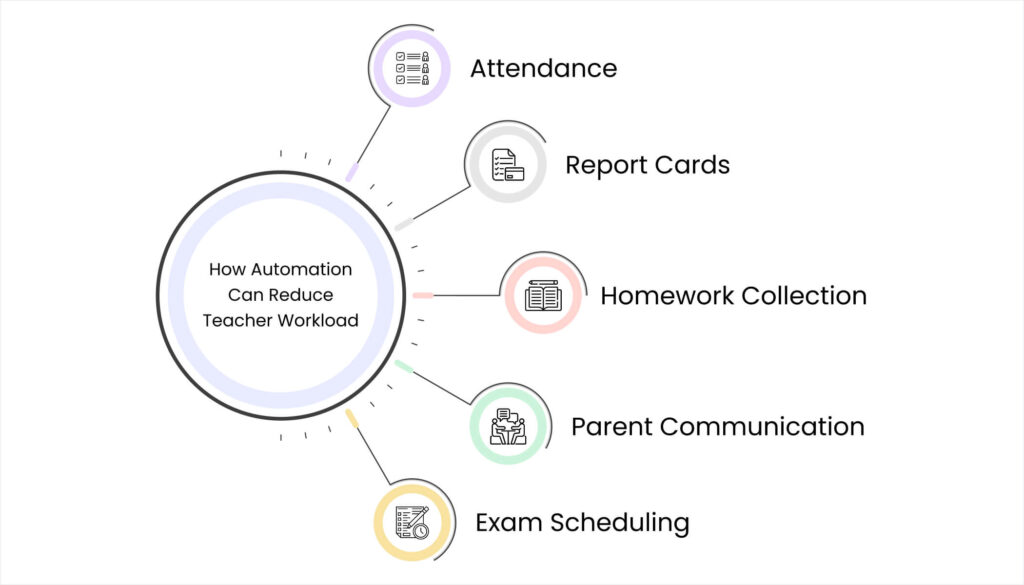
Now here’s the good news: nearly 60% of these administrative tasks can be automated completely, and another 30% can be significantly simplified. Let’s look at exactly how.
Attendance: 95% Time Saved
Current manual process:
- Teacher writes down present/absent for each student in register
- Copies same information to summary sheet
- Office staff manually counts and creates daily reports
- Parents call school asking if child arrived safely
Time spent: 70 minutes daily per teacher
Automated solution:
- Teacher marks attendance on tablet or phone (30 seconds per class)
- System automatically sends SMS to parents of absent students
- Daily attendance reports generate automatically
- Historical data available instantly for any student
Time spent after automation: 3-4 minutes daily per teacher
Time saved: 66 minutes daily = 5.5 hours weekly per teacher
Real example from Surat: A school with 35 teachers saved 192.5 hours weekly across their teaching staff. That’s equivalent to hiring 5 additional full-time teachers just from time savings.
Report Cards: 90% Time Saved
Current manual process:
- Teachers manually calculate term grades
- Fill out individual report cards by hand
- Double-check calculations (mistakes are common)
- Parents wait weeks for results
Time spent during exam season: 8-12 hours per teacher
Automated solution:
- Marks entered once into digital system
- Grades calculated automatically with zero errors
- Report cards generated instantly in standardized format
- Parents receive digital reports immediately
Time spent after automation: 1-1.5 hours per teacher
Time saved: 10 hours per exam cycle = 30+ hours annually per teacher
A Rajkot principal shared: “We used to have teachers working until 9 PM during result week. Now they finish everything during school hours with better accuracy.”
Homework Collection: 70% Time Saved
Current manual process:
- Check which students submitted homework physically
- Mark in register who completed assignments
- Chase missing submissions individually
- Explain to parents whose child didn’t submit
Time spent: 75 minutes daily per teacher
Automated solution:
- Homework assigned digitally with clear deadlines
- System tracks submissions automatically
- Automatic reminders to students and parents for pending work
- Teachers see completion status at a glance
Time spent after automation: 20-25 minutes daily
Time saved: 50 minutes daily = 4.2 hours weekly per teacher
Parent Communication: 60% Time Saved
Current manual process:
- Answer repeated phone calls with same information
- Send paper notices that get lost in bags
- Explain assignments individually to each parent
- Schedule meetings and send reminders manually
Time spent: 45 minutes daily per teacher
Automated solution:
- Announcements sent instantly to all parents
- Homework updates shared automatically
- Parents check student progress on app themselves
- Meeting scheduling handled by system
Time spent after automation: 15-20 minutes daily
Time saved: 25-30 minutes daily = 2.5 hours weekly per teacher
Exam Scheduling: 80% Time Saved
Current manual process:
- Create exam timetable manually
- Check for conflicts and overlaps
- Print and distribute schedules
- Handle parent queries about dates
Time spent per exam cycle: 6-8 hours coordination time
Automated solution:
- System creates conflict-free schedules automatically
- Digital distribution to students and parents instantly
- Automatic reminders before each exam
- Changes updated in real-time for everyone
Time spent after automation: 1-2 hours per cycle
Time saved: 5-6 hours per exam cycle = 15-20 hours annually
The Total Time Savings: Real Numbers

Let’s add up what automation can actually save for a typical Gujarat teacher:
Weekly Time Savings:
- Attendance: 5.5 hours
- Homework tracking: 4.2 hours
- Parent communication: 2.5 hours
- Daily grade updates: 1.5 hours
Total weekly savings: 13.7 hours
Monthly savings: 54.8 hours (equivalent to 7 full working days)
Annual savings: 658 hours (equivalent to 82 working days)
That’s almost three full months of working time returned to each teacher annually.
What Teachers Actually Do With Saved Time
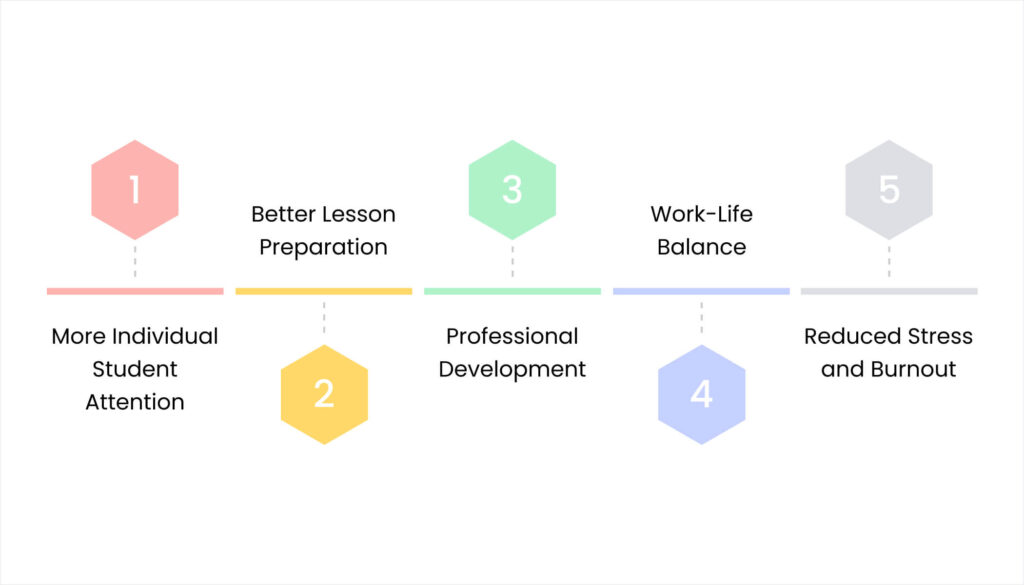
I asked teachers who’ve experienced this kind of time reduction what they do with those extra hours. Their answers show why this matters so much:
More Individual Student Attention
“Before automation, I knew my students’ names and grades. Now I actually know them as people. I have time to notice when someone’s struggling emotionally, not just academically.” – Math teacher, Ahmedabad
Better Lesson Preparation
“I can actually plan creative lessons instead of just surviving day-to-day. My teaching quality has improved dramatically because I have time to think about HOW to teach, not just WHAT to teach.” – Science teacher, Rajkot
Professional Development
“I finally have time to learn new teaching methods, take online courses, and improve my skills. Before, I was too exhausted to even think about professional growth.” – English teacher, Surat
Work-Life Balance
“I leave school at 4 PM now and actually have energy for my own family. I’m a better teacher because I’m not constantly burned out.” – Social Studies teacher, Vadodara
Reduced Stress and Burnout
Multiple teachers mentioned that the administrative burden reduction significantly decreased their stress levels and job satisfaction improved dramatically.
How to Implement Teacher Workload Reduction in Your School
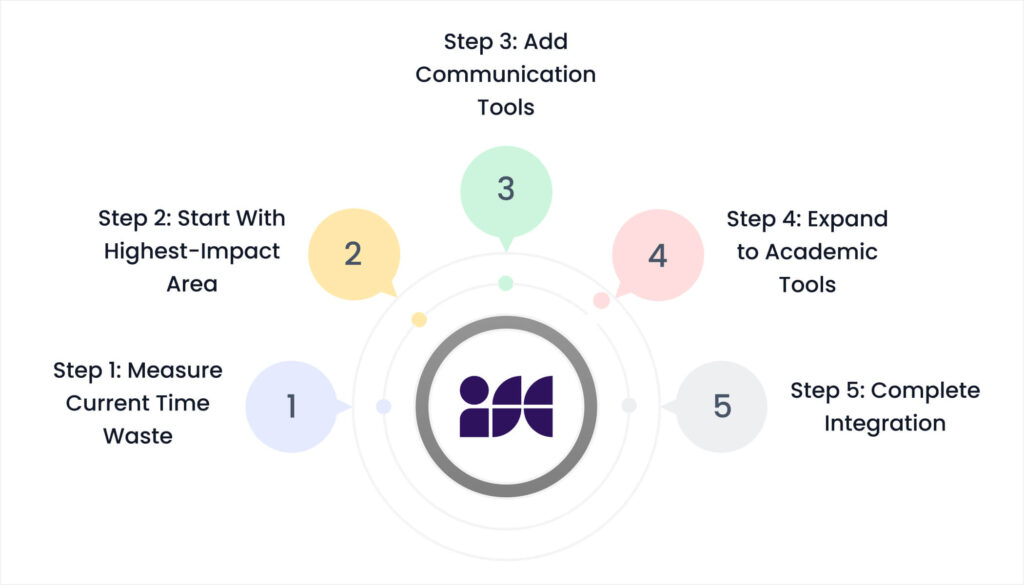
If you’re ready to reduce teacher workload at your Gujarat school, here’s the practical implementation approach:
Step 1: Measure Current Time Waste (Week 1)
Ask your teachers to track time spent on administrative tasks for one week:
- Attendance marking
- Homework collection
- Parent communication
- Grade book updates
- Report preparation
This baseline measurement will prove the ROI of automation investment.
Step 2: Start With Highest-Impact Area (Week 2-3)
Begin with attendance automation because it:
- Saves the most daily time (5.5 hours weekly per teacher)
- Shows immediate results that build teacher confidence
- Has visible parent benefits (attendance SMS notifications)
Step 3: Add Communication Tools (Week 4-5)
Implement parent communication automation next:
- Announcement broadcasting
- Homework update sharing
- Progress report access
This reduces phone calls and repetitive conversations significantly.
Step 4: Expand to Academic Tools (Week 6-8)
Roll out homework tracking and grade management:
- Digital assignment submission
- Automatic grade calculations
- Report card generation
Step 5: Complete Integration (Week 9-12)
Finish with exam scheduling, meeting coordination, and advanced features.
Investment vs. Time Value

School owners often worry about technology costs. Let’s calculate the actual value:
For a school with 25 teachers:
Annual automation investment: ₹2.5-4 lakhs
Time saved: 25 teachers × 658 hours = 16,450 hours annually
At average teacher salary of ₹300/hour: ₹49.35 lakhs worth of productive time recovered
Even if you only count 25% of this as “productive teaching time gained,” the ROI is massive.
Common Concerns Gujarat School Owners Have

“Will teachers actually use new systems?”
The key is choosing user-friendly automation designed for teachers, not complex enterprise software. Start with simple tools and provide proper training.
Success factor: Involve teachers in selection process. When they help choose tools, adoption rates exceed 90%.
“What about teachers who aren’t tech-savvy?”
Modern school automation is designed to be simpler than traditional methods. Most teachers learn basic functions within 2-3 days.
Reality check: If teachers can use WhatsApp, they can use good school automation tools. The interface is often more intuitive than manual processes.
“What happens if technology fails?”
Reliable systems include backup procedures and offline capabilities. Technology failure is actually less common than paper process failures (lost registers, misplaced documents, illegible handwriting).
Real Success Story: Reducing Teacher Workload in Rajkot

Let me share a complete case study from a 450-student school in Rajkot:
Before Automation:
- Teachers worked 10-11 hours daily
- Administrative tasks consumed 45% of their time
- Teacher turnover rate: 30% annually
- Parent satisfaction with communication: 6.2/10
Implementation Timeline: 12 weeks for full automation
After Six Months:
- Teachers working standard 7-8 hour days
- Administrative tasks reduced to 15% of time
- Teacher turnover rate dropped to 8% annually
- Parent satisfaction improved to 9.1/10
Principal’s reflection: “Our teachers are actually teaching again. The energy in classrooms has completely changed. Parents notice it, students feel it, and our academic results are improving.”
The Competitive Advantage Nobody Talks About

Here’s something most Gujarat school owners miss: teacher satisfaction directly impacts enrollment and reputation.
When teachers are happy and energized:
- They provide better education quality
- Word-of-mouth recommendations increase
- Student results improve
- Parent satisfaction rises
- Teacher retention improves (reducing recruitment costs)
Schools known for “treating teachers well” attract the best educators and the best families. Reducing teacher workload through automation isn’t just operational improvement—it’s a strategic competitive advantage.
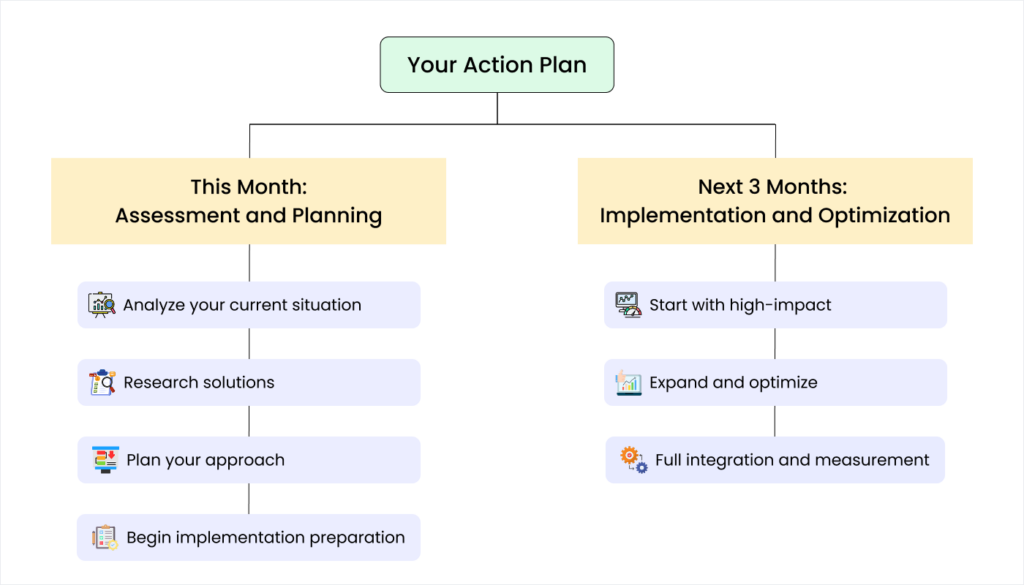
Your Action Plan: Starting This Month
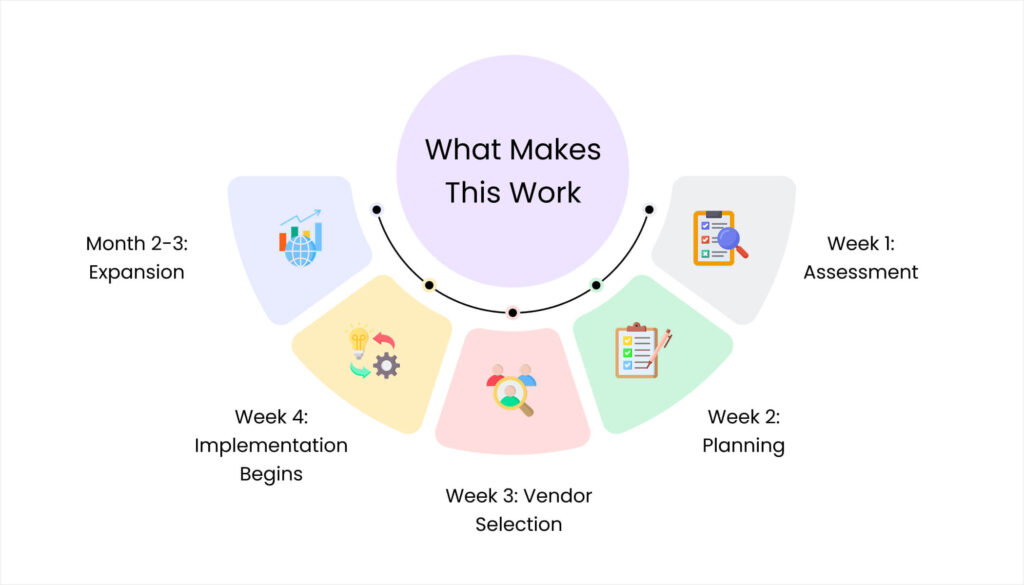
Week 1: Assessment
- Calculate current teacher time spent on administrative tasks
- Survey teachers about biggest time-wasters
- Research automation options suitable for Gujarat schools
Week 2: Planning
- Set specific time-saving goals
- Budget for automation investment
- Choose pilot area (recommend starting with attendance)
Week 3: Vendor Selection
- Evaluate 3-4 automation solutions
- Get teacher input on user-friendliness
- Check references from similar Gujarat schools
Week 4: Implementation Begins
- Train teachers on first automation tools
- Run parallel systems initially for confidence
- Gather daily feedback for quick adjustments
Month 2-3: Expansion
- Add additional automation features
- Measure actual time savings
- Celebrate teacher workload reduction wins
The Future Your Teachers Deserve

Every teacher in Gujarat entered education because they wanted to inspire young minds and shape futures. None of them dreamed of spending 17+ hours weekly on paperwork that adds zero educational value.
You have the power to give your teachers back those hours. To reduce teacher workload so they can focus on what they do best—teaching children.
The technology exists. The benefits are proven. The only question is: how much longer will your teachers spend their time filling registers instead of filling young minds with knowledge?
Ready to reduce teacher workload at your school and give your teachers 10+ hours back every week?
Contact iSchoolCloud today for a personalized demonstration of how automation can specifically reduce teacher administrative burden at your Gujarat school. We’ll show you exactly how much time your teachers can save and help you implement solutions that work for your unique needs.
Let’s free your teachers to do what they love most—teaching.